Every time you scroll past a post where someone you follow is talking about a product they love, you are watching influencer marketing in action. But what you see is only the final five percent of the work. Behind that one post is a chain of decisions, conversations, negotiations, data reviews, and workflow steps that most brands never fully understand — and that is exactly why so many campaigns fail.
Influencer marketing is one of the fastest-growing channels in digital marketing today. The global market crossed $27 billion in 2025 and is still climbing. Yet brands of all sizes continue to make the same basic mistakes: choosing influencers based on follower count alone, skipping audience vetting, writing vague briefs, and having no real way to track whether a campaign actually moved the needle.
This guide is written for brands and marketers who want to get the whole picture right. From the first step of setting goals to the moment your campaign goes live, we are going to walk through every stage of the influencer marketing process — with practical details, real frameworks, and the kind of honest advice that helps you avoid expensive mistakes.
Whether you are running your first campaign or trying to bring order to a process that has gotten too manual and messy, this is the guide you need.
Understanding Influencer Marketing in 2026: Why It Works Differently Now
If you are still thinking of influencer marketing as just paying someone to post about your product, your framework is out of date. The channel has matured significantly, and what works today is fundamentally different from what worked three years ago.
The biggest shift is in how audiences relate to the creators they follow. Trust has become the most important currency in influencer marketing. Audiences have grown sharper and more selective. They know when a creator is simply pushing products for a fee, and they tune it out. What actually earns their attention is a creator who genuinely uses and believes in what they are recommending.
At the same time, the bar for measurement has gone up. Brands used to accept reach and impressions as proof that a campaign worked. Now, teams want attribution. They want to know how many people clicked, how many actually bought, what the cost per acquisition looked like, and whether the creator’s audience overlapped with real potential customers. Campaigns that cannot answer these questions are harder to justify renewing.
This shift in expectations is one of the key reasons influencer marketing has become so central to how brands grow. The brands that are winning with this channel are not just doing more campaigns — they are running smarter, more intentional ones.
The Full Influencer Marketing Workflow
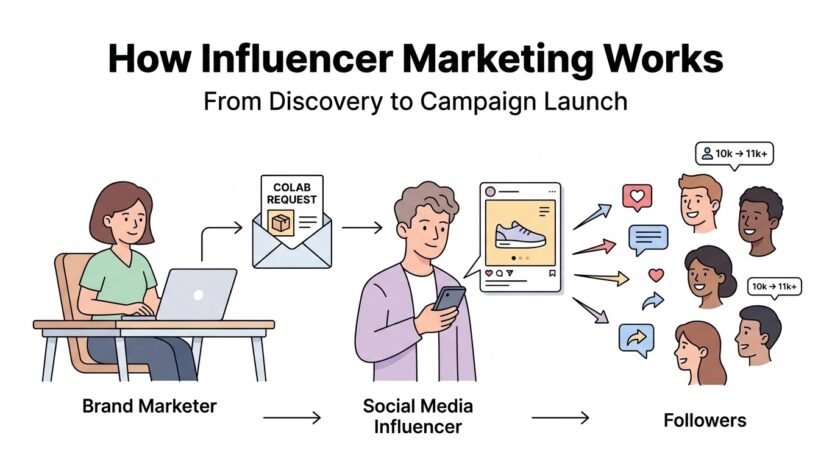
Before going deep on each stage, it helps to see the entire process on one page. Influencer marketing is not a single action — it is a sequence of connected steps, and each one feeds into the next. Skipping even one creates problems later.
| Stage | What You Are Doing | Why It Matters |
| 1. Goal Setting | Define what success looks like before anything else | Shapes every decision that follows |
| 2. Audience Mapping | Build a detailed picture of who you want to reach | Prevents wrong-fit influencer choices |
| 3. Influencer Discovery | Find creators who match your brand and audience | The quality of this step determines everything downstream |
| 4. Deep Vetting | Audit engagement quality and audience authenticity | Stops you from paying for fake reach |
| 5. Outreach | Open a genuine conversation with shortlisted creators | Sets the tone for the whole relationship |
| 6. Negotiation | Align on rates, deliverables, and usage rights | Prevents disputes and missed expectations |
| 7. Briefing | Give creators what they need to make great content | Balances brand direction with creator authenticity |
| 8. Content Review | Check drafts against your brief and brand standards | Protects brand integrity before going live |
| 9. Campaign Launch | Content goes live on the agreed date and platform | Where all preparation becomes visible |
| 10. Performance Tracking | Monitor results and measure against your original goals | Tells you what to do differently next time |
Each stage is covered in full detail below. Read through even if you are already running campaigns — there is likely at least one stage you are not doing as thoroughly as you could be.
Stage 1: Set Goals That Actually Guide Your Decisions
The biggest waste of budget in influencer marketing is not choosing the wrong influencer. It is starting a campaign without knowing what you are trying to achieve. When goals are vague, every decision that follows becomes a guess.
Good goal setting in influencer marketing means being specific about three things: what you want to happen, how you will measure whether it happened, and what timeframe you are working within. Generic goals like ‘increase awareness’ or ‘drive engagement’ tell you nothing useful about whether your campaign succeeded.
Common Campaign Goals and What They Actually Mean
- Brand Awareness: You want more people to know your brand exists. Measure this through reach, impressions, and new follower growth on your own channels.
- Audience Growth: You want to gain new followers on your social accounts. Measure the direct follower increase during and after the campaign window.
- Website Traffic: You want people to visit a specific page on your site. Use trackable links and measure click-through rate and time on page.
- Lead Generation: You want email sign-ups, form completions, or app downloads. Measure cost per lead against your other acquisition channels.
- Direct Sales: You want purchases attributed to the campaign. Use unique discount codes or affiliate links per influencer and measure conversion rate and revenue.
- Product Launch Support: You want to create momentum around something new. Measure pre-launch buzz, post engagement, and sales velocity in the first week.
- Content Creation: You want high-quality, creator-made content to repurpose. Evaluate based on content quality, usage rights secured, and how it performs when repurposed.
Once your goal is set, put a number on it. Not just ‘we want more sales’ but ‘we want 150 conversions through influencer discount codes during the 3-week campaign.’ Specificity gives your team a target and gives you a clear way to evaluate performance after launch.
Stage 2: Map Your Target Audience Before You Search for Influencers
This step is where many brands skip ahead too quickly. They jump straight to looking at influencer profiles without first getting clear on who they are actually trying to reach. The result is a list of creators who look relevant on the surface but whose audiences are not the right fit at all.
Your target audience profile should include more than just age and gender. Think about what platforms they use most actively, what kind of content they consume, what problems or desires they have that connect to your product, and what values matter to them. The more specific this picture is, the more useful it becomes when you start evaluating influencer audiences later.
A useful exercise is to describe your ideal customer in one paragraph, then ask: what kind of creator would this person already follow? What topics would they be interested in? What tone and style of content would they engage with? Those answers become your filter for the discovery stage.
Stage 3: Influencer Discovery — Finding the Creators Who Actually Fit
With your goals clear and your audience mapped, you can start looking for creators. This stage is called discovery, and it has changed dramatically over the past few years. Manual searching is still possible, but it is slow and hard to do thoroughly when you are building a campaign roster of any real size.
Methods for Finding Influencers
Manual Platform Search: Go to Instagram, TikTok, or YouTube and search by hashtag, keyword, or topic. Look through the posts that come up and check the profiles of creators who appear consistently. This is free but time-intensive and gives you a limited view of reach and audience data.
Your Own Community: Some of the best influencer partners are already talking about you. Check your own followers, brand mentions, and tagged posts. People who genuinely use your product and have their own following are often more authentic and more cost-effective than outreach to cold creators.
Referrals from Existing Partners: If you have already worked with a creator who performed well, ask them to refer you to others in their network. Influencers tend to know other creators in their niche, and a warm introduction can make outreach much more effective.
Influencer Discovery Platforms: These tools let you filter by niche, follower range, engagement rate, location, audience demographics, and more. They dramatically speed up the process and give you comparative data across many profiles at once. For any campaign of real scale, this is the most efficient route.
How to Think About Influencer Tiers
Not all follower counts are equal, and the right tier depends entirely on your goal and budget. Here is a practical breakdown:
| Tier | Follower Range | Typical Engagement Rate | Best Suited For |
| Nano | 1,000 – 10,000 | 5% – 10%+ | Hyperlocal, niche products, high trust |
| Micro | 10,000 – 100,000 | 2% – 6% | Targeted reach, strong ROI, cost-effective |
| Mid-Tier | 100,000 – 500,000 | 1% – 3% | Balanced reach and engagement |
| Macro | 500,000 – 1M | 0.5% – 2% | Broad brand awareness campaigns |
| Mega / Celebrity | 1M+ | 0.3% – 1% | Maximum reach, major launches, luxury brands |
The data consistently shows that micro-influencers deliver stronger engagement and more targeted reach than mega influencers for most campaign types. A creator with 40,000 followers who genuinely connects with your target audience will almost always outperform a celebrity with 2 million followers whose audience is broad and passive.
Understanding why certain influencer tiers outperform others is part of understanding why influencer marketing is important as a growth channel — and why the right partner selection matters more than reach alone.
Stage 4: Vetting Influencers — The Step Most Brands Rush Past
Finding an influencer who looks right is not the same as confirming they are right. Proper vetting is the step that separates brands that get real results from brands that waste their budget on inflated metrics and disengaged audiences.
The core problem in the industry is fake engagement. Purchased followers, engagement pods, and bot-driven comment activity are widespread enough that follower count and even raw engagement numbers can be completely misleading. A creator with 200,000 followers and a 4% engagement rate sounds impressive until you notice that 80% of their comments are generic emoji responses from accounts that post the same three emojis on hundreds of posts per day.
What to Check During Influencer Vetting
- Engagement Quality: Read the comments on their recent posts. Are people saying things that show they actually consumed and responded to the content? Or are the comments low-effort and generic? Real engagement looks like people asking follow-up questions, sharing their own experiences, and having conversations.
- Audience Demographics: Does the creator’s audience match your target customer profile? You need to look at age, gender, location, and where possible, interests. A creator in your niche but with an audience that is 70% in countries where you do not sell is not a useful match regardless of engagement rate.
- Follower Growth Patterns: Steady, organic growth over time is healthy. A sharp spike in followers followed by a plateau or decline is a strong indicator of purchased followers. Look for consistent, gradual growth that reflects genuine audience building.
- Past Brand Collaborations: Look at what brands they have promoted before. Did they work with competitors? How did their audience respond to sponsored content? Do they clearly label paid posts? A creator who routinely promotes conflicting brands or hides sponsored content is a risk.
- Content Consistency: Do they post regularly? Are the production quality and style consistent? An influencer who posts in unpredictable bursts or whose content quality varies wildly may be harder to work with and may have lower sustained audience engagement.
The most valuable data for vetting is not available from public profiles. Real audience demographics, genuine story view counts, and verified reach numbers all sit inside the creator’s own analytics — which is why platforms that access first-party Instagram Insights give you a fundamentally different quality of information.
This is where tools like Hyperr Manage create a real advantage. Rather than estimating metrics from public data, Hyperr Manage’s invitation-based system lets influencers connect their own Instagram accounts, giving you access to verified first-party Insights data. You see actual reach numbers, real audience demographics, and genuine story performance — not an algorithm’s estimate. Plans start from $75 per month with a 7-day free trial, making verified data genuinely accessible for growing brands and agencies.
You can also explore dedicated influencer audience analytics solutions that give you a much clearer picture of who is actually inside a creator’s community before you commit budget to a campaign.
Stage 5: Outreach — Starting a Relationship
You have your shortlist of vetted creators. Now you need to make contact. How you approach this step matters more than most brands realise. Influencers receive a lot of outreach, particularly the well-performing ones in popular niches, and a cold, generic pitch message is easy to ignore or decline.
The mindset that produces the best results is relationship-first. You are not closing a deal in your first message. You are starting a conversation with someone you want to work with. That shift in framing changes your tone, your approach, and your outcome.
Where to Make First Contact
- Email: The most professional channel and usually preferred for brand inquiries by creators who work with brands regularly. Most creators who take collaborations seriously have a business email in their bio or on a linked website.
- DM (Direct Message): Works well for nano and micro influencers who may not check email as regularly. For larger creators, DMs can get lost among high message volumes.
- Through a Management Platform: Sending outreach through a dedicated influencer management system can add a layer of professionalism and makes tracking responses and follow-ups much easier.
What an Effective First Message Looks Like
Keep it short. Keep it genuine. Make it clear why you are reaching out to them specifically. A good first outreach message includes four things: a brief introduction to you and your brand, a specific reference to something you genuinely appreciated about their content, a short explanation of the kind of collaboration you have in mind, and a simple call to action asking if they are open to hearing more.
Do not lead with rates or detailed deliverables in the first message. Do not attach a lengthy brief or contract. The goal of the first contact is a conversation, not an immediate agreement. Brands that lead with transaction-focused messages come across as treating creators like billboard space rather than creative partners — and that is not how the best influencer relationships get started.
Stage 6: Negotiation — Getting Agreement on What Matters
When a creator responds positively and expresses interest in working together, you move into the negotiation phase. This is where you align on the practical details of the collaboration — what will be created, what it will cost, and what the expectations are on both sides.
Influencer Rate Benchmarks by Platform
Rates vary significantly depending on the platform, content format, creator tier, and whether exclusivity is involved. The figures below are general market benchmarks — actual rates will vary based on niche, engagement quality, and specific deliverables.
| Platform | Creator Tier | Estimated Rate Per Content Piece |
| Nano (1K–10K) | $20 – $250 per post | |
| Micro (10K–100K) | $100 – $2,000 per post | |
| Macro (500K–1M) | $4,000 – $18,000 per post | |
| TikTok | Micro (10K–100K) | $50 – $1,200 per video |
| TikTok | Macro (500K–1M) | $2,500 – $12,000 per video |
| YouTube | Micro (10K–100K) | $250 – $2,500 per video |
| YouTube | Macro (500K–1M) | $6,000 – $35,000 per video |
Key Terms to Agree on Before Moving Forward
- Deliverables: Be specific. Exactly how many pieces of content, in what format, on which platform, on which dates? Vague deliverables lead to disappointment and disputes.
- Timeline: When will the creator submit draft content for review? When will it go live? Are there hard dates tied to a product launch or sale period?
- Compensation: Payment amount, method, and timing. Will they be paid on submission of final content, on the go-live date, or 30 days after delivery?
- Content Rights: Can you reuse the content in your own paid ads, on your website, or in email campaigns? For how long? Getting usage rights upfront is almost always more affordable than negotiating it later.
- Exclusivity: Will the creator agree not to promote competing brands for a defined period? If so, this should be reflected in the rate.
- Disclosure Requirements: Make it explicit that the creator must comply with FTC guidelines or equivalent local advertising disclosure requirements.
Once agreed, put everything in writing. A proper campaign agreement protects both parties and removes ambiguity about what was promised. Handling agreements over email chains and WhatsApp screenshots is a recipe for confusion and missed deliverables.
This is another area where dedicated tools change the workflow significantly. Hyperr Manage, for example, lets you create and send digital campaign agreements directly inside the platform. The agreement is linked to the campaign and the influencer, and once signed, the influencer is automatically added to the active campaign. No chasing PDFs over email — everything is stored, trackable, and clean from day one. Managing influencer campaigns without spreadsheets is not just more efficient — it removes a whole category of operational errors that manual systems create.
Stage 7: Writing the Campaign Brief — Giving Creators What They Need
The campaign brief is the most important document in the influencer marketing process. It is what turns your campaign goals into actual content. A good brief gives creators clear direction without stripping away the authentic voice and style their audience came to them for.
The most common brief mistake is writing too much. Brands that try to script every sentence, specify every hand gesture, and control every aspect of the content end up with stilted, inauthentic posts that audiences can see through immediately. The brief should set the parameters, not dictate the performance.
What a Strong Campaign Brief Includes
- Brand Context: Two to three sentences about what your brand is, who it is for, and what makes it different. The creator should be able to understand your positioning at a glance.
- Campaign Goal: One sentence explaining what this specific campaign is trying to achieve. Helps the creator understand what a successful outcome looks like.
- Key Messages: The two or three things you most want the audience to remember or feel after seeing the content. Not a script — just the core ideas to communicate.
- Product Details: Clear information about what is being promoted: what it does, how to use it, what problem it solves, and any features worth highlighting.
- Content Format and Specs: Exactly what you are asking for. A 60-second Reel? Three Instagram Stories? A dedicated YouTube video? Include aspect ratio, minimum length, and any technical requirements.
- Dos and Don’ts: What should they avoid? Any claims they cannot make? Any brand competitors they should not mention? Any visual guidelines around logo placement or product handling?
- Call to Action: What do you want the audience to do after seeing the content? Visit a link? Use a discount code? Follow your account? Make this clear.
- Disclosure Requirement: A reminder that the post must include a clear and visible paid partnership label in compliance with advertising standards.
- Draft Submission Deadline: The date by which you expect to receive the content for review.
A brief that takes two pages to read is already too long. The best briefs are clear, direct, and leave creative space for the creator to bring their own voice. The goal is to align on the what — not to control the how.
Stage 8: Content Review and Approval — Getting It Right Before It Goes Live
The creator submits their draft content. Now you review it. This step is where a lot of brand-creator friction happens, usually because one or both sides did not set clear expectations about the process upfront.
When reviewing content, keep your focus on two questions. First: does this content meet the non-negotiable requirements in the brief? Second: does it still feel like the creator’s authentic voice, or has it become so heavily directed that it would feel off to their audience?
Feedback should be specific, written, and focused on what actually matters for the campaign. Avoid rewriting the creator’s script word for word — that approach almost never produces better content, and it tends to damage the working relationship. Explain what you need to change and why, then let the creator find the best way to address it.
A Clean Content Review Workflow
- Creator submits draft content by the deadline stated in the brief
- Your team reviews within the turnaround window agreed in the negotiation stage
- You send written, specific feedback if revisions are needed
- Creator submits revised content
- Final review and approval — or one further revision round if necessary
- Content is cleared for publication on the agreed live date
Tracking content review status across multiple influencers simultaneously is exactly the kind of task that breaks down in spreadsheets. Brands that manage influencer campaigns without spreadsheets using a purpose-built platform can see content status at a glance, send feedback in one place, and avoid the endless email chains that slow campaigns down.
Stage 9: Campaign Launch — Making Sure Everything Goes Live Correctly
The preparation is done. The content is approved. Now it goes live. This stage sounds straightforward, but there are several things that can go wrong between approval and successful publication, and a few simple actions that make a big difference to campaign performance.
On Launch Day: What to Do
- Monitor the Published Post: Check within the first hour of posting that the content looks exactly as approved. Is the caption correct? Is the trackable link working? Is the discount code accurate? Is the paid partnership label visible? Catching errors early limits the damage.
- Engage in the Comments: Some brands choose to respond to early comments on the influencer’s post. This signals that the brand is active, human, and interested in the audience — which can help build a positive first impression for people encountering your brand for the first time.
- Activate Supporting Channels: If you planned to run paid amplification on the influencer’s content or share it across your own channels, activate those on launch day to build momentum in the critical early window.
- Track Performance Immediately: Start monitoring your trackable links, discount code usage, and platform analytics from the moment the content is live. Early data helps you identify if anything is underperforming quickly enough to make adjustments.
Timing Your Launch for Maximum Impact
When content goes live matters as much as what the content says. Posting time should be based on when the creator’s audience is most active, not when it is convenient for your team. Most creator analytics platforms can show peak engagement windows for each creator’s specific audience.
If you are launching a product, influencer content should go live at or just before the launch date — not after. If you are promoting a limited-time sale, influencer content should go live at the beginning of the sale window, when there is still time for the audience to act.
Stage 10: Tracking Performance and Measuring Real ROI
The campaign is live. Now comes one of the most important parts of the entire process — measuring what actually happened. Without this step, you cannot improve. You cannot justify budget increases to stakeholders. And you end up making the same decisions, right or wrong, in every future campaign.
Matching Metrics to Goals
| Campaign Goal | Primary Metrics | Secondary Metrics |
| Brand Awareness | Reach, total impressions | New follower growth, brand mention volume |
| Engagement | Engagement rate, comments, saves | Share volume, comment sentiment |
| Website Traffic | Click-through rate, landing page visits | Time on site, pages per session, bounce rate |
| Lead Generation | Form submissions, sign-ups | Cost per lead vs. other channels |
| Sales / Revenue | Conversion rate, attributed revenue | ROAS, cost per acquisition, average order value |
| Product Launch | Week-1 sales velocity, share of voice | Search volume increase, brand search lift |
| Content Creation | Content quality, repurpose performance | Audience response to repurposed content in ads |
How to Calculate Campaign ROI
For campaigns with direct sales attribution, the formula is straightforward: subtract total campaign cost from total revenue attributed to the campaign, divide by total campaign cost, and multiply by 100 to get your ROI percentage.
For awareness campaigns, financial ROI is harder to pin down directly. Instead, compare your cost per impression or cost per engaged user against what the same exposure would cost through paid social advertising. Influencer content frequently delivers more cost-effective awareness than paid ads because the audience is already primed to trust the creator.
Whatever metric you use, document your results systematically. Build a campaign performance log that captures key metrics from every campaign. Over time, this data tells you which types of creators consistently perform, which platforms deliver the best ROI for your brand, and what content formats drive the most conversions.
For agencies running multiple client campaigns, this kind of systematic tracking is even more critical. Using a proper influencer campaign management tool for marketing agencies lets you centralise reporting across all clients, track individual influencer performance over time, and produce clean reports that demonstrate results to the brands you work with.
How Technology Has Transformed Every Stage of This Process
Five years ago, the standard workflow for influencer marketing looked like this: hours of manual hashtag searching to find creators, a spreadsheet with influencer names and follower counts, outreach over email with no tracking, agreements handled by PDF attachments, and campaign performance reported by manually screenshotting analytics at the end of each week.
That workflow still exists at brands that have not updated their systems. It is slow, error-prone, and does not scale. A marketing coordinator managing 15 influencers across a campaign cycle spending half their week on admin tasks that a platform could handle automatically is not a sign of a functional process.
Modern influencer marketing platforms change this across every stage of the workflow — from discovery through reporting. The best ones do not just automate admin; they improve data quality in ways that fundamentally change how well campaigns can be planned and evaluated.
What Hyperr Manage Does Differently
Most influencer tools work from the outside of creator accounts, estimating metrics from publicly visible data. Hyperr Manage uses a different model: influencers connect their Instagram accounts through a unique invitation link, which authorises the platform to access their verified Instagram Insights directly. The data brands see is not an estimate — it is the same data the influencer sees in their own analytics dashboard.
This matters most during vetting and performance tracking. When you are deciding whether to commit budget to a campaign with a specific creator, verified audience demographics and real reach numbers give you a far more reliable foundation than a third-party algorithm’s best guess. And when you are tracking post-campaign performance, seeing actual reach data rather than estimated impressions makes your ROI calculations accurate rather than approximate.
Beyond analytics, Hyperr Manage handles the full campaign workflow in one place: roster management, campaign creation, digital agreement generation and signing, content submission tracking, and post performance monitoring via link-based tracking.
Plans start from $75 per month with a 7-day free trial — meaning you can onboard your real influencer roster, explore their verified data, and run a campaign through the full workflow before spending anything. For growing brands and agencies building serious influencer programs, the combination of verified data quality and complete campaign management at that price point is genuinely difficult to match.
If you are evaluating your options, this Instagram influencer analytics tool comparison gives a detailed look at how verified first-party analytics compare to the estimated data most platforms rely on.
You can also start with a free trial to see how the platform works with your own roster: Instagram influencer analytics tool with free trial.
Running Influencer Campaigns as a Small Brand: A Practical Approach
A persistent myth in marketing is that influencer marketing is only viable for brands with large budgets. That is simply not true. Small brands can run highly effective campaigns — and in some respects, smaller brands have structural advantages that enterprise teams do not.
Small brands can move faster. They can build more personal, direct relationships with creators. They can test and iterate without needing sign-off from five stakeholders. And because they tend to work with nano and micro-influencers rather than mega influencers, they can get far more targeted reach for the same spend.
Budget-Smart Tactics for Smaller Brands
- Start with gifting: Offer your product in exchange for an honest, organic post. Many nano and micro-influencers in niche categories will accept gifted collaborations for products they genuinely want to try. The key is making sure the creator is a real fit — gifted campaigns that produce low-quality content or go unposted are still a wasted cost.
- Focus on one platform first: Spreading a small budget across Instagram, TikTok, and YouTube at the same time is a recipe for thin results everywhere. Pick the platform where your target audience is most active, build your influencer program there, and expand once you have a proven approach.
- Invest in longer-term relationships: The time and cost of finding, vetting, and onboarding a new influencer is significant. A single campaign barely gives you enough data to know if a creator performs well. Brands that invest in multi-campaign or ambassador-style partnerships with a smaller roster of well-matched creators consistently see better returns than brands that constantly churn through one-off deals.
- Prioritise engagement rate over reach: For a small brand, a creator with 12,000 followers and a 7% engagement rate is almost always more valuable than one with 200,000 followers and 0.6% engagement. The smaller audience is more likely to actually care about what the creator says, and more likely to trust their recommendation.
For a complete breakdown of what tools and strategies work best for smaller marketing budgets, the guide on influencer marketing tools for small brands covers everything from free options to affordable platforms that give small teams real capability without enterprise pricing.
One-Off Campaigns vs. Long-Term Partnerships: What Actually Works Better
One of the most important strategic questions in influencer marketing is whether to run a series of one-off collaborations with different creators or to invest in longer-term relationships with a smaller, more consistent roster.
One-off campaigns are useful for specific situations: product launches, seasonal promotions, testing new creators before committing to an ongoing deal, or reaching a new audience segment. They are flexible and easy to budget by campaign.
But the data consistently points in a clear direction: long-term partnerships produce better results for brand building and sustained conversion. When an audience sees a creator mention a brand once, it registers as a sponsored post. When they see the same creator genuinely incorporating that brand into their life over several months, it feels like a trusted recommendation. That difference in perception is the difference between an ad and a referral.
Audiences also develop brand associations through repetition. A creator who mentions your product three times across two months has done far more for brand recall than three different creators who each mention it once.
Understanding the benefits and potential drawbacks of influencer marketing including the risks of over-reliance on one-off deals, helps brands build a more sustainable strategy from the start.
Platform-by-Platform: Where Influencer Marketing Works Best
The process of influencer marketing is largely the same across platforms, but the content formats, audience behaviours, and performance benchmarks differ significantly. Choosing the right platform for a campaign is part of the strategy, not an afterthought.
| Platform | Strongest Content Format | Audience Behaviour | Campaign Best Fit |
| Reels, Stories, Carousels | Discovery-driven, visual, aspirational | Lifestyle, fashion, beauty, food, product demos | |
| TikTok | Short-form videos, Trends | Entertainment-first, fast-scroll, trend-responsive | Viral moments, Gen Z products, challenges |
| YouTube | Long-form reviews, Tutorials | Intent-driven, research mode, deeper attention | Tech, finance, education, detailed product reviews |
| Short video, Articles | Professional mindset, B2B decision-making | SaaS, professional services, B2B tools | |
| Pins, Idea Boards | Planning mindset, longer consideration cycles | Home, wedding, food, fashion, travel |
The best platform choice is driven by where your target audience is most active and most receptive, not by where you personally prefer to spend time or where a particular influencer happens to have the largest following.
Legal and Compliance Basics Every Brand Needs to Understand
Influencer marketing is a form of paid advertising, and it is regulated. Brands that ignore compliance requirements expose themselves to legal risk, and their creator partners to the same. Getting this right is not complicated, but it does require that you build it into your process from the briefing stage.
Disclosure Requirements
In most markets, sponsored content must be clearly and visibly disclosed. In the United States, the Federal Trade Commission requires that paid relationships be disclosed in a way that is easy for the average viewer to understand. In the UK, the Advertising Standards Authority has equivalent requirements. Similar rules apply across the EU, Australia, and most other major markets.
Disclosure must be prominent. A small hashtag buried in a long caption does not meet the standard in most markets. A superimposed text label in a story that disappears after one second does not meet the standard. The disclosure should be clear, easy to read, and visible without requiring the viewer to search for it.
As a brand, you are responsible for ensuring your influencer partners are disclosing properly. This means building the disclosure requirement into your brief, confirming it during content review, and checking that it is live and visible once the content is published. If an influencer posts without proper disclosure, the brand can also face regulatory consequences.
Contracts and Agreements
- Define deliverables with specificity: Ambiguous language in contracts leads to disputes. Be precise about what is expected.
- Include intellectual property terms: Who owns the content? What rights does the brand have to use it, where, and for how long?
- Specify payment terms clearly: Amount, method, and the trigger for payment (e.g., on delivery of final approved content).
- Add a morality clause: This gives you the right to exit the partnership if the creator’s public conduct damages your brand’s reputation.
- State exclusivity terms if applicable: Which categories or specific brands is the creator agreeing not to work with, and for what time period?
Using a platform like Hyperr Manage that generates digital agreements inside the campaign workflow removes the operational friction of contract management while creating a proper record for every collaboration. You can explore how dedicated influencer management platforms handle agreements, compliance tracking, and campaign documentation to understand the full value this kind of tool brings to an organised influencer program.
Your Complete Campaign Launch Checklist
Use this checklist for every campaign. It is designed to catch the things that tend to fall through the cracks when teams are moving fast.
Before You Search for Influencers
- Campaign goal documented with specific, measurable targets
- Target audience profile written in detail
- Platform decision made based on audience location
- Budget allocated across influencer fees, production, and tools
During Discovery and Vetting
- Shortlist built using at least two discovery methods
- Engagement quality reviewed on recent posts for every creator
- Audience demographics confirmed against target customer profile
- Past brand collaborations reviewed
- Follower growth patterns checked for signs of purchased followers
During Outreach and Negotiation
- Personalised outreach messages sent — no generic copy-paste pitches
- Follow-up plan in place for non-responses
- All terms discussed and documented in writing before briefing
- Signed agreements in place before any content work begins
During Briefing and Content Review
- Brief covers all key elements without over-scripting
- Submission deadline clearly communicated and agreed
- Content reviewed within the agreed turnaround time
- Feedback written specifically and constructively
- Disclosure requirement confirmed in approved content
At and After Launch
- All trackable links and discount codes tested before launch
- Content monitored within the first hour of going live
- Performance data being captured from day one
- Mid-campaign check scheduled for campaigns longer than one week
- Post-campaign report completed and filed for future reference
Common Mistakes That Derail Influencer Campaigns — And How to Avoid Them
Choosing based on follower count alone: This is still the most common mistake in the industry. Follower count tells you almost nothing useful about whether a creator will deliver results for your brand. Engagement rate, audience quality, and content relevance matter far more.
Skipping the brief or writing one that is too vague: A brief that just says ‘show the product and mention the discount code’ gives the creator no real direction and gives you no basis for requesting revisions. The brief is your single best tool for campaign quality control — take the time to write it properly.
Micromanaging the content to the point of inauthenticity: The opposite mistake is trying to control every word and detail. When influencer content sounds like it was written by a marketing team, audiences disengage. Trust the creator enough to use their own voice within your parameters.
Working with too many influencers at once without the systems to manage them: A roster of 20 creators sounds like a strong campaign until you are managing 20 separate email chains, 20 contract processes, and 20 different posting schedules in a spreadsheet. Build systems before you scale headcount.
Not tracking performance against the original goal: If you set a goal before the campaign and then only look at vanity metrics afterwards, the goal was pointless. Tie your post-campaign analysis directly back to what you said success would look like before you started.
For a complete look at the pitfalls brands encounter most often, and how to structure a program that avoids them, review the detailed breakdown of best influencer marketing campaign management tools and how they address the operational gaps that cause most campaign failures.
Final Thoughts: Influencer Marketing Is a System, Not a Single Action
The brands that consistently win with influencer marketing are not the ones with the biggest budgets or the best connections to famous creators. They are the ones who treat it as a systematic, intentional process — where every stage from goal setting to post-campaign reporting is done with care and discipline.
Discovery matters because the wrong creator wastes everything that follows. Vetting matters because follower count without audience quality is a vanity number. Briefing matters because clear direction produces better content than micromanagement. Measurement matters because the only way to improve is to know what actually worked.
As the influencer marketing space becomes more professional and more data-driven, the brands that invest in proper systems — both in terms of process and technology — will pull ahead of those still working from spreadsheets and inbox searches. Verified data, clean campaign management, and proper documentation are no longer nice-to-haves. They are the foundation of a program that can actually scale.
Start with the goal. End with the analysis. Do every step in between with intention. That is how influencer marketing works — and that is how it delivers results worth talking about.
Ready to run your influencer campaigns the right way?
Hyperr Manage gives you verified Instagram Insights, campaign management, digital agreements, and post tracking — starting at $75/month with a 7-day free trial. Visit manage.hyperrvolt.com to get started.