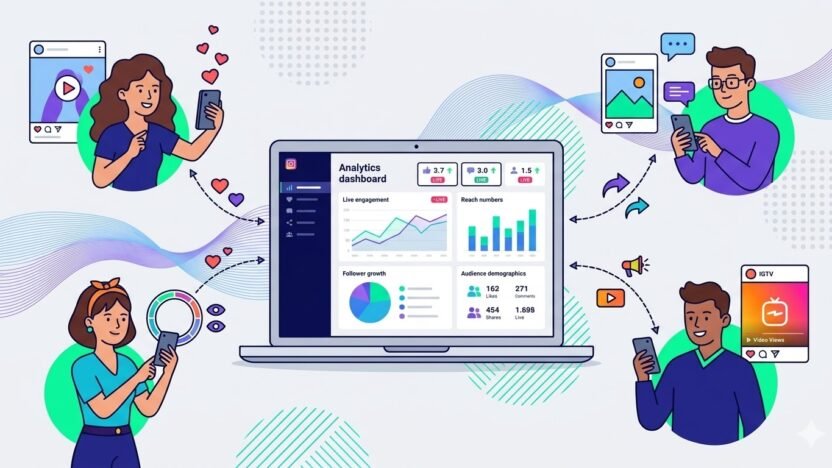
You have done the hard part. You researched creators, sent outreach, signed agreements, approved content, and watched posts go live. Now what?
For a lot of brands and marketers, the answer is: check the likes, nod at the numbers, and move on. But that approach leaves real money and learning on the table. Tracking Instagram influencer campaign performance in real time is not just about counting engagement after the fact — it is about having the visibility to make smart decisions while the campaign is still running, and building a data foundation that makes every future campaign better.
In 2025, with over 75% of marketers dedicating budget to influencer marketing and the industry projected to surpass $32 billion, the brands that win are not necessarily the ones with the biggest budgets. They are the ones with the best data systems. They know which creator is driving traffic, which post format converts, where the audience drops off, and how to reallocate spend in the middle of a campaign to improve results before it ends.
This guide covers everything you need to know about tracking Instagram influencer campaigns in real time — the metrics that matter, the tools that make it possible, the tracking setup you need before launch, and the reporting framework that keeps your team aligned.
Why Real-Time Tracking Changes Everything
There was a time when influencer marketing reporting meant waiting until a campaign ended, collecting screenshots from creators, and putting together a slide deck of likes and reach. That time is over.
Today, real-time campaign tracking means knowing — within hours of a post going live — how it is performing against your benchmarks. It means seeing which creator is pulling the most traffic to your landing page right now. It means catching a post with a broken tracking link before it costs you three days of attribution data. It means recognizing a Reel that is overperforming and making the decision to boost it with paid amplification while the momentum is there.
The difference between brands that track in real time and those that do not is not just efficiency — it is outcomes. Real-time feedback lets you optimize campaigns while they are still running, which is something post-campaign reporting can never do.
Consider the example of UK retailer B&Q: they spotted an influencer’s DIY content dramatically outperforming expectations mid-campaign and immediately asked the creator to produce more. That single pivot led to 283% of their average view rate target being achieved. That kind of result only happens when you are watching live data, not reading a summary two weeks later.
Understanding why influencer marketing matters as a channel is step one. Building the systems to track it properly is what turns that understanding into ROI.
Before the Campaign: Setting Up Your Tracking Foundation
Real-time tracking does not start when the post goes live. It starts before you send a single brief to a creator. Everything you set up before launch determines how clean and reliable your data will be throughout the campaign.
Define Your KPIs Before Anything Else
This sounds obvious, but most tracking problems trace back to unclear KPIs. If you do not know exactly what you are measuring before the campaign begins, no amount of data will tell you whether the campaign succeeded.
Your KPIs should directly reflect your campaign objective. Here are the most common alignments:
| Campaign Objective | Primary KPIs to Track |
|---|---|
| Brand Awareness | Reach, Impressions, Follower Growth, Brand Mentions |
| Engagement | Engagement Rate, Comments, Saves, Shares |
| Website Traffic | Clicks, Sessions from Influencer Source, Bounce Rate |
| Conversions / Sales | Conversion Rate, Revenue, Cost Per Conversion, ROAS |
| Lead Generation | Form Submissions, Sign-ups, Cost Per Lead |
| Content Performance | Saves, Shares, Story Views, Reel Plays |
The key is to set SMART KPIs — Specific, Measurable, Achievable, Relevant, and Time-bound. “Increase Instagram referral traffic by 30% in Q1” is a SMART KPI. “Get more engagement” is not.
Once your KPIs are set, communicate them clearly to your influencer partners before content creation begins. Creators who understand the goal — not just the deliverables — consistently produce content that performs better.
Set Up UTM Parameters for Every Link
UTM parameters are the backbone of accurate influencer campaign attribution. Without them, you cannot tell whether a website visitor came from an influencer’s Story, a feed post, a bio link, or an entirely different source.
UTM stands for Urchin Tracking Module. It is simply a tag you add to a URL that passes information to Google Analytics when someone clicks it. For influencer campaigns, a well-structured UTM link tells you:
- Which influencer drove the click
- Which platform the click came from
- Which campaign the link belongs to
- Which specific piece of content (Story, Reel, feed post) generated it
A clean UTM structure for influencer campaigns looks like this:
utm_source = instagram utm_medium = influencer utm_campaign = [campaign name] utm_content = [creator name]-[post type]
So a link used by a micro influencer named Sarah in a Reel for your summer campaign might look like:
utm_source=instagram&utm_medium=influencer&utm_campaign=summer2025&utm_content=sarah-reel
Create a unique UTM link for every creator and every content type in your campaign. This sounds like extra work, but it is the only way to attribute performance accurately to individual creators rather than the campaign as a whole.
One critical thing to communicate to your creator: they must use the exact link you provide. If they edit it, shorten it differently, or replace it, your attribution breaks. Make this requirement explicit in your content brief and your agreement.
Create Unique Discount Codes Per Creator
On Instagram, clickable links are restricted to Stories (swipe-up for eligible accounts), bio links, and ad-boosted posts. For organic feed posts and Reels, a trackable link is not always possible. This is where unique discount codes become essential.
Assign each creator their own discount code — something like SARAH15 or MIKE20. When a customer uses that code at checkout, the purchase is directly attributed to that creator, regardless of how they found the link.
Unique codes serve a double purpose: they drive conversions (discounts motivate purchases) and they create clean attribution data. Even when UTM tracking cannot capture every touchpoint, discount code redemptions give you a direct line between creator content and sales.
Build a Campaign Tracking Dashboard Before Launch
Before the first post goes live, set up the dashboard you will use to monitor performance throughout the campaign. Whether you build this in Google Analytics 4, Looker Studio, a dedicated influencer marketing SaaS platform, or your campaign management tool, the important thing is that it is ready before you need it.
Your pre-launch dashboard should include:
- A tracking link log (every UTM link for every creator, with the corresponding creator name and content type)
- Baseline metrics (your current follower count, website traffic baseline, current conversion rate) so you can measure the campaign’s incremental impact
- KPI targets so you can see at a glance whether you are on track or behind
- Creator roster with posting dates so you know when to expect data to start flowing
If you are managing campaigns without spreadsheets in a proper platform, many of these setup steps are streamlined into your campaign creation workflow, saving hours of pre-launch admin work.
The Core Metrics to Track During a Live Instagram Influencer Campaign
Once your campaign is live, these are the metrics you monitor in real time to gauge performance.
1. Reach and Impressions
Reach is the number of unique accounts that saw a piece of content. Impressions is the total number of times the content was displayed, including multiple views by the same person.
For awareness campaigns, these are your primary KPIs. They tell you how wide your message has spread. For conversion campaigns, they serve as context for your downstream metrics — they help you understand what percentage of people who saw the content took action.
How to track: Reach and impressions are available in Instagram Insights, but only the creator has access to their own post-level Insights. This means you either need the creator to share screenshots, grant you temporary access to their account, or use a platform connected to Instagram’s official API that pulls these numbers automatically.
Manual screenshot sharing is time-consuming and error-prone. For any campaign with more than two or three creators, a platform that pulls verified data directly from Instagram is a much better approach. The difference between estimated data (scraped from public posts) and verified data (pulled directly from Instagram Insights via API) is significant — verified data is the actual number, not an algorithm’s guess.
2. Engagement Rate
Engagement rate is calculated as:
(Likes + Comments + Shares + Saves) / Reach × 100
For Instagram in 2025, a rough benchmark is: under 1% is low, 1–3% is average, 3–6% is good, and above 6% is excellent for micro and nano creators.
However, do not apply a single benchmark across all creator tiers. A 2% engagement rate is excellent for a macro influencer with 500,000 followers. It is below average for a nano influencer with 5,000 followers. Always benchmark against the tier and niche, not a universal standard.
During a live campaign, engagement rate tells you how resonant the content is. A post with high reach but low engagement suggests the content is not connecting with the audience. A post with lower reach but very high engagement often indicates a highly targeted audience that is genuinely interested.
Save rate deserves special attention here. Saves are a strong signal of content value — when someone saves a post, they are saying “I want to come back to this.” Save-heavy content tends to get pushed by Instagram’s algorithm to more users over time, giving it a longer shelf life than most other post types.
3. Click-Through Rate (CTR)
CTR measures the percentage of people who see content and then click through to your link. It bridges the gap between content performance and website activity.
Track CTR for every link in your campaign. Instagram Story swipe-ups typically see 1–3% CTR. Feed posts with a bio link call-to-action typically see lower click rates because the path to click is less direct.
Low CTR despite good engagement is a clear signal. It usually means one of a few things: the call-to-action was unclear or weak, the link destination did not match what the audience expected, or there was a mismatch between the content tone and the conversion ask.
High CTR with low conversion on the landing page is a different problem — it means the traffic is arriving but the landing page is not doing its job. Either the page is slow, the messaging is off, or the product-audience fit needs revisiting.
4. Website Traffic from Influencer Sources
In Google Analytics 4, filter your traffic by source and medium to isolate influencer-driven sessions. With proper UTM tracking, you will see exactly which creator, which post, and which platform drove each session.
Look at not just the volume of sessions but also the quality:
- Session duration: Are influencer-referred visitors spending time on the page or bouncing immediately?
- Pages per session: Are they exploring the site or landing and leaving?
- Goal completions: Are they completing the action you want (purchase, sign-up, download)?
Influencer traffic that bounces immediately often points to an audience mismatch — the creator’s followers were not actually interested in what they found on your page. This is valuable real-time data because you can pause that creator’s link, check the issue, and decide whether to adjust the brief, the landing page, or the creator partnership.
5. Conversions and Revenue Attribution
For e-commerce brands, this is the metric that matters most. Every UTM link, every discount code, every affiliate link in your campaign should be connected to conversion tracking.
In Google Analytics 4, set up conversion events (purchases, form submissions, button clicks) and segment them by traffic source to see which influencers are generating actual conversions. In your e-commerce platform, track discount code redemptions by creator.
When a sale happens, you want to know: which creator’s content influenced this purchase? That attribution is the heart of real ROI measurement for influencer campaigns.
Note that not all conversions happen immediately. Research shows that the full attribution window for influencer-driven purchases can stretch 30 to 90 days. Someone sees a Reel on Monday, saves it, does their research mid-week, and buys on Saturday. UTM tracking captures this if the customer clicks the link at any point in that journey. Discount codes capture it whenever the code is used, regardless of time.
For this reason, real-time conversion tracking needs to be paired with a 30 to 90 day review window to capture the full impact of a campaign.
6. Story-Specific Metrics
Instagram Stories disappear after 24 hours, which makes tracking them a unique challenge. Unlike feed posts and Reels, Stories cannot be retrieved after they expire. If you are not capturing Story metrics in real time, that data is gone.
Key Story metrics to track:
- Views: How many accounts watched the Story
- Exits: Where in the Story sequence did people leave
- Link clicks / Swipe-ups: Tracked via UTM parameters on the link
- Replies: Direct messages sent in response to the Story
Story exits are a useful engagement signal. If most viewers are exiting on the first frame, the opening hook is not working. If they exit on the frame with your product, the integration feels too promotional. Tracking this in real time allows you to give the creator feedback and request a follow-up Story that addresses the issue.
How to Pull Verified Instagram Insights Data
The most accurate way to get Instagram performance data for influencer posts is through Instagram’s official API — the same data pipeline that powers Instagram Insights itself. Platforms connected to Instagram’s official API can pull actual Insights data from creator accounts, provided the creator has granted access.
This is fundamentally different from platforms that estimate performance by scraping public data (likes, comments, follower counts). Estimated data is an educated guess. Verified API data is the actual number Instagram records.
Why does this matter? Because a post can have 500 likes but actually reached 80,000 accounts — information that only the Instagram Insights data reveals. A creator with 50,000 followers might have real reach of 15,000 per post (low reach rate, often a sign of a declining account or algorithmic penalty) or 60,000 per post (strong reach, often a sign of content that Instagram actively pushes). You cannot see this from public data.
For Instagram influencer analytics, the difference between verified and estimated data can completely change your assessment of a creator’s performance.
Platforms like Hyperr Manage use Instagram’s official API to pull real Insights data from creator accounts, giving you the actual reach, impressions, and audience breakdown from each post rather than a statistical estimate. If you want to try a platform that does this before committing, it is worth looking at an Instagram influencer analytics tool with a free trial to see how verified data compares to what you have been working with.
Building a Real-Time Tracking Dashboard
A real-time dashboard is your campaign’s command center. It consolidates data from multiple sources into a single view so you can monitor performance without platform-hopping.
What Your Dashboard Should Show
At the campaign level:
- Total reach and impressions across all creators and posts
- Combined engagement rate
- Total clicks from all tracking links
- Total conversions and revenue attributed
- Campaign-level KPI progress (e.g., you are at 67% of your reach goal with 8 days remaining)
- Posts live vs. posts pending
At the creator level:
- Individual reach and impressions per post
- Individual engagement rate
- Clicks generated from their tracking link
- Conversions and revenue attributed to their link or code
- Creator-specific KPI vs. actuals
Post-level detail:
- Reach, impressions, engagement for each specific post
- Link clicks from that post
- Story metrics (views, exits, link taps) where applicable
- Comparison to your campaign benchmark
Having this data structured at three levels — campaign, creator, post — gives you the granularity to make precise decisions. Maybe the campaign-level numbers look fine, but one creator is significantly underperforming while another is carrying the results. Without creator-level breakdown, you would never see that.
Tools That Power Real-Time Tracking
Google Analytics 4: Free, powerful, and essential for tracking website activity from influencer links. GA4 is where your UTM data lands and becomes actionable. Set up custom dashboards for influencer traffic, filter by source/medium, and monitor goal completions. GA4 is not optional — it should be the backbone of every brand’s performance tracking infrastructure.
Native Platform Insights: Instagram’s built-in analytics are valuable but limited. Creators have access to detailed post-level data including reach, impressions, profile visits, website clicks, and audience demographics. The challenge is that this data lives in the creator’s account, not yours. You need a structured process for collecting it — either through screenshots (manual, unreliable) or through a platform with API access (automated, accurate).
Influencer Campaign Management Platforms: Purpose-built platforms that combine creator management, campaign tracking, post link monitoring, and analytics in one place. These are the tools that make real-time tracking practical at scale. For teams managing multiple creators across multiple campaigns, a dedicated influencer management platform eliminates the fragmentation that kills data quality.
Bitly or Custom Link Shorteners: Useful for creating branded, trackable short links that are easy for creators to copy and share correctly. Track click counts and geographic distribution in real time.
Your E-commerce Platform: Shopify, WooCommerce, and similar platforms have built-in discount code tracking. Filter sales by promo code to see exactly which creator’s code drove purchases.
Mid-Campaign Optimization: Using Live Data to Improve Results
This is where real-time tracking pays its biggest dividend. Most brands run campaigns passively — set it and forget it until the end. The brands that consistently outperform are the ones making data-driven adjustments while campaigns are still live.
Identify Your Top Performers Early
Within the first 48 to 72 hours of a campaign going live, patterns emerge. Some creators are generating significantly more engagement, more clicks, or more conversions than others. Identify these outliers quickly.
When you find a high performer, you have several options:
Amplify with paid promotion: Instagram allows brands to boost influencer posts as ads (called Branded Content Ads or Boosted Posts). When organic content is performing well, putting paid spend behind it extends its reach dramatically. This is one of the highest-ROI moves in influencer marketing — you already know the content works because real audiences have responded to it. You are just putting fuel on an existing fire.
Ask for additional content: Reach out to the high-performing creator and ask if they can create a follow-up Story or Reel that capitalizes on the momentum. Many creators are happy to do this, especially if the original content has performed well for their own metrics.
Share the content on your own channels: With the creator’s permission, repost or reshare high-performing influencer content on your brand’s Instagram account. Authentic creator content consistently outperforms polished brand content in engagement and trust.
Address Underperforming Content Quickly
When a post is underperforming against your benchmarks after 48 hours, do not wait for the campaign to end before acting. Try to understand why.
Common reasons for underperformance:
- The call-to-action was unclear or buried in a long caption
- The content format did not match the audience’s preference (e.g., a static image in an era where Reels dominate)
- The product integration felt forced or incongruent with the creator’s usual content
- The tracking link was broken or incorrectly placed
- The post went live at a suboptimal time for the creator’s audience
Real-time monitoring lets you catch these issues early and have a constructive conversation with the creator about what adjustment might help. This is not about blame — it is about working together to improve results. Creators who feel like genuine partners (not just paid posters) are more responsive to this kind of feedback.
Reallocate Budget in Real Time
If you are running a multi-creator campaign with variable pay structures, real-time performance data can inform budget reallocation. A creator who is delivering 3x the conversions of another at the same budget represents an opportunity to shift spend.
This is a more advanced optimization move and requires flexible campaign agreements — not all will accommodate mid-campaign changes. But even without formal budget reallocation, you can adjust your amplification spend, your gifting priority, or your content request volume based on live performance.
Tracking Instagram Stories: The 24-Hour Challenge
Instagram Stories present a unique tracking challenge: they disappear after 24 hours, and their data disappears with them if you do not capture it in time.
For campaigns that include Stories as a deliverable, you need a process for capturing Story metrics before they expire. This means:
Request real-time screenshots or screen recordings. Build this into your creator agreement. Ask creators to share their Story analytics (found in Instagram Insights by swiping up on an active Story) before the content expires. This is manual but reliable if the creator follows through.
Use platforms that auto-capture Story data. Some influencer marketing platforms with API access automatically pull Story metrics before they expire. This removes the dependency on the creator and ensures you always have the data.
Track Story links independently. Your UTM-tagged Story link generates click data in Google Analytics regardless of whether you have captured Instagram’s native Story analytics. Even if the Story has expired, your GA4 data shows exactly how many people clicked through.
Story exits and taps-forward data (which tells you how quickly viewers skipped past a specific frame) are only available through Instagram’s native data. If this granular data matters to your analysis, capture it before it disappears.
Tracking Influencer Audience Data: Beyond Engagement Metrics
Performance tracking is not just about what happens after content goes live. Understanding the audience behind the engagement is equally important, and this is where influencer audience analytics come in.
Before a campaign begins, you analyze audience demographics to make sure the creator’s followers match your target customer. But during a live campaign, audience data helps you understand whether the people engaging with influencer content are the right people.
Key audience metrics to verify:
Age and gender breakdown: Does the engaged audience match the demographic you are targeting? If your product is for women aged 25 to 40 and the creator’s audience is 60% male, the engagement numbers are largely irrelevant to your campaign goals.
Geographic distribution: For local campaigns or region-specific launches, geographic audience data is critical. High reach in a country you do not ship to does not help your conversion goals.
Audience authenticity: Are the followers real? Fake followers and bot accounts inflate reach and impression numbers without delivering any real value. Platforms that analyze follower quality using verified data can flag creators with suspicious audience patterns.
Audience interests and affinity: Do the creator’s followers have interests that align with your product category? An audience that is highly engaged with outdoor sports content is a strong match for an athletic gear brand.
This audience intelligence is what separates strategic influencer selection from follower-count gambling. For agencies running campaigns across multiple client categories, this data becomes even more critical. A dedicated influencer campaign management tool for marketing agencies should make audience analytics a central part of the campaign workflow, not an afterthought.
Post-Campaign Analysis: Turning Data Into Learning
Real-time tracking during a campaign produces a wealth of data. Post-campaign analysis is where you extract the lessons that make your next campaign better.
Build a Standardized Performance Report
Every campaign should end with a performance report that covers the same structure every time. Consistency in reporting format makes it easy to compare campaigns over time and identify patterns.
A solid influencer campaign performance report includes:
Executive summary: Campaign objective, total spend, key results, and whether KPIs were met. One page, readable in 60 seconds.
Creator performance breakdown:
| Creator | Tier | Reach | Impressions | Engagement Rate | Clicks | Conversions | Revenue | ROAS |
|---|---|---|---|---|---|---|---|---|
| Sarah M. | Micro | 42,000 | 58,000 | 5.2% | 1,240 | 38 | $1,330 | 2.66x |
| James K. | Micro | 31,000 | 44,000 | 3.8% | 890 | 21 | $735 | 1.47x |
| Priya S. | Nano | 8,200 | 11,000 | 7.1% | 560 | 29 | $1,015 | 4.06x |
This format immediately shows you which creators delivered the best return relative to their cost.
Content format analysis: Which format performed best — Reels, Stories, carousel posts, static images? This guides your content brief decisions for future campaigns.
Platform and time analysis: When did the best-performing posts go live? Were there patterns in posting time or day of week?
Audience insights: What audience demographics engaged most? Any surprises?
Campaign KPI vs. actuals: For each KPI set at the start of the campaign, report the target and the actual result.
Learnings and recommendations: What should change next time? What should be replicated?
Calculate Your Real ROI
The most important post-campaign calculation is ROI. The standard formula:
ROI = (Revenue Generated − Total Campaign Cost) / Total Campaign Cost × 100
For a campaign where you spent $5,000 total (creator fees + product costs) and generated $12,500 in attributed revenue:
ROI = ($12,500 − $5,000) / $5,000 × 100 = 150%
For campaigns where the primary goal was awareness rather than direct sales, calculate Earned Media Value (EMV) instead:
EMV = Total Impressions × Your Average CPM for Paid Advertising
If your campaign generated 800,000 impressions and your average paid CPM is $7, your EMV is $5,600. If you paid $3,000 for the campaign, the EMV represents roughly 1.87x the value of equivalent paid reach.
Neither metric is perfect, but both help you translate influencer campaign results into business language that resonates with stakeholders and finance teams.
Common Tracking Mistakes That Destroy Your Data
Even well-run campaigns can produce unreliable data due to simple setup mistakes. Here are the most common ones to avoid.
Broken or incorrect UTM links: A link with a typo in the UTM parameters sends traffic to your site without attribution — it shows up as direct traffic in Google Analytics, not influencer traffic. Always test every tracking link before sending it to a creator.
Not communicating link requirements clearly: If a creator shortens your UTM link themselves using a different tool, or uses a different link for convenience, your attribution is lost. Make link usage a non-negotiable requirement in the content brief.
Relying only on Instagram native data: Instagram Insights shows data for the creator’s own posts, but it is only accessible to the account owner. Without a platform that pulls this data via API, you are either dependent on creators to share it or working from incomplete information.
Not setting baseline metrics before launch: If you do not record your current follower count, website traffic, and conversion rate before the campaign starts, you cannot measure the campaign’s incremental impact accurately. Campaigns run at the same time as other marketing activities create noise — a pre-campaign baseline lets you isolate the influencer contribution.
Tracking vanity metrics instead of business metrics: Likes are easy to see. Revenue is harder to attribute. Too many campaign reports are filled with reach and engagement data and completely silent on conversions and ROI. Build your tracking system around business outcomes from the start.
Using estimated data instead of verified data: Platforms that estimate creator metrics from public post data are giving you approximations, not facts. For campaigns where budget decisions depend on audience size and engagement accuracy, estimated data can mislead. Verified data from the Instagram API is always more reliable.
How Hyperr Manage Supports Real-Time Campaign Tracking
Managing all of the above — UTM links, creator agreements, post tracking, audience data, performance reporting — across multiple creators and campaigns simultaneously is a real operational challenge. Without the right infrastructure, teams spend more time chasing data than acting on it.
Hyperr Manage is built specifically for this workflow. At $75/month, it gives brands and agencies a centralized platform for managing every stage of an influencer campaign — including the tracking and reporting stages that are most often left to manual processes.
The platform uses Instagram’s official API to pull verified Insights data from creator accounts, which means you get real reach, impression, and audience demographic data rather than estimates. Every post link in your campaign is tracked and monitored in one place. Digital agreements are created, sent, signed, and stored within the platform, eliminating the version-control chaos of email-based contracts.
For teams that have been struggling to simplify their influencer campaign management, having agreements, post tracking, audience analytics, and campaign management in a single platform removes the fragmentation that slows everything down.
For small brands just getting started with influencer tracking, Hyperr Manage offers the structure you need without the enterprise complexity and pricing that most platforms require. There is a dedicated guide on using influencer marketing tools as a small brand that walks through how to build an efficient tracking system even with a lean team and modest budget.
Influencer Tracking Across Different Campaign Types
Not every influencer campaign is tracked the same way. The metrics you prioritize and the tools you use depend on the type of campaign you are running.
Product Launch Campaigns
Goal: Maximum reach and initial purchase intent. Primary metrics: Reach, impressions, website traffic, first-week conversions, discount code redemptions. Tracking focus: How many unique people saw the launch announcement? How many clicked through? What percentage converted in the first 72 hours?
Long-Term Ambassador Campaigns
Goal: Sustained brand affinity and recurring conversions over months. Primary metrics: Month-over-month conversion trends, branded search volume growth, follower growth on brand account, repeat purchase rate among influencer-referred customers. Tracking focus: Are the ambassador’s repeated mentions building a recognizable association with your brand? Is their audience showing purchase signals over time?
UGC-Focused Campaigns
Goal: Generate authentic content for brand channels and paid ads. Primary metrics: Content quality (subjective but essential), saves and shares (proxy for content value), content usage rate (how many assets actually get used in paid ads or brand channels). Tracking focus: Not just engagement, but content utility — how many pieces can you repurpose?
Event or Launch Activation Campaigns
Goal: Create buzz around a specific moment in time — a product drop, a live event, a seasonal moment. Primary metrics: Real-time mention tracking, hashtag reach, Story views during the event window, immediate sales spike. Tracking focus: Speed of data is critical here. You need to monitor in real time during the activation window, not the day after.
Understanding Reach Rate: The Metric Most Brands Ignore
One metric that does not get enough attention in influencer campaign tracking is reach rate. It is arguably more useful than raw reach numbers, and understanding it can change how you evaluate creator performance entirely.
Reach rate = Reach / Total Followers × 100
A creator with 100,000 followers and a post that reached 40,000 people has a 40% reach rate. A creator with 100,000 followers and a post that reached 12,000 has a 12% reach rate. The second creator is significantly less effective at getting their content in front of their own audience, even though their follower count is identical.
In 2025, average Instagram reach rates vary significantly by account size:
| Follower Range | Typical Reach Rate |
|---|---|
| Under 10,000 | 40% – 60% |
| 10,000 – 50,000 | 20% – 40% |
| 50,000 – 200,000 | 10% – 20% |
| 200,000 – 1,000,000 | 5% – 15% |
| 1,000,000+ | 3% – 10% |
A creator with a reach rate significantly below the typical range for their tier is a red flag. It suggests their content is not being pushed by the Instagram algorithm, which often happens when an account has a high proportion of ghost followers (inactive accounts), bought followers, or a history of engagement manipulation.
On the flip side, a creator with reach rate well above the typical range for their size is likely producing content that Instagram’s algorithm actively rewards — consistent posting, high engagement within the first hour of publishing, strong save and share rates, or content that often gets featured in Explore.
For campaign planning, tracking reach rate alongside raw reach gives you a much better picture of content performance. If a macro influencer’s reach rate is consistently below 5% and a micro influencer’s is consistently above 25%, the micro creator is delivering more effective content distribution relative to their audience size — even if the absolute reach number favors the macro creator.
Tracking reach rate over multiple posts with the same creator also shows you trends. A creator whose reach rate has been declining over six months may have an audience quality problem building up. A creator whose reach rate is growing is likely benefiting from positive algorithm signals. Both are relevant to your campaign planning.
How to Handle Attribution Gaps in Influencer Tracking
No tracking system is perfect. There are always attribution gaps — moments where someone sees influencer content, gets influenced, and converts through a path that your tracking does not fully capture. Understanding where these gaps exist helps you build a more complete picture of campaign performance.
The Dark Social Problem
A significant portion of influencer content is shared via direct messages, WhatsApp, private stories, copied links, and other channels that do not pass referral data. This is called “dark social” — sharing that happens in private spaces that analytics tools cannot see.
When someone sees an Instagram Reel about your product, screenshots it, and sends it to three friends via WhatsApp, and one of those friends later searches for your brand and buys directly — that conversion will show up in your analytics as organic search or direct traffic. The influencer’s role in triggering that purchase is invisible to your tracking system.
Dark social is a real and significant attribution gap. Some estimates suggest that 20 to 40% of all social sharing happens through dark social channels. For influencer campaigns, this means your tracked conversions likely undercount the real impact of your creator partnerships.
How to account for it: Add a “How did you hear about us?” survey question to your post-purchase flow or email sequence. The answers will often reveal influencer channels that your UTM tracking missed. Over time, this gives you a qualitative data layer that supplements your quantitative tracking.
The Multi-Touch Attribution Challenge
Most UTM tracking operates on a last-click attribution model — the most recent touchpoint before conversion gets the credit. But the customer journey for influencer-influenced purchases is rarely a single click.
A customer might see your product in a macro influencer’s Reel, then see it again in a micro influencer’s Story three days later, then see a paid retargeting ad on Friday, and finally click the retargeting ad to buy on Saturday. Last-click attribution credits the paid ad. But the two influencer touchpoints were what built the awareness and desire that made the ad click happen.
In Google Analytics 4, you can explore multi-touch attribution models that distribute credit across multiple touchpoints. While this is more complex to interpret, it gives you a more accurate picture of how influencer content contributes to conversions alongside other marketing activities.
For brands running influencer marketing alongside paid social, email, and SEO, multi-touch attribution is the most honest way to understand each channel’s real contribution. Influencer marketing vs. social media ads is a comparison that looks very different under last-click attribution versus multi-touch attribution — influencer marketing almost always performs better in multi-touch models.
Brand Lift and Search Volume Tracking
One often-overlooked signal of influencer campaign impact is branded search volume — the number of people searching for your brand name on Google. When a campaign runs, especially a large-scale one, you often see a measurable lift in branded search.
Track this in Google Search Console or Google Trends. A spike in “your brand name” searches during or shortly after a campaign period is strong evidence of influencer-driven awareness, even when direct conversion attribution is incomplete.
Similarly, track your social media follower growth during campaign windows. When influencer campaigns are working, your brand account typically gains followers — people who found you through a creator and wanted to follow the source directly. This is a lagging indicator of awareness that supplements your real-time click and conversion data.
Monitoring brand mentions across social media during a live campaign is another real-time signal. Tools that track hashtag usage and brand mentions show you when a campaign is creating organic conversation beyond just the creator’s immediate audience. The benefits of influencer marketing that go beyond direct conversion — brand equity, trust, and organic awareness — are often best captured through these brand lift indicators rather than pure performance metrics.
Creating a Recurring Campaign Reporting Cadence
One of the structural decisions that most improves influencer campaign tracking is establishing a fixed reporting cadence. Rather than reporting once at campaign end, plan for regular check-ins throughout the campaign lifecycle.
Day 1 report (24 hours after first posts go live): Early engagement signals, UTM link status check (confirm all links are tracking correctly), initial reach and impression data where available. This is your early warning system — catch broken links, missed posting requirements, or content issues before they compound.
Day 3-5 report (mid-early campaign): Engagement rate per creator, click-through rates, initial conversion data, Story metrics captured before they expire. Start identifying high performers and underperformers.
Mid-campaign report (halfway point): Comprehensive performance data across all creators. Creator-level ROAS where trackable. Optimization decisions: which creators to amplify, which briefs to adjust, which content formats to request more of. This is the action report — it drives decisions.
End-of-campaign report (within one week of final post): Full performance summary across all KPIs. Creator-level and post-level breakdowns. ROI and ROAS calculations. Campaign learnings and recommendations.
30-day follow-up report: Capture conversions and sales that occurred in the 30 days following the campaign’s end. Many influencer-influenced purchases happen in this delayed window as audiences research and decide. This report gives you the full revenue picture.
This five-report cadence ensures you have both real-time visibility during the campaign and a complete performance record after it ends. It also builds a consistent reporting history that makes year-over-year comparison and program-level analysis possible.
For teams managing multiple campaigns for different clients, this structured cadence within a campaign management platform means every client gets consistent reporting quality without the team starting from scratch each time.
Influencer Campaign Performance vs. Paid Social Ads
One comparison that comes up frequently in marketing planning discussions is whether influencer campaigns can be tracked with the same precision as paid social ads. The short answer is: not quite, but close.
Influencer marketing vs. social media ads is a comparison worth understanding in depth. Paid ads give you complete attribution control, pixel-based tracking, and A/B testing infrastructure. Influencer campaigns deliver trust, authenticity, and organic reach that paid ads cannot replicate — but the tracking infrastructure is more complex.
The best digital marketing strategies use both. Influencer campaigns create the awareness and trust. Paid ads capture and convert the interest they generate. When high-performing influencer content is boosted as a paid ad, you get the best of both worlds — authentic creative backed by precise paid tracking.
From Tracking to Strategy: Using Data to Improve Over Time
Every campaign you run and track properly builds a data asset that makes future campaigns more effective. Over time, you accumulate benchmarks: your average cost per click from micro influencers in your niche, your typical conversion rate from Story swipe-ups, your average ROAS from nano influencer campaigns.
These benchmarks become your standards. When a new creator partnership underperforms, you know it because you have a baseline. When a new format outperforms, you know that too — and you scale it.
Understanding how influencer marketing helps brands grow is ultimately about building this compounding data advantage. Brands that track consistently, report systematically, and apply learnings to each new campaign are the ones that see influencer marketing become a reliable, high-performing channel rather than a series of unpredictable experiments.
And understanding the full picture — how influencer marketing actually works as a channel from discovery through conversion — helps you set up tracking that captures the complete journey rather than just the last click.
For teams working with diverse creator portfolios, understanding how different types of influencers perform across tiers also informs smarter tracking benchmarks. Nano and micro creators have different baseline engagement rates, different typical CTRs, and different conversion patterns than macro creators. Tracking them against the same benchmarks produces misleading comparisons.
Final Thoughts: Track Like It Matters, Because It Does
Real-time tracking of Instagram influencer campaigns is not optional if you want to build a program that grows, improves, and delivers reliable ROI. The brands that treat tracking as an afterthought are the ones stuck explaining to stakeholders why influencer marketing “kind of works sometimes.”
The brands that build proper tracking infrastructure — verified data, UTM parameters, unique codes, centralized dashboards, structured reporting — are the ones who can point to specific ROI numbers, scale what works, cut what does not, and build an influencer program that becomes a genuine competitive advantage over time.
Set up your tracking before launch. Monitor in real time. Optimize while campaigns are live. Report systematically. Apply learnings to the next campaign. Repeat.
That cycle, done consistently, is how influencer marketing goes from an experiment to a core growth channel. And when every campaign leaves behind a clean performance record — verified data, structured reporting, clear learnings — each new campaign starts from a stronger foundation than the last. That compounding advantage is what separates brands with a real influencer program from brands that are still running one-off experiments and hoping for the best.