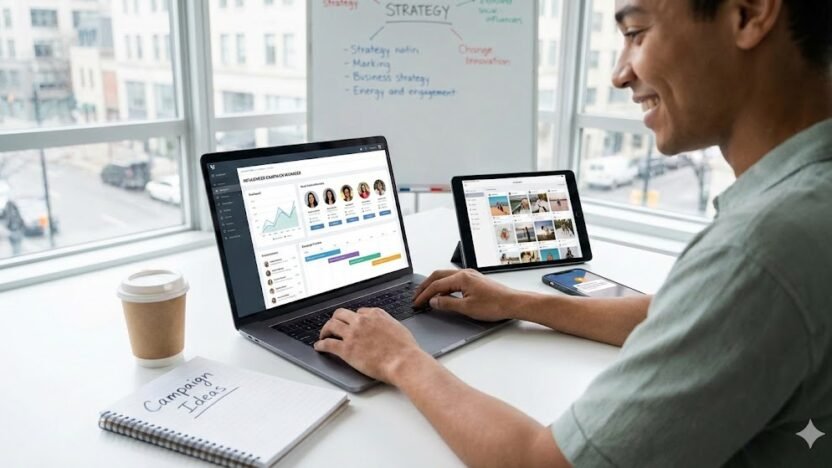
Running an influencer marketing campaign without the right system feels a lot like trying to herd cats while blindfolded. One minute you’re trying to pinpoint the perfect micro-influencers with highly engaged followings in a specific regional market, and the next, you’re buried under a mountain of spreadsheets, DM screenshots, and chaotic email threads.
Whether you are an agency trying to scale your operations or a brand demanding measurable ROI, manual outreach just doesn’t cut it anymore. The industry has grown up. Today’s successful campaigns require seamless workflows that connect the dots between brands, agency managers, and the creators themselves.
That’s exactly where dedicated campaign management tools come in. The best platforms don’t just track links—they act as the central nervous system for your entire operation. In this post, we’re breaking down the absolute best influencer marketing tools on the market right now. We’ll look at the features that actually move the needle—from streamlined discovery and automated payouts to comprehensive performance analytics—so you can stop managing spreadsheets and start driving revenue.
Here’s the rewritten content in a natural human tone with proper mixed formatting:
1. Hyperr Manage (by Hyperr Volt)
Let’s start with a tool that was clearly built by people who have actually felt the pain of managing influencer campaigns manually. Hyperr Manage, developed by Hyperr Volt, is not your typical all-in-one marketing platform that tries to do everything and ends up doing nothing particularly well. It is focused, practical, and honestly — a breath of fresh air for anyone running roster-based influencer campaigns.
If you are an agency or a brand team working with a consistent group of creators, you already know how messy things can get. Contracts sitting in email threads, deliverables tracked on spreadsheets, audience data scattered across different tools. Hyperr Manage brings all of that into one place and actually makes it manageable.
Here is what the platform covers:
1. Roster Campaign Management
Managing a large roster of influencers without a proper system is like trying to herd cats. Hyperr Manage gives you a structured way to organize your entire creator network. You can segment influencers by niche, engagement rate, audience size, platform, or past campaign performance. When a new campaign brief comes in, finding the right creators takes minutes instead of hours.
This is especially useful for talent agencies that manage hundreds of creators at once. Instead of relying on memory or messy spreadsheets, everything is organized and searchable inside the platform.
2. Contract Management
Contracts are one of those things nobody wants to deal with but everyone has to. Hyperr Manage handles the entire contract process inside the platform — from creating and sending agreements to tracking signatures and storing finalized documents. Every partnership has a clear paper trail covering:
- Deliverables and timelines
- Payment terms and amounts
- Content usage rights
- Revision policies
No more chasing creators over email for signed contracts or wondering which version of an agreement is the final one.
3. Influencer Audience Data and Analytics
This is where Hyperr Manage really protects your budget. Before committing to any creator, you can dig into their audience data and see exactly who is following them. The platform gives you a breakdown of:
| Metric | What It Tells You |
|---|---|
| Age and gender split | Whether the audience matches your target customer |
| Location data | If the audience is in your target market |
| Interest categories | How relevant the audience is to your product |
| Authenticity score | Whether the followers are real and engaged |
This kind of audience intelligence stops you from wasting money on influencers who look great on paper but whose followers have zero interest in what you sell.
4. Campaign and Deliverables Management
Once a campaign is live, keeping track of who has posted, who is late, and what still needs approval can become a full-time job on its own. Hyperr Manage gives you a clear campaign dashboard where every deliverable is tracked from brief to published post. You can see:
- Which creators have completed their deliverables
- Which posts are waiting for approval
- Which deadlines are coming up
- Where revisions are needed
Stakeholders get visibility without needing to be CC’d on every email. Creators know exactly what is expected of them. And your team spends less time chasing and more time actually managing the campaign strategically.
Who should use Hyperr Manage?
Hyperr Manage is a great fit for:
- Talent management agencies with large creator rosters
- Influencer marketing agencies running multiple brand campaigns at once
- In-house brand teams managing long-term ambassador programs
- Any team that is currently juggling contracts, briefs, and deliverables across spreadsheets and email threads
If that sounds like your situation, this tool will genuinely make your working life easier.
Everything You Need to Run Influencer Campaigns Seamlessly
Manage rosters, analyze deep insights, and automate agreements with Hyperr Manage.
2. Aspire
Aspire has been around long enough to earn genuine trust in the influencer marketing space, and the reason is simple — it was built around the idea that good influencer marketing is really about good relationships. Not transactions, not one-off posts, but actual long-term partnerships between brands and creators.
The platform covers the entire campaign lifecycle in one place, and it does so in a way that feels intuitive rather than overwhelming.
What Aspire does well:
Discovery that goes beyond follower counts
Most platforms let you filter by follower size and engagement rate. Aspire goes further by letting you search based on visual content style and aesthetic — which matters enormously if you are a beauty brand, a fashion label, or any business where how something looks is part of the selling point. You can find creators who already naturally fit your brand before you even reach out.
Campaigns in one dashboard
Whether you are running a gifting campaign, a paid partnership, or an affiliate program, Aspire handles all three from the same place. Here is a quick look at what you can manage:
| Campaign Type | What Aspire Handles |
|---|---|
| Product Gifting | Creator outreach, address collection, shipment tracking |
| Paid Partnerships | Briefs, content approvals, payment processing |
| Affiliate Programs | Unique links, commission tracking, performance reporting |
Content approvals and communication
Everything stays inside the platform. No more switching between Instagram DMs, email, and WhatsApp to communicate with different creators. Briefs go out through Aspire, creators submit content for review through Aspire, and approvals happen there too.
Reporting that actually makes sense
Aspire gives you campaign performance data that you can present to a client or a senior manager without needing to explain what any of it means. Reach, impressions, engagement, earned media value, and return on investment are all laid out clearly.
Who should use Aspire?
Aspire works best for e-commerce brands and direct-to-consumer companies that run campaigns regularly and want to build a loyal community of creators around their brand over time. If relationship building is at the heart of your influencer strategy, Aspire is one of the best tools to support that approach.
3. Grin
Grin describes itself as a creator management platform rather than an influencer marketing tool, and once you see how deeply it integrates with e-commerce systems, that label starts to make a lot of sense. This is a platform that was clearly designed with online stores in mind.
If your brand runs on Shopify, WooCommerce, or Magento, Grin connects directly to your store — and that integration unlocks some genuinely useful functionality that most other platforms simply cannot offer.
What makes Grin different:
1. Product seeding made simple
Instead of manually coordinating which products to send to which creator, Grin lets creators browse your actual store and select the products they want to feature. The order then flows automatically through your existing fulfillment system. This saves your team hours every week and makes the gifting process feel more natural for creators too.
2. A content library that actually gets used
Every piece of creator content produced through Grin campaigns is stored, tagged, and searchable inside the platform. This means when you need content for a paid ad, a website banner, or a social post, you are not digging through old emails or chasing creators for file downloads. You already have everything organized and ready to repurpose.
3. Performance tracking at creator level
Grin does not just show you overall campaign numbers. It breaks performance down by individual creator so you can clearly see:
| Metric | Why It Matters |
|---|---|
| Earned media value per creator | Understand who delivers the most value for your spend |
| Clicks and conversions | See which creators actually drive purchases |
| Revenue attribution | Know exactly how much each partnership contributed |
| Engagement rate over time | Spot creators whose audiences are growing or declining |
4. Creator relationships managed like a CRM
Grin treats each creator like a contact in a customer relationship management system. You have full history of every interaction, campaign, payment, and piece of content in one place. For brands running ongoing ambassador programs, this kind of organized relationship history is incredibly valuable.
Who should use Grin?
Grin is the go-to choice for e-commerce brands — especially Shopify stores — that are running ambassador programs, product gifting campaigns, or any influencer strategy where tracking conversions and repurposing content are important. If you sell physical products online and want to connect your influencer program directly to your store, Grin makes that connection seamlessly.
4. Later Influence (Formerly Mavrck)
Later Influence was born when Later — the well-known social media scheduling platform — acquired Mavrck, which had already built a strong reputation as an enterprise influencer marketing tool. The combination gives you something fairly unique: a platform that handles both your owned social media content and your influencer campaign management under the same roof.
For marketing teams that are tired of switching between multiple tools just to coordinate a single campaign, that is a genuinely attractive proposition.
What Later Influence brings to the table:
Serious creator vetting before you spend a penny
One of the biggest risks in influencer marketing is paying for reach that is not real. Later Influence takes the vetting process seriously. Before you commit to any creator, you can review:
- Audience quality scores that flag suspicious follower patterns
- Fraud detection signals that identify artificially inflated engagement
- Detailed demographic breakdowns of the creator’s actual audience
- Historical performance data from past campaigns
This level of pre-campaign due diligence is something a lot of platforms talk about but few actually deliver in a meaningful way.
Multiple campaign types, one workflow
Later Influence supports gifting campaigns, paid partnerships, affiliate activations, and UGC-focused campaigns — all managed through the same workflow system. Briefs, approvals, creator communications, and deliverables tracking are centralized, so your team is not bouncing between platforms and email threads to keep things moving.
Measurement that goes beyond surface metrics
| What Later Influence Measures | Why It Is Useful |
|---|---|
| Campaign-level performance over time | Track whether your program is improving |
| Individual creator benchmarks | Identify your best long-term partners |
| Audience demographic reporting | Confirm you are reaching the right people |
| Cross-campaign comparison | Understand what campaign types deliver best results |
The social scheduling advantage
Because Later Influence sits within the Later ecosystem, your team can coordinate influencer content drops alongside your owned social media calendar. It sounds like a small thing but when you are trying to time a product launch across multiple channels simultaneously, having everything in one view makes coordination significantly easier.
Who should use Later Influence?
Later Influence is a great fit for mid-to-large brands and digital marketing agencies that want influencer campaign management and social media planning in one place. If you are already a Later user, upgrading to Later Influence is an obvious and worthwhile step.
5. Traackr
Traackr is the platform you graduate to when influencer marketing stops being an experiment and starts being a serious, measurable part of your overall marketing strategy. It has been around for years and has stayed relevant not by chasing trends but by consistently delivering the kind of deep data and strategic insight that enterprise brands and serious agencies actually need.
Fair warning upfront — Traackr has a learning curve. It is not the tool you spin up on a Monday morning and have fully figured out by Friday. But if your team is willing to invest the time, what you get in return is a level of strategic intelligence that most other platforms simply cannot match.
What Traackr does differently:
1. Influencer discovery with real depth
Traackr’s creator database is one of the largest in the industry. But more importantly, the data behind each creator profile is genuinely detailed. When evaluating a potential partner, you can look at:
- Audience demographics broken down by age, gender, location, and interests
- Engagement trends over the past months — not just current numbers
- Brand affinity data showing what other brands and products the creator’s audience already engages with
- Audience overlap analysis so you can make sure your selected creators are reaching different people rather than all talking to the same audience
2. ROI measurement that works for boardroom conversations
This is Traackr’s biggest differentiator. Most platforms show you impressions and engagement. Traackr shows you business outcomes. The platform connects your influencer activity to metrics like:
| Business Outcome | How Traackr Measures It |
|---|---|
| Brand awareness growth | Share of voice tracking over time |
| Audience sentiment | Positive vs negative conversation analysis |
| Revenue contribution | Attribution modeling tied to influencer activity |
| Competitive positioning | How your program compares to industry benchmarks |
When your CMO or CFO asks what the influencer program is actually delivering for the business, Traackr gives you the data to answer that question confidently.
3. Competitive benchmarking
Very few influencer marketing tools let you measure your program against competitors. Traackr does. You can see how your share of voice, creator partnerships, and campaign performance stack up against other brands in your category. This turns influencer marketing from a creative exercise into a genuine strategic business function.
4. Built for long-term program management
Traackr is not really designed for one-off campaigns. It is built for brands and agencies that are running ongoing influencer programs and want to track performance, improve results, and build better creator relationships over months and years — not just individual activations.
Who should use Traackr?
Traackr is the right choice for:
- Enterprise brands with mature influencer marketing programs
- Global organizations running campaigns across multiple markets
- Agencies that need to prove measurable ROI to clients
- Marketing teams that need to justify influencer spend to senior leadership with real data
If you are still in the early stages of building your influencer program, Traackr might be more platform than you need right now. But if you are ready to treat influencer marketing as a serious, data-driven business channel, it is one of the best tools available.
Here are 10 natural, helpful FAQs for this blog post:
Frequently Asked Questions
1. What is an influencer marketing campaign management tool?
An influencer marketing campaign management tool is a software platform that helps brands, agencies, and marketing teams handle every part of an influencer campaign in one place. Instead of juggling spreadsheets, email threads, and multiple apps, these tools bring together creator discovery, contract management, content approvals, deliverables tracking, and performance analytics under a single dashboard. The goal is simple — save time, reduce errors, and run better campaigns.
2. Do small businesses really need an influencer marketing tool or can they manage manually?
Honestly, if you are only working with one or two influencers occasionally, a spreadsheet might be enough to get by. But the moment you start running multiple campaigns, managing several creators at once, or trying to track actual ROI from your influencer spend, doing it manually becomes a real liability. You miss deadlines, lose track of contracts, and have no clear picture of what is working. A proper tool pays for itself fairly quickly in time saved and mistakes avoided.
3. Which influencer marketing tool is best for e-commerce brands?
Grin is widely considered the strongest option for e-commerce brands, especially those running on Shopify. Its direct store integration makes product gifting seamless and its conversion tracking connects influencer activity directly to sales. Aspire is also a solid choice if building long-term creator relationships is a bigger priority for your brand than conversion tracking.
4. What is the difference between an influencer marketplace and an influencer campaign management tool?
An influencer marketplace is primarily a place to find and connect with creators — think of it like a directory. An influencer campaign management tool goes much further. It covers the entire workflow from discovery and contracts all the way through to content approvals, deliverables tracking, payments, and performance reporting. Many modern platforms combine both functions, but the management side is what actually keeps campaigns running smoothly day to day.
5. How do these tools help with influencer fraud detection?
Most good influencer marketing tools include audience authenticity analysis that flags creators with suspicious follower patterns — things like sudden follower spikes, unusually low engagement relative to follower count, or audiences concentrated in bot-heavy regions. Platforms like Later Influence and Traackr are particularly strong in this area. Running this kind of check before signing any creator partnership is one of the smartest things you can do to protect your campaign budget.
6. Can influencer marketing tools handle contracts and payments?
Yes, many of them do. Hyperr Manage, for example, has dedicated contract management built into the platform so you can create, send, and store agreements without ever leaving the tool. Aspire and Grin also handle payments directly, which removes a lot of the back-and-forth that typically slows down the post-campaign process. Having contracts and payments inside the same platform where you manage everything else keeps things organized and reduces the risk of things falling through the cracks.
7. What metrics should I track in an influencer marketing campaign?
The metrics worth tracking depend on your campaign goals, but here are the most important ones to keep an eye on:
- Reach and impressions — how many people saw the content
- Engagement rate — how actively the audience interacted with it
- Click-through rate — how many people took action after seeing the post
- Conversions and sales — the actual business impact of the campaign
- Earned media value — the estimated monetary value of the coverage
- Audience demographics — whether the right people are actually being reached
- Return on investment — what the campaign delivered relative to what you spent
8. Is Traackr suitable for small agencies or only enterprise brands?
Traackr is genuinely built with enterprise brands and large agencies in mind. Its depth of data, competitive benchmarking, and ROI measurement capabilities are powerful but they come with a steeper learning curve and pricing that reflects that positioning. If you are a smaller agency just getting started with structured influencer marketing, tools like Aspire or Hyperr Manage will likely serve you better at this stage and you can always graduate to something like Traackr as your program grows.
9. How do influencer marketing tools help with content approvals?
Instead of emailing drafts back and forth and losing track of which version is the latest, these platforms give you a built-in approval workflow. Creators submit their content directly through the platform, you review it, leave comments or request changes, and approve it — all in one place. This keeps a clear record of every revision and makes sure nothing gets published before it has been properly reviewed and signed off. For brands with strict compliance or legal requirements around content, this kind of structured approval process is especially important.
10. How do I choose the right influencer marketing campaign management tool for my business?
The honest answer is that the right tool depends on what your biggest pain points actually are. Ask yourself these questions before making a decision:
- How many creators am I managing at once?
- Do I need contract and payment management built in?
- Is audience authenticity and fraud detection a priority for me?
- Am I focused more on awareness campaigns or driving direct conversions?
- What is my budget for a management platform?
- Does my team need something easy to pick up quickly or are we willing to invest time learning a more advanced tool?