You’ve just wrapped up an Instagram influencer campaign. The influencer posted on time, the content looked great, and your team is feeling good about it. Then someone in the meeting asks: ‘So, how did it actually perform?
You have a screenshot of the post with some likes on it. You have a rough idea of the influencer’s follower count. And that’s it. No verified reach data. No audience breakdown. No way to know if the people who saw the post were even remotely close to your target customer.
This is the reality for most brands still managing influencer marketing the old way. And it’s the exact problem that Instagram influencer analytics tools are built to fix.
In this guide, we’re going to walk through everything — what influencer analytics actually means, which metrics matter, what to look for in a tool, and how Hyperr Manage brings it all together in a way that makes influencer marketing feel less like a gamble and more like a strategy.
What’s inside: Why analytics matters | Key metrics to track | What makes a great analytics tool | How Hyperr Manage works | Common mistakes to avoid | FAQs
Why Instagram Influencer Analytics Is No Longer Optional
Let’s start with the honest truth: influencer marketing has been running on vibes for too long. Brands pick creators because they like their aesthetic. Campaigns are judged by how many likes a post gets. Success is declared if the influencer’s audience seems ‘engaged.’
That approach worked when influencer budgets were small and expectations were low. But today? Brands are allocating serious money to influencer programs. Agencies are being held accountable for ROI. And the bar for what counts as ‘results’ has risen dramatically.
That’s why social media influencer analytics has moved from a nice-to-have to a non-negotiable. When you have real data behind your influencer decisions, everything changes:
- You stop choosing influencers based on follower count and start choosing based on actual audience quality
- You can tell the difference between an influencer with genuine reach and one with inflated numbers
- You know which content formats actually drive results for your brand
- You can report campaign performance to stakeholders with confidence, not approximations
- You build smarter influencer relationships over time because you have a record of what works
The brands and agencies winning at influencer marketing in 2026 aren’t the ones with the biggest budgets — they’re the ones making the smartest decisions. And smart decisions start with good data.
What Is Instagram Influencer Analytics — Really?
When people talk about influencer analytics, they often mean different things. Let’s break it down clearly.
Instagram influencer analytics refers to the collection and interpretation of performance data from an influencer’s Instagram presence. This includes data about their audience, their content performance, their engagement patterns, and how those metrics relate to your campaign goals.
There are two distinct types of analytics you’ll encounter when working with influencers:
1. Profile-Level Analytics
This is the big picture view of an influencer’s Instagram presence. It includes their overall follower count and growth trend, average engagement rate across posts, audience demographics (age, gender, location, language), peak posting times, and what content formats perform best for them.
Profile-level analytics help you decide whether to work with an influencer in the first place. It answers the question: ‘Is this person a good fit for our brand and audience?’
2. Campaign-Level Analytics
This is post-specific performance data tied to a campaign deliverable. It covers reach and impressions for a specific post, engagement on that post (likes, comments, saves, shares), story views and completion rates if a Story was part of the deliverable, Reel plays and shares if a Reel was posted, and any conversion data tied to the content.
Campaign-level analytics answer a different question: ‘Did this specific piece of content perform as expected, and did our campaign deliver results?’
A truly useful influencer analytics tool helps you with both — before the campaign to make the right decision, and after to measure and report on what happened.
The Metrics That Actually Matter in Influencer Analytics
There are dozens of numbers you could track in influencer marketing. But not all of them are equally useful. Here are the key analytics for influencers and brands that consistently prove their worth:
| Metric | What It Tells You | Why It Matters |
| Engagement Rate | % of audience actively interacting with content | Separates real influence from inflated follower counts |
| Reach | Number of unique accounts who saw the content | True measure of how far the message traveled |
| Impressions | Total number of times content was displayed | Useful for brand awareness campaigns |
| Audience Demographics | Age, gender, location of the influencer’s followers | Confirms the audience actually matches your target customer |
| Follower Growth Trend | How the following has grown or declined over time | Spots organic growth vs. sudden suspicious spikes |
| Story Completion Rate | % of viewers who watched a Story all the way through | Indicates content quality and audience interest |
| Reel Views & Shares | Total plays and shares on Reel content | Measures viral potential and discovery reach |
| Saves | Number of times a post was saved by users | High-intent signal — users found the content valuable enough to revisit |
| Post-Specific Engagement | Engagement metrics for one specific campaign post | Directly measures campaign content performance |
One metric that often gets overlooked but is critically important is audience authenticity. This tells you what percentage of an influencer’s followers are real, active accounts versus bots, inactive accounts, or purchased followers. An influencer with 200,000 followers and a 30% authenticity problem is effectively an influencer with 140,000 real followers — and your budget should reflect that reality.
What Makes a Good Instagram Influencer Analytics Tool?
The market is full of platforms that call themselves influencer analytics tools. But there’s a significant difference between a tool that shows you estimated public data and one that gives you verified, first-party insights. Here’s what separates a genuinely useful platform from a flashy dashboard with questionable numbers:
Verified Data, Not Just Estimates
Most third-party analytics tools work by scraping publicly available Instagram data and estimating metrics they can’t directly access. The result is approximate data — useful for a rough sense, but not reliable enough for significant budget decisions.
The gold standard is first-party data: analytics sourced directly from the influencer’s own Instagram account, with their authorization. This is the actual data Instagram provides to account owners — not an outside estimate of it. The difference in accuracy is significant, especially for metrics like story views, audience demographics, and real reach.
Both Profile and Campaign-Level Tracking
You need analytics before the campaign (to evaluate and select influencers) and during and after it (to track content performance). A tool that only handles one side of this is only half useful. Look for platforms that let you analyse an influencer’s profile comprehensively and then link specific posts to specific campaigns for performance tracking.
Audience Quality and Demographics
Follower count is a starting point, not a conclusion. Any serious influencer analytics platform needs to show you who the audience actually is — their age, gender, location, and language — and ideally flag any signs of audience quality issues like fake followers or sudden unexplained growth spikes.
Campaign Management Built In
Here’s something that rarely gets discussed: analytics without a management layer is incomplete. If your analytics tool shows you the data but doesn’t help you act on it — manage agreements, track campaign deliverables, record post performance — then you’re still stitching together a workflow from multiple disconnected tools.
The best influencer analytics platforms combine data with workflow. That’s exactly what Hyperr Manage does.
Clean, Usable Reporting
At some point, you need to share your campaign results with a client, a manager, or your own team. Your analytics tool should make this easy. Look for customizable dashboards, exportable reports, and a layout that tells a clear story — not just a wall of numbers that requires interpretation.
How Hyperr Manage Handles Instagram Influencer Analytics
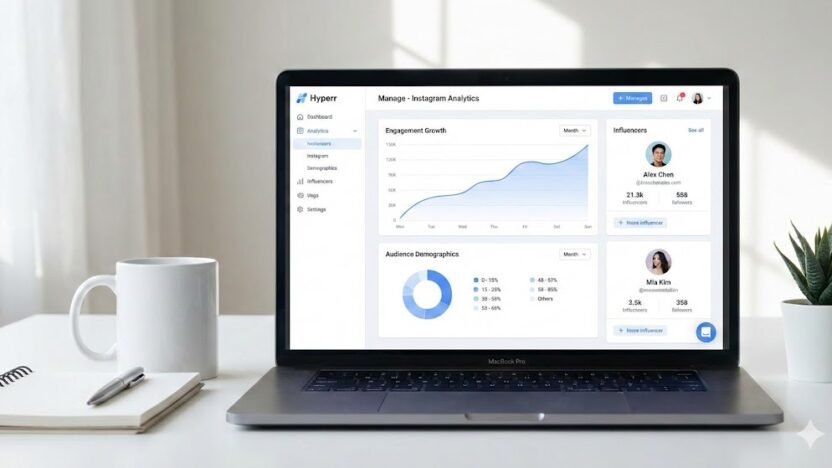
Hyperr Manage takes a fundamentally different approach to influencer analytics compared to most tools on the market. Rather than pulling estimated data from public profiles, it’s built around a verified, invitation-based system where influencers themselves connect their Instagram accounts — giving brands and agencies access to real, first-party Instagram Insights.
Here’s how the workflow actually works:
Step 1: Invite Your Influencer with a Link
You generate a unique invitation link directly from your Hyperr Manage dashboard and share it with the influencer through any channel — WhatsApp, email, or DM. The influencer clicks the link and connects their Instagram account. From that point on, their verified Instagram Insights data is available in your dashboard.
No cold-searching a database. No scraping public profiles. Your roster is built around the influencers you actually work with, and every piece of analytics data comes directly from their account.
Step 2: Analyse Real Instagram Insights
Once an influencer is in your roster, you can dive into their verified data: audience demographics by age, gender, and location; engagement rate trends over time; follower growth patterns; top-performing content; story and Reel performance. This is the same data the influencer sees in their own Instagram app — shared with you because they’ve chosen to connect.
First-party data from an influencer-authorized account is always more accurate than third-party estimates. With Hyperr Manage, you’re working with the real numbers — not an approximation of them.
Step 3: Create Campaigns and Agreements
When an influencer in your roster is selected for a campaign, you create the campaign inside Hyperr Manage and generate a digital agreement document linked to that campaign. The agreement captures the deliverables, compensation, timeline, and authorized signatory details. A signing link is generated and shared with the influencer. Once they sign, they’re officially added to the campaign — with a documented, time-stamped agreement on record.
This step alone solves one of the most persistent problems in influencer marketing: the lack of clear, formal agreements. When everything is documented in the platform, there are no miscommunications about what was agreed.
Step 4: Track Content Performance Without the Manual Work
After the influencer publishes their campaign content on Instagram, you add the post’s URL to the campaign in Hyperr Manage. The platform pulls the performance data for that specific post — reach, impressions, engagement, saves, and more — and displays it directly in your campaign dashboard.
No more manually visiting the influencer’s profile. No more asking them to send screenshots of their Insights. No more spreadsheets. The data is there, in context, tied to the campaign it belongs to.
| What You Need | How Hyperr Manage Delivers It |
| Verified influencer audience data | Influencers connect their own Instagram accounts — real Insights, not estimates |
| Influencer roster management | Centralized dashboard with all your influencers, their data, and history |
| Campaign creation and tracking | Built-in campaign management linked directly to influencer profiles |
| Formal campaign agreements | Digital agreement creation, signing, and storage — all in-platform |
| Post-specific performance tracking | Add a post link to track campaign content metrics without leaving the platform |
| Clean reporting | All campaign data organized by campaign and influencer for easy review |
Why First-Party Influencer Data Changes Everything
It’s worth spending a moment on why the data quality difference matters so much — because it affects every decision you make in an influencer program.
When you use a third-party analytics tool to research an influencer, the platform is working with publicly visible information. It can see their follower count, it can count the likes and comments on their public posts, and it can estimate engagement rates based on those numbers. But there’s a lot it can’t see: actual story views, verified audience demographics, real reach versus impressions, and whether their audience is genuinely active.
When an influencer connects their account to Hyperr Manage, you gain access to the data that was previously invisible from the outside. You see the actual reach of their posts — not an estimate. You see exactly where their audience is located — not a guess based on username patterns. You see how their stories are performing — something third-party tools can’t access at all.
This changes the quality of your decisions at every stage:
- Before the campaign: You select influencers based on verified audience fit, not assumed demographics
- During the campaign: You track real performance numbers, not approximations
- After the campaign: You report actual results, not estimates dressed up as data
In influencer marketing, better data leads to better decisions, and better decisions lead to better results. The gap between working with estimates and working with verified first-party data is not small — it’s the difference between guessing and knowing.
The Difference Between Managing Influencers and Managing Influencer Data
A lot of brands focus entirely on analytics — finding tools that show them good data — without thinking about how that data connects to their actual workflow. The result is that they have great insights but no efficient way to act on them.
Think about how a typical influencer campaign actually runs. You identify and vet the influencer using one tool. You manage outreach and communication via WhatsApp or email. You send the agreement as a PDF attachment. You track campaign deliverables in a spreadsheet. You check post performance by visiting Instagram manually. You compile the report by pulling data from several different places.
Every one of those handoffs between tools is a place where things get missed, get delayed, or get lost. Hyperr Manage is designed to collapse this entire workflow into one platform — not just the analytics part, but the whole thing.
Influencer Roster as a Living Asset
Your influencer roster in Hyperr Manage isn’t just a list of names — it’s a growing database of verified performance data, campaign history, and signed agreements. Every influencer you onboard adds to this asset. Over time, you build an increasingly valuable record of who performs well for your brand, what content resonates with their audience, and what your expected results look like for different types of campaigns.
This is what transforms influencer marketing from a series of one-off campaigns into a scalable, systematic program. The data compounds. The decisions get smarter. The results improve.
Agreements Are Part of Analytics
Here’s a connection that most people don’t make: the agreement you sign with an influencer is actually part of your analytics infrastructure. When the deliverables are clearly documented — post type, timeline, usage rights, compensation — you have a baseline against which to measure actual performance. Was the content delivered on time? Did they post the format they agreed to? Did they meet the minimum engagement expectations?
Hyperr Manage ties agreements directly to campaigns and influencer profiles, which means your performance data always has context. You know what was promised, and you can see exactly what was delivered.
Common Mistakes Brands Make With Influencer Analytics
Even with the right tools available, there are some patterns that consistently lead brands astray when it comes to influencer analytics. Here are the ones worth knowing — and avoiding:
Treating Follower Count as a Performance Metric
Follower count tells you about audience size, not audience quality or engagement. A micro-influencer with 40,000 highly engaged followers in your exact target demographic will almost always outperform a mega-influencer with 1 million passive followers. Influencer analytics tools exist precisely to help you see past the vanity metric of follower count and focus on what drives actual campaign results.
Relying Only on Estimated Third-Party Data
When brands make significant budget commitments based on estimated engagement rates and approximate audience demographics from public-facing analytics, they’re building campaign decisions on a shaky foundation. Verified first-party data — like what Hyperr Manage provides through its invitation-based connection system — gives you the confidence to make those commitments based on real information.
Skipping Formal Agreements
Informal influencer arrangements might feel easier in the moment, but they create serious problems later. Without a clear agreement, ‘post once’ can become ‘post twice but only as a Story’ in the influencer’s interpretation. Compensation expectations get blurry. Timelines slip. Hyperr Manage builds agreement creation into the campaign workflow specifically because this step is too important to leave out.
Only Checking Performance at the End
Post-campaign reporting is important, but it’s too late to change anything. The most useful analytics work happens mid-campaign, when you can still adjust. If a post is underperforming, is it the content? The timing? The caption? Mid-campaign data lets you have that conversation with the influencer while there’s still time to course-correct.
Not Building on Historical Data
Every campaign you run generates data that should inform the next one. Which influencers consistently hit their engagement benchmarks? Which content formats drive the most saves? Which audience demographics convert best? If you’re not systematically capturing and reviewing this data, you’re leaving the compounding value of your influencer program on the table.
Instagram Influencer Analytics for Different Campaign Goals
Not every campaign has the same objective, and your analytics focus should shift depending on what you’re trying to achieve. Here’s a practical breakdown:
| Campaign Goal | Primary Metrics to Track | Secondary Metrics |
| Brand Awareness | Reach, Impressions | Follower growth, Story views |
| Audience Engagement | Engagement Rate, Comments, Saves | Shares, Post saves |
| Product Education | Story Completion Rate, Reel Views | Saves, Profile visits |
| Website Traffic | Link Clicks, Swipe-Ups | Click-through rate, Bounce rate |
| Lead Generation | Link Clicks, UTM-tracked visits | Cost per click, Conversion rate |
| Sales & Revenue | Promo code redemptions, Purchases | Revenue attributed, ROAS |
| Community Building | Comments Quality, DM Volume | Follower growth, Shares |
One thing that Hyperr Manage makes easier is connecting post-specific performance data to the campaign goal you’ve defined. When the content is tied to a campaign that has a stated objective, the analytics tell a clearer story — not just ‘this post got X impressions’ but ‘this post got X impressions against a brand awareness goal, which is Y% above our benchmark.’
How to Build a Proper Influencer Analytics Workflow Using Hyperr Manage
If you’re ready to bring real structure to your influencer analytics process, here’s a practical workflow built around Hyperr Manage:
Phase 1 — Onboard Your Influencers
Start by generating invitation links from Hyperr Manage and sending them to the influencers you want in your program. Once they connect their Instagram accounts, their verified analytics data populates your dashboard. Do this for every influencer you plan to work with, not just the ones in your current campaign. Your roster is a long-term asset — the more creators in it, the more useful it becomes.
Phase 2 — Analyse Before You Commit
Before confirming any influencer for a campaign, review their verified Instagram Insights in Hyperr Manage. Check that their audience demographics match your target customer. Look at their engagement trend over the past few months — is it growing, stable, or declining? Review their top-performing content to understand what their audience responds to. This step alone will save you from expensive mistakes.
Phase 3 — Create the Campaign and Agreement
Once you’ve selected your influencers, create the campaign in Hyperr Manage and generate the agreement document for each creator. Link the agreement to the campaign, fill in the deliverables and compensation, and send the signing link to the influencer. Don’t proceed to content creation until the agreement is signed — this protects both parties and keeps expectations clear.
Phase 4 — Track Content Performance
When the influencer publishes their content, add the post link to the campaign in Hyperr Manage. The platform pulls the performance data for that specific post and displays it in your campaign dashboard. Check it regularly — don’t just look once and move on. Performance data continues to evolve for days after a post goes live, especially for Reels.
Phase 5 — Review and Learn
After the campaign ends, review the full analytics picture inside Hyperr Manage. Compare actual results to the benchmarks you set at the start. Document what worked and what didn’t. Use this as the foundation for your next campaign decision — which influencer to re-engage, what content format to prioritize, what audience segment to target.
The brands that consistently win at influencer marketing aren’t necessarily the most creative or the best-funded. They’re the most systematic. A platform like Hyperr Manage gives you the system.
Is Hyperr Manage Right for You?
Hyperr Manage isn’t for everyone, and it’s worth being honest about that. It’s not a discovery tool for finding new influencers from scratch. It’s a management and analytics platform for brands and agencies that already have — or are building — relationships with influencers they want to work with.
Here’s who gets the most value from it:
- Brands running ongoing influencer programs who need an organized, scalable system for managing their creator network
- Marketing agencies handling influencer campaigns for multiple clients who need clean workflows, proper agreements, and organized reporting
- E-commerce and D2C brands that need to tie influencer content performance to actual business metrics, not just vanity numbers
- Teams that have been managing influencer programs manually and are ready to professionalize the process
- Any brand or agency that has experienced the frustration of missed deliverables, blurry agreements, or uncertainty about campaign results
If you recognize your situation in any of those descriptions, the question isn’t whether you need a better system — it’s how quickly you can get one in place.
Frequently Asked Questions
What are Instagram influencer analytics tools?
Instagram influencer analytics tools are platforms that help brands and agencies measure, track, and interpret the performance of Instagram influencer campaigns. They provide data on audience demographics, engagement rates, content reach, and campaign-level performance metrics — helping teams make better decisions about which influencers to work with and whether campaigns are delivering results.
How is Hyperr Manage different from other influencer analytics tools?
Most analytics tools work by estimating data from publicly visible Instagram profiles. Hyperr Manage is different because it’s built on an invitation-based system: influencers connect their own Instagram accounts to your dashboard, giving you access to verified, first-party Instagram Insights data. You also get Influencer marketing campaign management, digital agreement creation, and post-specific performance tracking built into the same platform — not just analytics.
Does Hyperr Manage have a database of influencers I can search?
No. Hyperr Manage is not an influencer discovery tool and doesn’t maintain a public database of influencer profiles. It’s designed for managing your own influencer relationships — the creators you already work with or plan to work with. You invite them into your dashboard using a unique invitation link, and their data is available once they connect their Instagram account.
What Instagram data can I see once an influencer connects their account?
Once an influencer connects their Instagram through your Hyperr Manage invitation link, you gain access to their verified Instagram Insights: audience demographics (age, gender, location, language), follower growth trends, engagement rate, reach and impressions, story performance, Reel views, and top-performing content. This is first-party data from Instagram, not third-party estimates.
How does content performance tracking work in Hyperr Manage?
After an influencer publishes their campaign content on Instagram, you add the post’s URL to the relevant campaign in Hyperr Manage. The platform pulls the performance data for that specific post — including reach, impressions, engagement, saves, and shares — and displays it in your campaign dashboard. You don’t need to visit Instagram manually or ask the influencer to share screenshots.
Can I manage agreements inside Hyperr Manage?
Yes. Hyperr Manage includes a built-in agreement system. You create a campaign agreement document, link it to a campaign, select the influencer, add compensation and signatory details, and generate a unique signing link. The influencer signs digitally, and once signed, they are automatically added to the campaign with the agreement stored on record.
What metrics should I focus on for Instagram influencer campaigns?
The most important metrics depend on your campaign goal. For brand awareness, prioritize reach and impressions. For engagement campaigns, focus on engagement rate, comments, and saves. For conversion-focused campaigns, track click-through rates, promo code usage, and revenue attribution. Hyperr Manage organizes metrics within campaigns, so your analytics always have context relative to the goal you’re working toward.
Is Hyperr Manage suitable for agencies managing multiple clients?
Yes, agencies are one of the primary use cases Hyperr Manage is built for. You can maintain separate influencer rosters and campaign workflows, generate client-ready reports, and manage agreements and performance tracking across multiple client programs from a centralized platform.
The Bottom Line on Instagram Influencer Analytics
Here’s the simple truth: influencer marketing works when it’s done with intention. Choosing the right creators, setting clear expectations, getting proper agreements in place, tracking real performance data, and learning from every campaign — that’s what separates brands that see results from brands that keep hoping for them.
Instagram influencer analytics tools exist to make all of that easier, faster, and more reliable. But the best tools don’t just show you data — they help you act on it. They connect the analytics to the workflow so that insight leads directly to action.
That’s what Hyperr Manage is built to do. The invitation-based roster gives you verified data. The campaign management layer gives you structure. The agreement system gives you accountability. The post-link tracking gives you performance visibility without the manual work. Put it all together, and what you have is a complete influencer marketing management system — not just a dashboard.
If you’re ready to run influencer campaigns the way they should be run — with real data, clear agreements, and systematic performance tracking — Hyperr Manage is where that starts.
Stop managing influencer campaigns in WhatsApp threads and spreadsheets. Hyperr Manage gives you the system, the data, and the confidence to run a professional influencer program — from the first invitation link to the final campaign report.