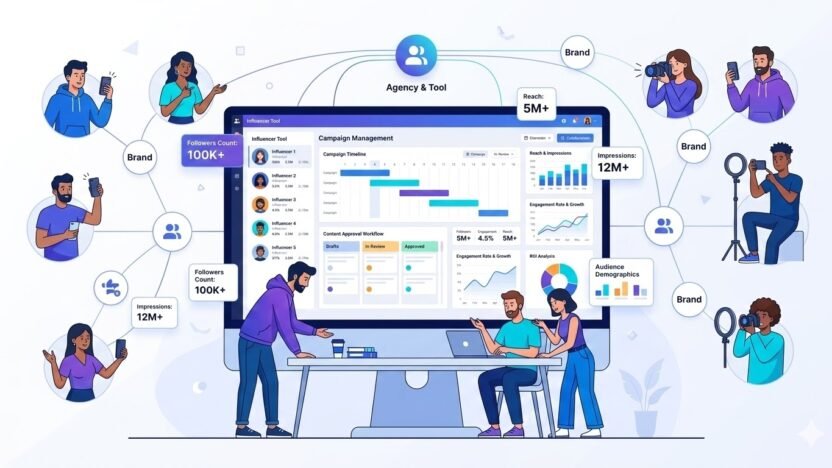
Running influencer campaigns for one brand is manageable. Running them for five or six clients at the same time — each with their own roster of creators, their own campaign timelines, their own reporting requirements — is a completely different animal.
If you work at or run a marketing agency that handles influencer programs, you already know this. You’ve probably got a folder system that made sense a year ago but is now a filing cabinet nobody trusts. You’re chasing influencer signatures over email. You’re pulling campaign performance data by hand because your current tool doesn’t quite do what you need. And every time a client asks for a progress update, you’re doing twenty minutes of manual work to pull together something that looks like a report.
This isn’t a workflow problem you can solve by working harder. It’s a tools problem. And the good news is that in 2026, the tools have actually caught up with what agencies need — if you know where to look.
This guide is specifically for marketing agencies managing influencer programs for multiple clients. We’re going to look at what an agency actually needs from an influencer campaign management tool, what the market currently offers, and why Hyperr Manage is the platform that makes the most sense for most agency setups.
If you’re a smaller brand rather than an agency, you might want to read our guide on best influencer marketing tools for small brands — the needs are similar in some ways but different enough that it’s worth a separate read.
Why Agency Influencer Management Is Its Own Problem
There’s a category of tool that gets marketed as an “all-in-one influencer platform” but was clearly designed with a single brand in mind. You can tell because the whole system assumes one client, one roster, one reporting view.
That’s fine if you’re a brand. It doesn’t work if you’re an agency.
Here’s what agency influencer management actually looks like in practice:
- You have multiple clients, each with different categories of influencers — different sizes, different niches, different platforms
- Each client has its own campaign calendar, budget structure, and reporting expectations
- You’re managing agreements with creators on behalf of clients — which means you need contracts that are clear about who the client is and what the deliverables are
- You need to report performance data to clients in a way that looks professional and makes sense to someone who wasn’t in the campaign planning meeting
- You’re building creator relationships that span multiple clients — and you need to keep that data organised without it bleeding across accounts
None of this is dramatically complicated. But it requires a tool with a structure that can actually hold it. And a surprising number of influencer platforms — even the expensive enterprise ones — can’t do this cleanly.
For a broader look at why campaign management matters so much in influencer marketing, this guide on the best influencer marketing campaign management tools in 2026 is worth bookmarking.
What Agencies Actually Need From an Influencer Management Tool
Before we get into specific platforms, let’s be honest about what the requirements actually are. Because a lot of comparison content conflates what’s impressive with what’s useful — and for agencies, those two things are not always the same.
Organised, Separate Client Workspaces
This sounds basic. It often isn’t. You need a system where Client A’s roster, campaigns, agreements, and performance data are completely separate from Client B’s — but you can move between them without logging out and back in, and without the constant risk of mixing things up.
For larger agencies, you might have junior team members who work on some clients but not others. Access controls matter.
Verified Influencer Analytics — Not Estimates
Agency clients are paying for results. When they ask about an influencer’s audience demographics or real reach, “our tool estimates it’s probably around this” is not a satisfying answer.
The difference between estimated and verified influencer data is significant, and it’s something we’ve written about in detail in our post on the
best Instagram influencer analytics tool in 2026. The short version: most platforms build their analytics from publicly available Instagram data — follower counts, likes, public comments. They estimate the rest. Hyperr Manage works differently. Influencers connect their Instagram account directly, and you get access to their actual Instagram Insights — the real data, not a model’s best guess.
For agencies, this isn’t just a nice-to-have. Presenting verified audience demographics and actual reach numbers to a client is meaningfully more credible than presenting estimates. It also protects you — if a campaign underperforms, you can show the client exactly what the data said going in.
Campaign Management That Covers the Full Workflow
Discovery is only the start. Running a campaign means briefing creators, getting agreements signed, following up on content, tracking post performance, and compiling results. Most influencer tools handle one or two parts of this well and leave the rest to your inbox.
An agency needs the entire workflow in one place. Not because it’s convenient — though it is — but because having campaign data scattered across four different systems makes reporting slow, error-prone, and genuinely stressful.
Digital Agreement Management
This is the one that consistently causes the most pain before agencies find a proper solution. Managing influencer contracts across email threads is fine for one campaign with two creators. It falls apart fast when you’re running three campaigns for four clients simultaneously.
You need a system that creates agreements, sends them for digital signing, tracks who’s signed and who hasn’t, and stores everything in a retrievable, organised way.
Post Performance Tracking Without the Manual Work
After content goes live, someone has to track how it’s performing. In most agencies, that someone is a junior account manager opening Instagram in a separate tab and copying numbers into a spreadsheet.
That’s not a good use of anyone’s time. A proper tool tracks post performance automatically once you link the post. You can see reach, engagement, and impressions without chasing data manually.
Client Reporting That Doesn’t Take Half a Day
Reporting is where the campaign value is proven. It’s also where a huge amount of agency time gets lost. If your tool gives you a proper campaign dashboard with actual performance data, building a client report is mostly presentation work. If your tool doesn’t, you’re rebuilding the data from scratch every time.
The Main Influencer Management Tools Agencies Use in 2026
Here’s an honest look at how the main platforms stack up for an agency use case specifically — not just generic feature comparisons.
| Platform | Verified Data | Campaign Mgmt | Digital Agreements | Multi-Client | Agency Pricing | Free Trial |
| HypeAuditor | ❌ Estimated | ❌ None | ❌ None | ⚠️ Basic | High / Custom | ❌ Limited |
| Upfluence | ❌ Estimated | ⚠️ Available | ⚠️ Basic | ⚠️ Basic | Very High | ❌ Demo only |
| Modash | ❌ Estimated | ❌ None | ❌ None | ❌ None | Mid-High | ⚠️ 14 days |
| Aspire | ❌ Estimated | ✅ Available | ⚠️ Basic | ⚠️ Limited | High / Custom | ❌ Demo only |
| Hyperr Manage | ✅ Verified | ✅ Full workflow | ✅ Built-in | ✅ Yes | From $75/month | ✅ 7 days |
A few things jump out from this comparison. The platforms that are strongest on discovery — HypeAuditor and Modash — have essentially no campaign management. Upfluence has more features but comes with enterprise pricing that most small to mid-sized agencies can’t easily justify. And none of the alternatives offer verified first-party Instagram data.
For a much deeper comparison of these platforms head to head, we’ve broken it all down in HypeAuditor vs Upfluence vs Modash vs Hyperr Manage — it covers each platform’s strengths and weaknesses in detail.
A Deep Dive Into Hyperr Manage for Agencies
Hyperr Manage is built around the idea that managing influencer relationships properly is a different job than discovering new influencers from a cold database. Most platforms start with discovery and treat management as a secondary feature. Hyperr Manage flips that.
Here’s how the platform works in practice for an agency setup.
Roster Management — Your Creators, Organised Properly
You build your roster by inviting influencers through a unique link. They accept the invite, connect their Instagram account, and they’re in. No scraping. No estimates. From that point, you have access to their verified Instagram Insights — real audience demographics, real reach data, real story performance.
For an agency managing multiple clients, the roster structure lets you keep each client’s creators properly organised. You’re not working from a shared master list that’s impossible to filter — you have clearly structured rosters per campaign or per client.
Verified Instagram Insights — Why This Changes the Agency Game
Let’s be specific about what “verified Instagram Insights” actually means for an agency.
When you present an influencer recommendation to a client, you’re staking some of your professional credibility on it. If you say “this creator has a 34% female audience aged 25–34 primarily based in London” and you’re working from a third-party estimate, you’re essentially saying “our software guesses this.” That’s fine — until it’s wrong.
With Hyperr Manage’s verified data, that same recommendation comes with the actual Instagram Insights behind it. The influencer has shared their account access. You’re not estimating — you’re reporting. That’s a meaningfully different conversation to have with a client who’s spending £3,000 on a campaign.
The same goes for story data. Story views, exits, and completion rates are completely invisible to third-party tools — Instagram doesn’t share that data externally. With Hyperr Manage, you can see it because the influencer’s own account is connected. For agencies running story-heavy campaigns, this is genuinely valuable data that competitors simply cannot provide.
If you want to understand more about why influencer data accuracy matters at the strategic level, this guide on why influencer marketing is important goes into it from the brand and agency perspective.
Campaign Creation and Management
Creating a campaign in Hyperr Manage is straightforward. You give it a name, set the timeframe, add the influencers involved, specify the deliverables and compensation, and you’re ready to generate the agreement.
Each campaign sits cleanly in the platform with its own view — which influencers are in it, what they’re delivering, whether agreements have been signed, which posts are live, and how those posts are performing. You can run multiple campaigns simultaneously without them interfering with each other.
For an agency, this means you can have five or six active campaigns across three or four clients and actually see what’s happening in each one without opening four different spreadsheets.
Digital Agreements — The Biggest Time Saver in the Platform
This feature tends to be the one that agencies feel most immediately after switching to Hyperr Manage. Not because it’s technically the most impressive thing in the platform — but because it removes the single most painful manual process in influencer campaign management.
Here’s what it replaces: draft agreement in Word, format it properly, export to PDF, email to influencer, wait for response, discover they’ve printed and scanned it with handwritten notes, chase for a clean signature, eventually get something you’re not sure counts as a legally signed document, file it somewhere you’ll have trouble finding it later.
Here’s what Hyperr Manage does instead: you fill in the campaign and compensation details in the platform, generate the agreement, send the influencer a signing link. They sign digitally. They’re automatically added to the campaign. The signed agreement is stored on the platform, linked to the campaign and the influencer, accessible whenever you need it.
For an agency running 20 campaigns a year with an average of 8 influencers each, that’s 160 agreement processes annually. Even if the old way only wasted 45 minutes per agreement, that’s 120 hours of account management time per year. The math is pretty clear.
Post Performance Tracking — Automatic, Not Manual
Once a campaign post goes live, you add the link in Hyperr Manage. The platform tracks performance automatically — reach, impressions, engagement metrics — and ties it to the campaign it belongs to.
This means at any point during or after a campaign, you can open the campaign view and see exactly how the content is performing across all the influencers involved. No manual Instagram visits. No “can you screenshot your insights and send them over” messages. No separate spreadsheet where someone has to manually update numbers.
For reporting purposes, having this data already collected and organised in the platform saves a significant amount of time. You’re building the report, not building the data.
Real Agency Scenarios Where Hyperr Manage Makes a Difference
Scenario 1: A Mid-Sized Agency Managing 4 to 6 Client Accounts
You’re running influencer programs for half a dozen clients. The clients are in different sectors — fashion, food, wellness, tech — so the creator rosters don’t overlap much, but the management process is the same across all of them.
Right now, your team is probably using a combination of Google Sheets, email, and maybe one discovery tool that you pay for but mostly use for analytics screenshots. Client reporting takes a day and a half every month because you’re pulling data together from too many places.
With Hyperr Manage, each client’s roster is properly structured. Campaigns are managed inside the platform. Agreements are generated and stored there. Performance data is already collected. When a client asks how the campaign is going, you open the campaign view and tell them — instead of spending an hour preparing to have the conversation.
Scenario 2: A Boutique Agency Building an Influencer Service From Scratch
You’re an agency that has traditionally focused on paid social or content strategy, and you’re adding influencer marketing as a service line. You’ve got the client relationships and the strategic knowledge — you need a system to deliver the service professionally.
Starting with the right tool is much easier than building habits around the wrong one and migrating later. Hyperr Manage’s structure — the roster system, the campaign workflow, the agreement management — gives you a professional delivery framework from day one. The 7-day free trial means you can test it with a pilot campaign before presenting it to your first influencer marketing client.
Scenario 3: An In-House Agency Team Managing Influencer Programmes for a Parent Brand and Affiliates
Some “agency” setups aren’t external agencies at all — they’re in-house teams that function like agencies because they manage influencer programs across multiple business units or sub-brands. The challenge is identical: multiple campaigns, multiple rosters, reporting to multiple stakeholders.
Hyperr Manage works just as well for this setup. The structure doesn’t require you to be an external agency — it just requires you to be managing more than one campaign at a time, which this team certainly is.
The Verified Data Advantage: What Your Competitors Can’t Offer Clients
Here’s something worth thinking about from a competitive agency perspective. If every agency in your market is using the same third-party tools and presenting the same estimated analytics to clients, the data you’re showing looks the same as everyone else’s data. There’s no differentiation in the insight.
An agency using Hyperr Manage can tell clients: we have access to the influencer’s verified Instagram Insights. Not an estimate. Not a third-party model. The actual data from their account.
That’s a different kind of claim. It sounds more credible because it is more credible. And in a competitive pitch, credibility differences add up.
The specific data points that third-party tools genuinely cannot access — and that Hyperr Manage can, through the influencer’s connected account — include:
- Real story view counts and completion rates
- Accurate audience geographic distribution at city and country level
- Verified audience age and gender breakdown (not algorithmic inference)
- Actual post reach figures — unique accounts reached, not estimated impressions
- Follower growth data including the cause and timing of any significant spikes
Understanding how influencer marketing actually helps brands becomes a much stronger conversation when you can back it up with verified data rather than estimates. Clients who have been burned by inflated influencer numbers in the past will notice the difference.
Pricing for Agencies: What Makes Financial Sense
Agency economics are different from brand economics. You’re managing a cost that your clients are (ideally) paying for, either directly or as part of your service fee. This means tool pricing has to make sense relative to the billable work it enables.
| Platform | Starting Price | Free Trial | Multi-Client Support | Agency Value |
| HypeAuditor | Custom / High | ❌ Limited | ⚠️ Basic | Poor for small–mid agencies |
| Upfluence | Custom / Very High | ❌ Demo only | ⚠️ Limited | Enterprise only — too expensive |
| Modash | Mid-High range | ⚠️ 14 days | ❌ None | Discovery only — no campaign tools |
| Aspire | High / Custom | ❌ Demo only | ⚠️ Basic | Better fit for large agencies |
| Hyperr Manage | $75/month | ✅ 7 days | ✅ Yes | Strong value for growing agencies |
Hyperr Manage at $75 per month is a different kind of pricing conversation than the enterprise platforms. For an agency billing even one influencer campaign per month, the tool cost is a small fraction of the campaign value. The time savings in agreement management and performance tracking alone justify it within the first couple of campaigns.
The 7-day free trial is also genuinely useful for agencies because it means you can test the platform with a real client roster before any commitment. Run a campaign through it. Try the agreement workflow. Check the verified analytics for two or three creators. Then decide.
If you’re comparing the full landscape of campaign management tools before making a decision, the best influencer marketing campaign management tools guide for 2026 covers the market in more depth.
How to Set Up Hyperr Manage for an Agency Workflow
Here’s a practical picture of what getting started looks like.
Step 1: Set Up Your First Client Roster
Start with one client — your most active influencer program. Create the roster in Hyperr Manage and invite the influencers you’re working with. The invitation is a simple link. They click it, connect their Instagram account, and within a short time their verified analytics are visible in your dashboard.
You don’t need to do this all at once. Start with five or six creators and build from there. The data improves as more creators connect their accounts — and getting everyone connected is usually easier than it sounds because most influencers understand the professional benefit of transparent analytics for brand relationships.
Step 2: Create Your First Campaign
Set up an upcoming campaign inside the platform. Add the influencers involved, the deliverables, the timeline, and the compensation. Generate the agreements and send the signing links to each creator. This is usually the moment agencies feel the biggest shift — what used to take a morning of email-writing takes about twenty minutes.
Step 3: Track Content as It Goes Live
As posts go up, add the links inside the campaign. Hyperr Manage picks up the performance data automatically. By the end of the campaign, you have a complete picture of how every piece of content performed — without a single manual data entry.
Step 4: Report to Your Client
Pull the campaign performance data from the platform and build your client report. You’re presenting verified performance data from a clearly structured campaign — which is a much more confident position than “here’s what we think happened based on public metrics.”
Common Questions Agencies Have About Influencer Management Tools
Can Hyperr Manage handle multiple clients in one account?
Yes. The platform is designed to support separate rosters and campaigns, which means different client programs sit cleanly apart from each other. You can move between clients without mixing data or getting confused about which campaign belongs to which account.
What if an influencer doesn’t want to connect their Instagram account?
This does come up occasionally. The honest answer is that an influencer who won’t share their verified analytics with a brand they’re being paid to represent is a small red flag — it removes the ability to verify the very thing the brand is paying for.
That said, the best approach is usually to explain the process clearly. Connecting their account to Hyperr Manage gives the agency access to their Insights data — not their messages, not posting ability, just the analytics. Most professional creators understand that transparency about their data is part of working with serious brands and agencies.
How is Hyperr Manage different from a spreadsheet?
A spreadsheet can store information. It can’t generate digital agreements, connect to Instagram for verified analytics, track post performance automatically, or give you a structured campaign view with everything tied together. The comparison isn’t really apples to apples — a spreadsheet is a place to put data, Hyperr Manage is a system for running campaigns.
Most agencies that switch from spreadsheets to Hyperr Manage don’t switch because the spreadsheet was “wrong” — they switch because they hit the point where the spreadsheet stopped scaling. Running three campaigns simultaneously for three different clients on a shared spreadsheet is the exact moment most agencies start looking for something better.
Does Hyperr Manage work for TikTok or YouTube influencers?
Hyperr Manage’s verified data system is built around Instagram Insights specifically. If your agency works primarily with Instagram creators — which most agencies running brand partnership programs do — it covers you well. For agencies heavily focused on TikTok or YouTube, it’s worth checking the current platform capabilities during the free trial period.
Is influencer marketing worth the investment for agency clients?
This is a question agencies get from clients regularly. The short answer is yes — when it’s done properly, with the right creators and genuine performance tracking. For a more detailed answer, the benefits and drawbacks of influencer marketing guide covers it honestly from both sides.
The Honest Summary: Which Agencies Should Use Hyperr Manage
Not every agency is the right fit for every tool. Here’s a straightforward breakdown.
| Agency Type | Hyperr Manage Fit | Notes |
| Small to mid-sized agency managing 3–10 client influencer programs | ✅ Strong fit | Built exactly for this scale |
| Boutique agency adding influencer marketing as a new service line | ✅ Strong fit | 7-day trial, quick to set up |
| In-house team managing influencer programs across multiple brands | ✅ Strong fit | Multi-campaign structure works well |
| Large enterprise agency running hundreds of campaigns simultaneously | ⚠️ Evaluate | May need to assess scale limits |
| Agency focused primarily on TikTok or YouTube only | ⚠️ Evaluate | Core data features built around Instagram |
| Agency that only needs cold influencer discovery, no management | ❌ Not the right tool | Look at Modash or HypeAuditor for discovery |
For the majority of agencies running active Instagram influencer programs for brand clients, Hyperr Manage offers a combination of features that’s difficult to match at any price point, let alone $75 per month.
Verified Instagram data. Campaign management that covers the whole workflow. Digital agreements built into the platform. Post performance tracking without the manual work. And a structure that actually holds up when you’re running multiple client accounts at the same time.
If you want to understand the full picture of what makes influencer marketing work for brands — and by extension, for the agencies managing their programs — this piece on how influencer marketing helps brands grow is a useful companion read to this guide.
Ready to Run Your Agency’s Influencer Programs Properly?
The 7-day free trial on Hyperr Manage gives you enough time to set up a real client roster, run through a campaign workflow, test the agreement system, and see the verified analytics in action. No demo call required. No enterprise sales process. Just the platform, working with your actual influencer relationships.
Head to manage.hyperrvolt.com to get started.
If you’re still in research mode, these related guides might help:
Related Reading
- Best Influencer Marketing Tool for Small Brands in 2026
- HypeAuditor vs Upfluence vs Modash vs Hyperr Manage: Full Comparison 2026
- Best Instagram Influencer Analytics Tool 2026
- Why Is Influencer Marketing Important?
- How Influencer Marketing Helps Brands Grow
- Benefits and Drawbacks of Influencer Marketing: A Complete Guide
- Best Influencer Marketing Campaign Management Tools 2026