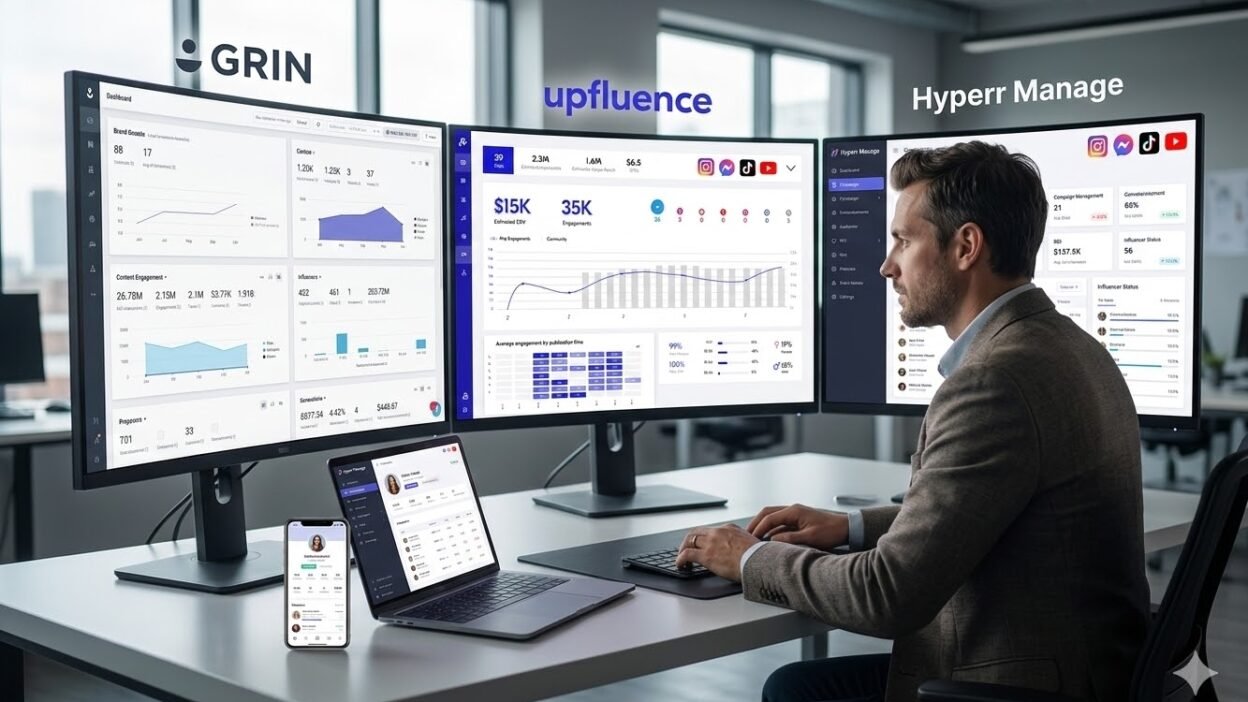
The grin vs upfluence debate has been going on for a while in influencer marketing circles. Both platforms are well-established, both are positioned as all-in-one solutions, and both come with enterprise price tags. So when people start comparing them, the real question is usually not which one is bigger. It is which one actually fits the way you work.
But there is a third platform in this comparison that often gets overlooked: Hyperr Manage. It takes a fundamentally different approach to influencer marketing, and for a large number of brands and agencies, that approach turns out to be the better fit.
This guide does a full comparison of all three. We look at how they handle analytics, campaign management, agreements, pricing, and day-to-day workflow. By the end, you will have a clear picture of which platform suits your situation and why.
| Quick answer: Grin is best for ecommerce brands on Shopify. Upfluence suits large enterprises running discovery-heavy programs. Hyperr Manage is the strongest choice for brands and agencies that want verified Instagram data, proper campaign management, and a price that does not require a custom enterprise quote. |
What This Comparison Covers
- Overview of each platform
- How Grin and Upfluence compare on key features
- Where Hyperr Manage fits into this comparison and why it wins on several fronts
- Head-to-head feature tables and pricing breakdown
- Which platform is right for which type of team
- Frequently asked questions on all three platforms
Why Picking the Right Platform Actually Matters
Influencer marketing has become one of the most consistent ways for brands to reach engaged audiences. If you want to understand why so many brands are investing heavily in this channel, the reasons why influencer marketing is important for brands guide covers the core arguments in detail.
But the channel only works if the workflow behind it is solid. A lot of brands lose money on influencer campaigns not because influencer marketing does not work, but because they are using the wrong tools to manage it. They are working with estimated data instead of real numbers, managing agreements over email, and tracking performance manually in spreadsheets.
The platforms you choose directly affect the quality of your campaigns. If you want to understand how influencer marketing helps brands grow in practice, and how the right tools support that growth, the guide on how influencer marketing helps brands grow is worth reading alongside this comparison.
Platform Overview: Grin, Upfluence, and Hyperr Manage at a Glance
Before going deep on comparisons, here is a quick snapshot of where each platform sits in the market.
| Platform | Primary Focus | Best For | Data Type | Starting Price |
| Grin | Ecommerce influencer marketing | DTC brands on Shopify / WooCommerce | Estimated public data | Custom / High |
| Upfluence | Influencer discovery & outreach | Large enterprise brands | Estimated public data | Custom / Very High |
| Hyperr Manage | Roster management & verified analytics | Brands & agencies managing campaigns | Verified Instagram Insights | From $75/month |
The most important thing to notice in that table is the data type column. Grin and Upfluence both rely on estimated analytics pulled from public-facing profiles. Hyperr Manage uses verified first-party data directly from influencer accounts. That single difference has significant consequences for every decision you make using those numbers.
Grin: What It Is and How It Works
Grin was built specifically for ecommerce brands. If you run a DTC operation on Shopify or WooCommerce, Grin is designed with your workflow in mind. The platform connects with your store, lets you send products to influencers directly, and tracks which influencer content is actually driving purchases.
It also has a strong influencer relationship management system. You can manage outreach, contracts, content approvals, and payments all inside the platform. For a brand running a structured ambassador program with clear sales attribution goals, Grin has the right features.
Grin’s Core Features
- Shopify and WooCommerce integration for product gifting and sales tracking
- Influencer CRM for managing ongoing creator relationships
- Content library and approval workflow
- Payment processing and campaign budget management
- Outreach and email tools with template management
- Performance reporting tied to ecommerce data
Where Grin Falls Short
Despite its feature depth, Grin has several limitations worth understanding before you commit.
- Pricing is enterprise-level with no published rates: you need to go through a sales demo to get a number
- Analytics are still estimated from public data: Grin cannot access what Instagram keeps private
- Significant learning curve: the platform is not quick to get up and running for smaller teams
- Heavy focus on ecommerce means it is less useful for brands not selling direct-to-consumer
- No free trial available: demo only
Upfluence: What It Is and How It Works
Upfluence is one of the most recognized names in influencer marketing software. It has been around since 2013 and built a large user base among enterprise brands and agencies. Its primary strength is influencer discovery: it maintains a large database of creators that you can search and filter by niche, location, platform, follower count, engagement rate, and audience demographics.
Beyond discovery, Upfluence includes outreach tools, some campaign management features, and integrations with ecommerce platforms similar to Grin. The Chrome extension is a popular feature, letting you pull analytics on an influencer while browsing their Instagram or other social profiles.
Upfluence’s Core Features
- Large searchable influencer database across multiple platforms
- Advanced discovery filters including audience demographics
- Outreach and email tools with campaign tracking
- Chrome extension for on-the-fly influencer analysis
- Shopify and WooCommerce integrations
- Basic campaign management and reporting
Where Upfluence Falls Short
The upfluence review conversation on Reddit and review platforms consistently raises a few recurring complaints.
- Pricing is not transparent: custom quotes are required and typically run well above what most brands budget
- The platform is discovery-first: if you already know your influencers, many of the core features become irrelevant
- All analytics come from estimated public data: the same limitation as Grin and HypeAuditor
- Built for large enterprise teams: leaner operations often find it too complex for what they need
- No free trial: demo only, which means a time investment before you even know the price
If you want to understand the full landscape of how Upfluence compares to other major platforms including HypeAuditor and Modash, the HypeAuditor vs Upfluence vs Modash vs Hyperr Manage comparison covers that in depth.
Hyperr Manage: What It Is and How It Works
Hyperr Manage takes a different approach to influencer marketing than both Grin and Upfluence. Rather than building around a public influencer discovery database, it is built around the influencers you already work with or plan to work with.
The key mechanism is its invitation system. You invite influencers to join your roster through a unique link. When they accept and connect their Instagram account, the platform gets direct access to their Instagram Insights data. Not estimated numbers. Not public profile analytics. Real, verified data from the influencer’s own account.
From there, Hyperr Manage handles the complete campaign workflow: roster management, campaign creation, digital agreement generation, post link tracking, and performance reporting. Everything in one place, built around data you can actually trust.
Hyperr Manage’s Core Features
- Invitation-based influencer roster with verified account connection
- Real Instagram Insights: actual reach, story views, audience demographics, follower growth
- Full campaign management from creation to post-performance tracking
- Digital agreements created, sent, and stored inside the platform
- Post link tracking for automatic performance monitoring
- Client-ready reporting for agencies managing multiple brands
- Starting price of $75 per month with a 7-day free trial
To understand what an influencer management platform actually does and why the workflow matters, the guide on what is an influencer management platform and why brands need one gives a clear overview of the category.
The Data Question: Verified vs Estimated Analytics
This is the most important technical distinction in this entire comparison, so it is worth spending some time on it.
Grin, Upfluence, and almost every other influencer platform on the market builds its analytics from what it can observe publicly. They see follower counts, likes, comments on public posts, and they use that information to calculate engagement rates, estimate audience quality, and infer demographic data. The algorithms behind these estimates are sophisticated, but they are still estimates.
What Instagram keeps private includes: actual story views and completion rates, real reach versus impressions, verified audience age and gender breakdown, genuine follower growth patterns, and true post reach for individual pieces of content. Third-party platforms simply cannot access this information because Instagram does not share it with them.
Hyperr Manage solves this by having the influencer connect their own account. When an influencer authorizes the platform through Instagram’s API, Hyperr Manage accesses the same Insights panel the influencer themselves sees. The data is real, not estimated.
Why This Matters for Budget Decisions
When you are committing thousands of dollars to an influencer campaign, the difference between estimated and verified data is the difference between an informed decision and a blind bet. An influencer who looks great based on estimated metrics might have a far smaller real reach than the numbers suggest. An influencer who seems average on paper might have genuinely exceptional story engagement that the public data cannot capture.
For a detailed breakdown of what influencer analytics actually mean and how to read them properly, the guide on influencer audience analytics explains the key metrics and what to look for.
Grin vs Upfluence: How They Compare Directly
The grin vs upfluence comparison is one of the most searched in the influencer marketing software space. Here is how they genuinely stack up.
Discovery and Database
Upfluence has a larger and more developed discovery database than Grin. If finding completely new influencers from a cold search is your priority, Upfluence has the advantage here. Grin’s discovery is functional but it is not what the platform was built around.
Ecommerce Integration
Grin wins this category. Its Shopify and WooCommerce integrations are deeper and more purpose-built than Upfluence’s. If you want to send products directly to influencers through the platform, track specific sales from influencer content, and measure ROI in direct revenue terms, Grin handles this more naturally.
Campaign Management
Both platforms include campaign management, but Grin’s workflow tends to feel more complete for the full campaign lifecycle. Upfluence’s campaign management is functional but heavier on the outreach side and lighter on the post-campaign tracking side.
Agreements and Contracts
Neither Grin nor Upfluence has a particularly strong built-in agreement system. Both offer some contract functionality, but neither platform makes it as clean or organized as a dedicated system. Agreements often still end up in emails or external documents for both platforms.
Pricing
Both are enterprise-priced with custom quotes and no free trials. User-reported data puts Upfluence generally higher in cost than Grin, though both are well above what most small to mid-sized teams can justify.
Analytics Quality
Both rely on estimated public data. Neither can provide verified Instagram Insights. This is where both platforms share the same fundamental limitation.
| Feature | Grin | Upfluence |
| Influencer Discovery DB | Moderate | Large and developed |
| Ecommerce Integration | Strong (Shopify/WooCommerce) | Available but less deep |
| Campaign Management | Full lifecycle | Outreach-heavy |
| Agreement Tools | Basic | Basic |
| Analytics Data | Estimated public | Estimated public |
| Pricing Transparency | No (custom quote) | No (custom quote) |
| Free Trial | No | No |
| Best For | DTC ecommerce brands | Enterprise discovery programs |
Grin vs Upfluence vs Hyperr Manage: Full Feature Comparison
Now the full three-way comparison across every feature category that matters for running real influencer campaigns.
| Feature Category | Grin | Upfluence | Hyperr Manage |
| Analytics Data Type | Estimated public | Estimated public | Verified Instagram Insights |
| Influencer Discovery | Moderate database | Large database | Invitation-based roster |
| Audience Demographics | Estimated | Estimated | Verified real data |
| Fake Follower Detection | Basic | Basic | Via verified account access |
| Campaign Management | Full | Available | Full |
| Digital Agreements | Basic | Basic | Full built-in system |
| Post Performance Tracking | Limited | Limited | Post link tracking |
| Roster Management | CRM-style lists | Lists | Verified roster system |
| Ecommerce Integration | Strong (Shopify) | Available (Shopify) | Instagram-focused |
| Payment Processing | Yes | Yes | Not primary focus |
| Client Reporting | Basic | Basic | Clean agency reports |
| Starting Price | Custom / High | Custom / Very High | $75/month |
| Free Trial | No | No | Yes, 7 days |
| Best For | DTC ecommerce | Large enterprise | Brands and agencies |
Analytics Deep Dive: What Each Platform Actually Shows You
The analytics section of any influencer platform is where the real differences show up. Here is what you actually get from each one.
Grin Analytics
Grin shows you public-facing engagement data: follower count, average likes, average comments, estimated engagement rate, and some audience demographic information. It also connects to your ecommerce platform so you can see conversion data from influencer campaigns. That last part is genuinely useful for DTC brands. The Instagram metrics themselves, however, are still estimates.
Upfluence Analytics
Upfluence’s analytics are more detailed than Grin’s on the discovery side. You get audience quality scores, estimated demographic breakdowns, engagement benchmarks, and content performance history. The Chrome extension lets you pull these numbers while browsing an influencer’s profile, which is useful for quick research. But again, all of it is estimated from public data.
Hyperr Manage Analytics
This is where Hyperr Manage is in a different category entirely. Because influencers connect their actual Instagram accounts, the platform can show you data that neither Grin nor Upfluence can access.
- Exact audience age and gender split, pulled directly from Instagram Insights
- Real city and country distribution of followers, not an algorithmic guess
- Actual story views, exit rates, and completion rates for individual stories
- True post reach: how many unique accounts actually saw each piece of content
- Verified follower growth over time, including the ability to spot sudden suspicious spikes
- Impression and reach data per post, not available from public data
For brands that rely on Instagram as their primary influencer marketing channel, understanding what a proper Instagram influencer analytics tool should give you makes it much easier to evaluate what you are actually getting from each platform.
Campaign Management: Running Campaigns on Each Platform
Beyond analytics, the day-to-day campaign workflow is where platforms either save you time or create more admin work.
Running Campaigns in Grin
Grin’s campaign management is one of its stronger features. You can create campaigns, add influencers, manage content approvals, and track performance in one place. The integration with Shopify means you can link specific discount codes to influencers and track sales in real time. For a DTC brand running ambassador programs, this workflow is well thought out.
The limitations are around analytics depth and agreement management. Content approvals work well, but the contract system is fairly basic. Teams often still manage the actual legal agreements externally.
Running Campaigns in Upfluence
Upfluence’s campaign management is heavier on outreach and lighter on post-campaign tracking. You can organize campaigns, manage communications, and track some performance metrics. But the workflow assumes a large team: someone managing discovery, someone handling outreach, someone tracking results. For leaner setups, the complexity can slow things down rather than speed them up.
Running Campaigns in Hyperr Manage
Hyperr Manage is built around the idea that campaign management should be connected to the analytics, not separate from it. When you create a campaign, you link it to influencers from your verified roster. Their real data is already in the system. You generate the digital agreement from inside the platform, set the deliverables and compensation, and send a signing link to the influencer. Once they sign, they are added to the campaign automatically.
During the campaign, you add post links and the platform tracks performance automatically. After the campaign, you have a clean record of every agreement, every deliverable, and every performance metric, all in one place.
If you are an agency managing influencer campaigns for multiple clients, the guide on the best influencer campaign management tool for marketing agencies explains what agencies should specifically look for in a platform and how to evaluate the workflow.
Agreements and Contracts: A Surprisingly Important Difference
Campaign agreements are one of the most underrated features to evaluate when choosing an influencer platform. Most brands and agencies are managing contracts over email, using PDFs and digital signature tools outside their main platform. That creates real problems: losing track of who has signed, missing deliverable details, and having no centralized record of campaign commitments.
Grin and Upfluence on Agreements
Both platforms have some contract functionality, but neither one handles it comprehensively. You can store some information about agreements, but the actual creation, sending, and signing process often happens outside the platform. This means your campaign workflow is split across multiple tools.
Hyperr Manage on Agreements
Hyperr Manage has a fully built-in agreement system. You create the agreement inside the platform, set the influencer’s compensation and deliverables, and send a signing link. The influencer signs digitally, and the signed agreement is stored in the platform linked to the campaign and the influencer’s profile. Every agreement is organized, searchable, and tied to the campaign record.
For agencies in particular, this is a meaningful difference. Client-facing reporting is much cleaner when every campaign has proper documentation attached to it.
Pricing Comparison: Grin vs Upfluence vs Hyperr Manage
Pricing is often the deciding factor, especially for teams that need to show ROI before scaling tool budgets. Here is an honest look at what each platform actually costs.
| Platform | Pricing Model | Reported Range | Free Trial | Value for Growing Teams |
| Grin | Custom quote | Enterprise level | No | Difficult to justify at smaller scale |
| Upfluence | Custom quote | $1,500-$3,000+/month | No (demo only) | High cost for features many won’t use |
| Hyperr Manage | Published tiers | From $75/month | Yes, 7 days | Strong value for active programs |
The upfluence pricing situation is a recurring frustration in online discussions. The custom quote model means you invest time in a sales process before knowing whether the tool even fits your budget. Grin follows the same pattern.
Hyperr Manage takes the opposite approach: the starting price is published, the 7-day free trial means you can test the actual platform with your real influencers before spending anything, and there are no surprises once you decide to pay.
If you are specifically a smaller brand evaluating what you actually need versus what enterprise platforms include, the guide on the best influencer marketing tool for small brands helps narrow down the criteria that matter at that scale.
Who Should Use Which Platform?
Rather than giving a single winner, here is a breakdown by situation.
Use Grin If
- You run a DTC ecommerce brand on Shopify or WooCommerce
- Sales attribution from influencer content is your primary measurement goal
- You need product gifting workflows built into the platform
- You have an enterprise budget and a dedicated influencer team
- Direct-to-consumer revenue tracking is more important to you than deep Instagram analytics
Use Upfluence If
- You need to discover large numbers of new influencers regularly from a cold database
- You run a global enterprise influencer program with a large team
- The Chrome extension workflow fits how your team researches creators
- Your budget is enterprise-level and the full feature set justifies the cost
- Influencer discovery is your primary challenge rather than campaign management
Use Hyperr Manage If
- You have existing influencer relationships and need a professional system to manage them
- Verified Instagram data matters to you: real reach, real story views, real audience demographics
- You want campaign management, digital agreements, and performance tracking in one place
- You are tired of managing campaigns across WhatsApp, email, and spreadsheets
- You need transparent pricing with a free trial before committing
- You are a marketing agency building organized, scalable influencer programs for clients
It is also worth considering the broader picture. Understanding the benefits and drawbacks of influencer marketing before choosing a platform helps you decide which features actually matter for your specific goals.
Real-World Scenarios: Which Platform Wins?
Scenario 1: DTC Fashion Brand on Shopify, 20 Micro-Influencers
This brand wants to track exactly which influencer content is driving sales. They do regular product gifting and need the workflow to be streamlined. They have a small team and cannot afford months of onboarding.
Best fit: Grin for the Shopify integration and sales tracking. However, they would benefit from Hyperr Manage for campaign management and verified analytics alongside Grin for ecommerce attribution, as the data quality gap is significant.
Scenario 2: Enterprise CPG Brand, Global Discovery Program
This brand needs to find and vet 200+ influencers across 10 markets every quarter. Discovery at scale is the primary challenge. They have a team of 15 managing influencer programs.
Best fit: Upfluence. The discovery database and filtering tools are built for exactly this. The price is justified by the scale of usage.
Scenario 3: Marketing Agency, 8 Clients, 5-15 Influencers Per Client
This agency manages influencer programs for multiple clients. They need verified performance data to report back to clients, clean agreements for every campaign, and organized records per client account.
Best fit: Hyperr Manage. The verified analytics give the agency credible data to show clients. The agreement system creates professional documentation. The roster management keeps each client’s influencers organized. And the price makes it profitable even for clients with smaller influencer budgets.
Scenario 4: Growing Brand, First Serious Influencer Program
This brand has worked with a handful of influencers informally and wants to build a proper program. They know which creators they want to work with but need better tools to manage the workflow and verify that the results are real.
Best fit: Hyperr Manage. The 7-day free trial means they can onboard their existing influencers and see real data before committing. The starting price of $75/month means the program is profitable from day one.
For a broader look at how campaign management tools compare across the market, the guide on the best influencer marketing campaign management tools in 2026 covers a wider set of options beyond just these three platforms.
Frequently Asked Questions
Is Grin better than Upfluence?
It depends on what you need. Grin is better for ecommerce brands on Shopify because its product gifting and sales attribution tools are more purpose-built for that use case. Upfluence is better for brands that need large-scale influencer discovery across multiple platforms. Neither is clearly superior for all use cases, and both share the same core limitation of relying on estimated analytics rather than verified data.
What is the main difference between Grin and Hyperr Manage?
Grin is primarily an ecommerce influencer platform focused on discovery, product gifting, and sales attribution. Hyperr Manage is a campaign management platform focused on verified analytics, agreement management, and performance tracking for the influencers you already work with. Grin works with estimated public data; Hyperr Manage uses real Instagram Insights from influencer accounts. Grin requires custom pricing; Hyperr Manage starts at $75 per month.
Does Upfluence offer a free trial?
No. Upfluence requires a demo request and goes through a sales process before you can access the platform. There is no free trial available. Hyperr Manage, by comparison, offers a 7-day free trial with no payment required, so you can test it with your actual influencers before making any commitment.
How much does Grin cost?
Grin does not publish its pricing. Based on user-reported data, Grin is enterprise-priced and typically requires a significant budget commitment. You will need to go through a sales demo to get an actual quote. This lack of transparency is a common frustration among teams evaluating the platform.
Can Hyperr Manage replace both Grin and Upfluence?
For most brands and agencies, yes. Hyperr Manage covers campaign management, verified analytics, digital agreements, and performance tracking more thoroughly than both platforms. The main area it does not replace is large-scale cold influencer discovery from a public database, which Upfluence does better. If you primarily need to manage existing influencer relationships with real data, Hyperr Manage replaces both.
Which platform is best for influencer analytics?
Hyperr Manage. It is the only platform in this comparison that provides verified first-party Instagram Insights rather than estimated public data. If you need accurate analytics to make informed budget decisions, verified data is significantly more valuable than estimated numbers from public profiles.
Is Upfluence worth the cost?
For large enterprise brands running high-volume discovery programs with dedicated teams, Upfluence can be worth the cost. For most other teams, the price is difficult to justify relative to the alternatives available. The estimated analytics, lack of free trial, and enterprise pricing combine to make it a poor fit for brands that do not fully leverage the discovery features.
What makes Hyperr Manage different from other influencer platforms?
The core difference is verified data. By having influencers connect their own Instagram accounts, Hyperr Manage provides real Insights data that third-party platforms cannot access. Combined with full campaign management, built-in digital agreements, and transparent pricing starting at $75 per month, it offers a more complete workflow at a far more accessible price point than either Grin or Upfluence.
Final Verdict: Grin vs Upfluence vs Hyperr Manage
All three platforms have genuine strengths, and the right choice depends on your situation.
Grin is the strongest option for ecommerce brands on Shopify that need sales attribution and product gifting tools. If measuring direct revenue from influencer content is your primary goal and you have an enterprise budget, Grin is built for you.
Upfluence is the right tool for large enterprise brands that need to discover and vet influencers at scale across a cold database. If your biggest challenge is finding the right creators from thousands of options across multiple markets, Upfluence’s discovery depth is hard to match.
Hyperr Manage wins for the majority of brands and agencies running active influencer programs. Verified Instagram analytics, complete campaign management, built-in digital agreements, and transparent pricing at $75 per month make it the most practical and data-accurate option in this comparison. The 7-day free trial means the decision is easy to test before you commit.
| Try Hyperr Manage free for 7 days. Real Instagram Insights from influencer accounts, complete campaign management, digital agreements, and post performance tracking. Starting at $75/month. No estimated data, no enterprise pricing surprises, no demo-before-you-know-the-price. Just a clean workflow built around data you can actually trust. |