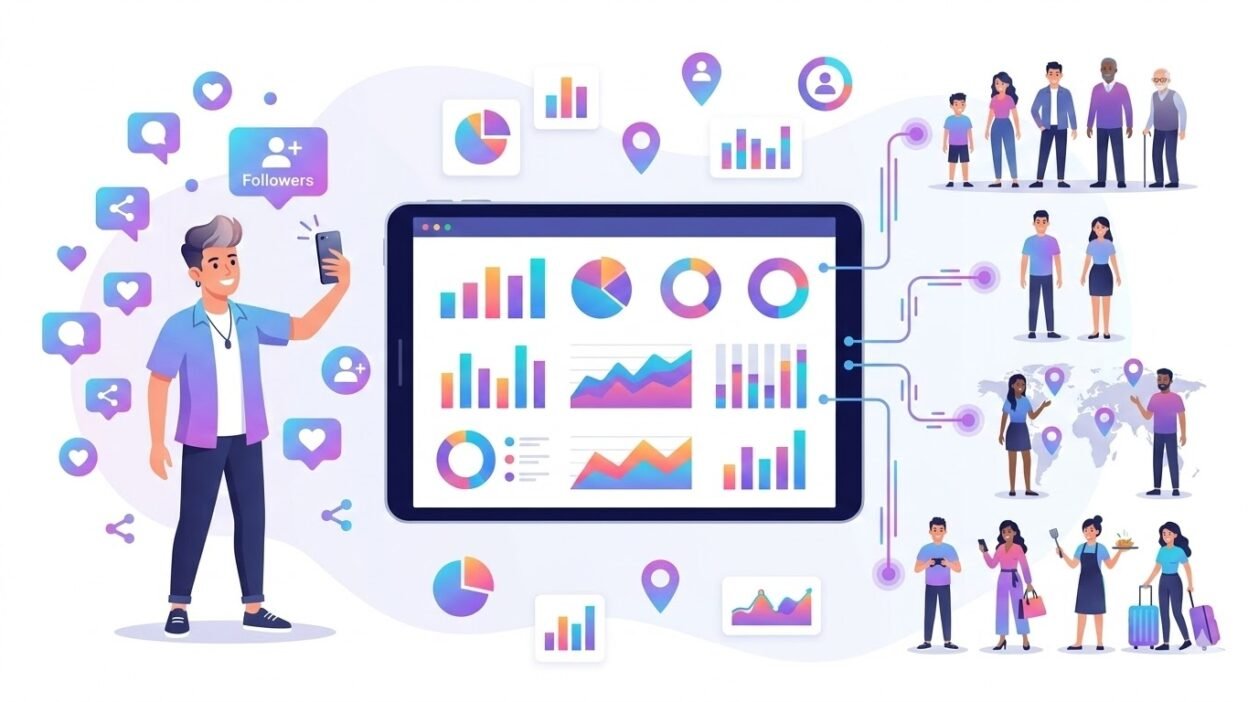
There’s a number that gets more attention than it deserves in influencer marketing. It sits right at the top of every Instagram profile, it’s the first thing most brand managers look at when they’re evaluating a creator, and it tells you far less about whether that creator is a good fit for your campaign than most people realise.
That number is follower count.
This isn’t an original observation. Most people who have spent any real time in influencer marketing already know, somewhere in the back of their mind, that follower count is a shallow metric. And yet the way most brands actually make decisions — who to approach, how much to pay, whether a campaign was worth it — still leans heavily on it.
The reason is simple: follower count is the number you can see. It’s public, it’s easy to compare, and it feels like an objective measure of reach. The numbers that actually matter — who those followers are, where they live, whether they’re even real, and whether they care about your product — are harder to access.
This guide is about those harder numbers. We’re going to walk through what influencer audience analytics actually covers, why audience demographics tracking matters so much more than a headline figure, how to tell real followers from fake ones, and how platforms like Hyperr Manage give you access to the verified influencer audience insights that most tools can only estimate.
The Problem With Follower Count as a Decision Metric
Let’s start with a scenario that’s frustratingly common.
A brand in the UK skincare space is looking for a creator to promote a new moisturiser aimed at women aged 25 to 40. They find a beauty influencer with 85,000 Instagram followers. The engagement rate looks decent — around 3.2%, which by standard benchmarks is solid for an account that size. The content is good. The aesthetic fits. They agree on a fee and run the campaign.
The results come back underwhelming. Link clicks were low. Promo code redemptions barely moved. Sales didn’t shift in any meaningful way.
What went wrong? Not the content, necessarily. Not the creator’s effort. The problem was that nobody looked closely at who that 85,000-follower audience actually was. When the creator finally shared their Instagram Insights screenshot post-campaign, the picture became clearer: over 60% of their audience was based in the United States and India, with UK followers making up under 15% of the total. The audience skewed male, not female. And the age breakdown was heavier in the 18–24 bracket than 25–40.
The follower count told one story. The audience demographics told a completely different one.
This is the core problem with follower count as a primary decision metric: it tells you how big the number is, not whether any of those people are your customers.
| A creator with 20,000 followers who are 80% UK women aged 25–40 who love skincare will outperform a creator with 100,000 followers who don’t match your audience — every single time. |
Understanding why influencer marketing is important starts with understanding that it only works when the audience is right. The reach number means nothing if the people it’s reaching aren’t your market.
What Influencer Audience Analytics Actually Covers
Influencer audience analytics is the study of who follows and engages with a creator — not just how many people do. Done properly, it gives you a detailed picture of the audience behind the number.
Here are the data points that actually matter:
Audience Location
Where are the followers actually based? At country level and, ideally, at city level. For most brands, this is one of the most important filters because your campaign only delivers value if the audience is in a market you can sell to.
A UK brand running a campaign with an influencer whose audience is 70% based in the US isn’t getting UK reach — it’s paying for American eyeballs that can’t easily buy the product. A local service business needs an audience in their city or region, not spread across three continents.
Audience Age and Gender
Does the creator’s audience match your target demographic? This seems obvious, but it’s consistently overlooked when brands focus on follower count and engagement rate and treat demographic fit as a secondary check.
A fitness brand targeting men aged 30–45 should care more about whether 40% of a creator’s audience is men in that age range than about whether the account has 50,000 or 80,000 followers. The demographic match determines whether the audience is worth reaching.
Audience Authenticity — Real vs Fake Followers
This is the one that makes most brands uncomfortable to look at closely, but it’s too important to skip. Fake followers are not a niche problem in influencer marketing. They’re common enough that any brand spending real budget on a campaign should verify audience authenticity before committing.
Fake followers come in a few different forms. The most obvious are bot accounts — automated profiles with no posts, no engagement, and no human behind them. More sophisticated are purchased follower packages — real-looking accounts that follow and occasionally like things, but which represent no genuine audience interest. Then there’s the giveaway inflation problem, where a creator has run a follow-to-enter giveaway that pulled in thousands of followers who have no ongoing interest in the content.
The impact on campaign performance is direct. If a creator has 60,000 followers but 25,000 of them are bots or disengaged follow-back accounts, their effective engaged audience is much smaller than the headline suggests. You’re paying for reach that doesn’t exist.
Engagement Quality, Not Just Rate
Engagement rate — the percentage of followers who like or comment on posts — is a more useful metric than follower count, but it still has significant limitations when taken at face value.
High comment counts can be purchased. Like patterns can be inflated by engagement pods — groups of accounts that mutually like and comment on each other’s content to boost numbers artificially. A 5% engagement rate sounds impressive until you look at the comments and find they’re all generic: “Great post!”, “Love this!”, “Fire 🔥” — the hallmarks of automated or incentivised engagement rather than genuine audience interest.
Quality engagement looks different. It’s specific. People are asking questions about the product. They’re tagging friends who they think would be interested. They’re sharing personal reactions to the content. That kind of engagement can’t be bought easily, and it’s a much stronger signal of genuine audience connection.
Story Views and Completion Rates
Instagram Stories is one of the most valuable formats for brand partnerships — it’s immediate, authentic, and shown to followers in a context that feels more personal than feed posts. But story performance data is completely private. You cannot see story view counts on anyone else’s profile. Standard third-party analytics tools can’t access this data at all.
For brands running story-based campaigns — product reveals, swipe-up links, promo codes in Stories — story views and completion rates are the performance metrics that matter most. Without verified access to the creator’s Instagram Insights, you simply can’t know this data before or after a campaign.
| Analytics Data Point | Why It Matters | Available via Public Tools? |
| Follower Count | Basic size indicator — limited value alone | ✅ Yes — publicly visible |
| Audience Country | Geographic match with your target market | ⚠️ Estimated only |
| Audience City | Precise local targeting for regional brands | ❌ Cannot reliably estimate |
| Audience Age & Gender | Demographic fit with your ideal customer | ⚠️ Estimated only |
| Real vs Fake Followers | Ensures budget reaches a genuine audience | ⚠️ Model-based estimates |
| Engagement Quality | Genuine interest vs inflated/bot engagement | ⚠️ Partially visible |
| Post Reach (unique accts) | Actual content visibility beyond followers | ❌ Private — not accessible |
| Story Views | Performance of Stories-format brand content | ❌ Private — not accessible |
| Story Completion Rate | Audience drop-off during Stories content | ❌ Private — not accessible |
| Follower Growth Patterns | Organic growth vs suspicious sudden spikes | ⚠️ Partially visible |
For a detailed breakdown of which analytics tools give you access to which data points, our guide to the best Instagram influencer analytics tools in 2026 covers the full landscape.
The Real vs Fake Followers Problem: How Bad Is It Really?
The honest answer is: bad enough that you should always check.
Industry estimates on fake follower prevalence vary, but multiple studies over the past few years have consistently found that a meaningful percentage of followers on large Instagram accounts are inauthentic. For accounts that have bought followers at any point — or that have used aggressive follow/unfollow tactics, engagement pods, or giveaway inflation — the gap between headline followers and genuine audience can be enormous.
Here’s the part that matters practically: a creator doesn’t have to be deliberately fraudulent for their follower quality to be poor. Many influencers bought followers early in their career when the practice was more normalised, built an audience they thought was real, and genuinely don’t know that a substantial chunk of their following is inauthentic. Others ran giveaways that brought in thousands of followers who immediately disengaged. Still others are victims of third-party bot networks that follow accounts without any action on the creator’s part.
This doesn’t mean you need to assume bad faith. It means you need to verify, regardless.
What Fake Followers Look Like in the Data
There are specific patterns that flag fake or low-quality followers when you’re looking at audience analytics properly:
- Sudden follower spikes: A growth chart that shows steady, organic increases is healthy. A chart that shows 8,000 new followers in a single week — especially not tied to any viral moment — is a red flag. Purchased follower packages typically land in batches.
- Engagement rate significantly lower than platform average: For accounts in the 10,000–100,000 follower range, an engagement rate below 1% suggests a large percentage of followers aren’t genuinely engaged with the content.
- Geographic audience mismatch: Accounts with a disproportionately large percentage of followers from countries with historically high bot traffic, especially when the creator’s content has no logical connection to those markets.
- Comment patterns: Generic, one-word, or emoji-only comments at volume. Real engaged audiences leave specific comments. Engagement pod participants and bots leave identical ones.
- Follower-to-following imbalance: Large numbers of followers who themselves follow thousands of accounts and have minimal content — a signature pattern of follow-back or bot accounts.
| Verifying audience authenticity isn’t about distrusting influencers. It’s about protecting your budget and making decisions based on the real audience size — not the inflated one. |
Why Estimated Audience Analytics Isn’t Enough
Most influencer analytics tools on the market today build their data from publicly observable Instagram information. They can see follower counts. They can see post likes and comments. From these signals, they build statistical models that estimate the private data — audience demographics, engagement quality, follower authenticity.
These models are genuinely sophisticated. They use machine learning, historical pattern analysis, and cross-referencing with other data sources. And they’re right a lot of the time. But there are specific categories of information they cannot estimate reliably, and there are situations where the estimates are systematically wrong in ways that cost brands money.
Where Estimated Data Falls Short
The most significant blind spots in estimated influencer audience analytics are:
- Story data — completely inaccessible: Instagram does not expose story views, story completion rates, or story reach to any third-party tool. If an influencer’s value to your campaign comes primarily through Stories, no estimation model can tell you what their stories actually deliver.
- Audience location at city level: Country-level estimates are manageable. City-level demographic tracking is much harder to do accurately from public signals. For a regional brand or a localised campaign, this matters.
- Post reach vs follower count: A creator with 50,000 followers might reach 8,000 unique accounts per post — or 30,000. This depends on algorithm performance, content quality, and audience engagement patterns. Estimated tools can guess at this; they can’t verify it.
- Demographic accuracy for smaller accounts: Estimation models work better with more data. For creators in the micro-influencer range — 5,000 to 50,000 followers — the models have less to work with and the estimates are less reliable.
This is the gap that Hyperr Manage is built to close. When creators connect their Instagram account through the platform, they authorise access to their actual Instagram Insights. What you see is not an estimate — it’s the real data, sourced directly from Instagram’s own systems.
Understanding the difference between what estimated tools can offer and what verified data looks like is covered in depth in our comparison of HypeAuditor vs Upfluence vs Modash vs Hyperr Manage. It’s worth reading if you’re evaluating tools and want an honest picture of what each one actually delivers.
How Hyperr Manage Gives You Verified Influencer Audience Insights
Hyperr Manage approaches audience analytics from a fundamentally different starting point than most influencer tools. Rather than scraping public data and estimating what’s behind it, it goes to the source.
Here’s how it works in practice.
The Invitation and Connection Process
When you add a creator to your roster in Hyperr Manage, you send them an invitation link. They click it, connect their Instagram account through Instagram’s official API, and authorise Hyperr Manage to access their Insights data. The connection is transparent — the creator knows what data they’re sharing and has actively agreed to share it.
From that point, the data you see in your dashboard is drawn directly from Instagram’s private Insights layer. Not reconstructed from public signals. Not estimated by a third-party algorithm. The actual numbers that the creator sees on their own profile.
What You Can See With Verified Access
Once a creator is connected, the audience analytics available to you include:
- Exact audience age and gender breakdown: Not an algorithmic inference based on usernames and bio keywords — the actual demographic data Instagram collects from its users.
- Verified audience country and city distribution: Where the followers actually are, at both country and city level. For a brand that needs to reach a specific geographic market, this is the data that actually tells you whether the partnership makes sense.
- Real post reach figures: How many unique accounts were actually shown the content — not estimated from follower count and average engagement, but the real number from Instagram’s tracking.
- Story views and completion rates: Completely invisible to any other analytics tool. With a connected creator account, you can see exactly how many people watched each story and how many watched it to the end.
- Follower growth history: The actual timeline of how the audience grew, including any periods of unusually rapid growth that might indicate purchased followers or giveaway inflation.
- Audience authenticity signals: Based on verified data rather than pattern estimation — a meaningfully different and more reliable basis for assessing follower quality.
| When a creator’s Instagram Insights are directly connected, the data you’re making decisions on is the same data their bank would see if they were applying for a business loan based on their reach. It’s the ground truth — not an educated guess. |
Audience Demographics Tracking in Practice: What Good Analysis Looks Like
Having access to verified audience data is only useful if you know what you’re looking for. Here’s a practical framework for how to analyse creator audience demographics before committing to a campaign partnership.
Step 1: Check Geographic Match First
Before anything else — before engagement rate, before content quality, before follower count — ask whether the audience is in a place where your product is available and your target customers actually live.
For global brands this filter is less critical. For brands selling in specific markets — a UK subscription service, a US regional restaurant chain, an Australian skincare company — it’s the most important filter there is. A creator with a beautiful feed and 150,000 followers is worthless to a London-based business if 80% of their audience is in Southeast Asia.
Step 2: Match Age and Gender to Your Target Customer
Once you’ve established geographic fit, look at the demographic profile. Does the age distribution align with who you’re trying to reach? Does the gender split match? These aren’t rigid filters — there’s always range and overlap — but a significant mismatch between a creator’s audience demographics and your target customer is a strong signal to keep looking.
The mistake most brands make here is treating demographic data as a secondary validation rather than a primary selection criterion. Run the demographic check before you get emotionally invested in a creator based on their content aesthetic.
Step 3: Look at Authenticity Signals
Review the follower growth chart. Check whether any periods of rapid growth correspond to viral moments, major press coverage, or other organic events — or whether they look like purchased follower batches. Review the engagement quality alongside the rate. Look at the geographic distribution for unusual concentrations in high-bot-traffic regions that don’t match the creator’s content focus.
You’re not trying to catch creators lying. You’re trying to understand what the audience actually is so you can make a realistic assessment of what a partnership will deliver.
Step 4: Assess Story Performance for Story-First Campaigns
If your campaign involves Stories content — which for most product launches and promotional campaigns it should — story views are a critical data point. A creator might have impressive feed post reach but poor story performance, or vice versa. Without verified access to story data, you’re flying blind on the format that might be the most important part of your campaign.
Step 5: Compare Across Your Shortlist
Audience analytics is most useful when you can compare multiple creators side by side. Two creators with similar follower counts and engagement rates might have very different audience quality and demographic fit. The one with better analytics for your specific campaign might be the one you’d have dismissed on follower count alone.
The Business Case: How Better Audience Analytics Improves Campaign ROI
All of this matters because influencer marketing is a budget decision. Whether you’re spending £500 per campaign or £50,000, the goal is to reach people who might actually buy from you. Audience analytics determines how accurately you can make that bet.
Let’s put some rough numbers around it to make this concrete.
| Scenario | Creator A | Creator B |
| Follower Count | 80,000 | 22,000 |
| Audience in Target Market | 18% (≈ 14,400 real reach) | 74% (≈ 16,280 real reach) |
| Target Age/Gender Match | 41% | 78% |
| Effective Matched Audience | ≈ 5,900 people | ≈ 12,700 people |
| Campaign Fee | £1,200 | £400 |
| Cost per Matched Audience | ≈ £0.20 | ≈ £0.03 |
The numbers in this table are illustrative, but the pattern they show is real and consistent. A creator with far fewer followers but a highly matched audience often delivers more value — and at a lower cost per relevant impression — than a larger creator whose audience doesn’t align with the target market.
You can only see this when you have access to verified audience demographics. When you’re working from follower count and estimated data, Creator A looks like the obvious choice. When you see the real audience breakdown, Creator B is the more rational investment.
This is one of the core arguments made in our guide on how influencer marketing helps brands grow — the brands that get consistent returns from influencer marketing are the ones that make decisions based on audience fit rather than audience size.
Common Audience Analytics Mistakes Brands Make
Even brands that understand the importance of audience analytics often make the same recurring mistakes. Here are the ones worth being deliberate about.
Treating Engagement Rate as a Proxy for Audience Quality
Engagement rate is better than follower count as a signal — but it has its own problems. It’s gameable through engagement pods. It can be inflated by viral content that doesn’t represent the creator’s typical audience response. And a high engagement rate doesn’t tell you anything about whether the people engaging are your customers.
Use engagement rate as a supporting data point, not a primary qualifier. Demographic fit and audience authenticity should come first.
Relying on Creator-Sent Screenshots
Asking creators to send their Instagram Insights screenshots is common and understandable — it’s the workaround brands use when they don’t have platform-level access to the data. The problem is that it’s easy to cherry-pick. A creator can send you their best-performing post’s insights or their most favourable demographic snapshot. You have no way to verify that what they’ve sent is representative.
Verified platform access through a tool like Hyperr Manage eliminates this problem entirely. The data comes from Instagram directly, not filtered through the creator’s choice of what to share.
Only Checking Analytics Before the Campaign, Not After
Pre-campaign analytics tells you whether to work with a creator. Post-campaign analytics tells you whether it worked and why. Both matter. Brands that don’t track performance properly after a campaign lose the ability to build on what worked and learn from what didn’t.
Post-campaign analytics tracking is a core part of what a proper influencer management platform should deliver — and it’s something that Hyperr Manage handles automatically once posts are linked to campaigns.
Looking at Country-Level Data When City-Level Matters
For a national brand, country-level audience distribution might be precise enough. For a regional service, a local retailer, or a brand whose product is only available in certain cities, country-level data isn’t granular enough to be useful. Make sure the analytics tool you’re using can give you city-level data — and that you’re actually looking at it.
Audience Analytics for Different Types of Campaigns
The demographic data points that matter most shift depending on what the campaign is trying to do. Here’s how to prioritise analytics based on campaign type.
| Campaign Type | Most Important Analytics | Secondary Analytics |
| Product launch (UK-targeted) | Audience location (UK %) | Age/gender match, reach |
| Story-led promo campaign | Story views & completion rate | Post reach, engagement quality |
| Affiliate / promo code | Engagement quality, saves | Audience purchasing demographics |
| Brand awareness play | Post reach (unique accounts) | Audience age/gender alignment |
| Local service / regional brand | City-level audience data | Country location, engagement |
| Niche product (e.g. fitness) | Audience interest alignment | Age range, gender split |
For a broader view of how different brands use influencer campaigns to achieve different goals, the benefits and drawbacks of influencer marketing guide covers the full picture — including when audience analytics can save a campaign from going in the wrong direction.
Who Should Be Doing Deeper Audience Analytics Work?
The short answer: any brand or agency that spends real money on influencer partnerships. But the level of rigour needed scales with investment.
Small Brands
If you’re a small brand spending £200–£500 per campaign with micro-influencers, verified audience analytics still matters — maybe more than it does for big brands, because you have less budget to absorb the cost of a mismatch. Getting the audience fit right on a smaller spend is the difference between a campaign that generates real return and one that buys you reach among people who will never buy your product. Our guide to the best influencer marketing tools for small brands covers how to access this data without enterprise-level pricing.
Marketing Agencies
For agencies managing influencer programs on behalf of clients, audience analytics accuracy is a professional credibility issue. Presenting verified demographic data — not third-party estimates — to a client is a meaningfully different proposition. It also protects you: if a campaign underperforms, verified pre-campaign analytics demonstrates that the selection was made on sound data, not guesswork. The influencer campaign management guide for marketing agencies goes deeper on how agencies can use verified data as a competitive differentiator.
Growing Brands Scaling Their Programs
The more creators you work with and the more campaigns you run, the more valuable consistent audience analytics becomes. You start to see patterns — which creator profile tends to deliver the best audience match for your product, which audience characteristics correlate with campaign performance, where your budget goes furthest. This kind of institutional knowledge is only buildable when you’re tracking the right data consistently.
The Summary: What Better Audience Analytics Looks Like in 2026
Influencer audience analytics has come a long way from simply counting followers. The brands and agencies that are doing this well in 2026 are working with a different set of questions than they were five years ago.
They’re not asking: how many followers does this creator have?
They’re asking: are those followers real? Are they in the right country and city? Are they the right age and gender? What do their story views look like? What does the reach data actually say — not the estimate, the actual number?
These questions have always been the right questions. The difference now is that the right tools make them answerable — specifically, tools that access verified Instagram Insights rather than estimating from public data.
Hyperr Manage is built around giving brands and agencies access to this verified data through a connected-creator model. Influencers connect their Instagram accounts, and the audience analytics you see is sourced directly from Instagram’s own systems — the same data the creator sees themselves.
The result is a fundamentally different quality of decision-making: audience demographics tracking that tells you what the audience actually is, real vs fake follower analysis based on verified data, story views that most tools simply can’t access, and post reach figures that reflect reality rather than a model’s best guess.
It starts at $70 per month with a 7-day free trial. You can connect your first creators and see their verified audience data before you spend anything.
To see how Hyperr Manage fits into the broader landscape of influencer marketing tools, the best influencer marketing campaign management tools guide for 2026 covers the full evaluation.
Related Reading
- Best Influencer Marketing Tool for Small Brands in 2026
- HypeAuditor vs Upfluence vs Modash vs Hyperr Manage: Full Comparison 2026
- Best Instagram Influencer Analytics Tool 2026
- Why Is Influencer Marketing Important?
- How Influencer Marketing Helps Brands Grow
- Benefits and Drawbacks of Influencer Marketing: A Complete Guide
- Best Influencer Marketing Campaign Management Tools 2026
- Best Influencer Campaign Management Tool for Marketing Agencies in 2026
- What Is an Influencer Management Platform & Why Do Brands Need One?