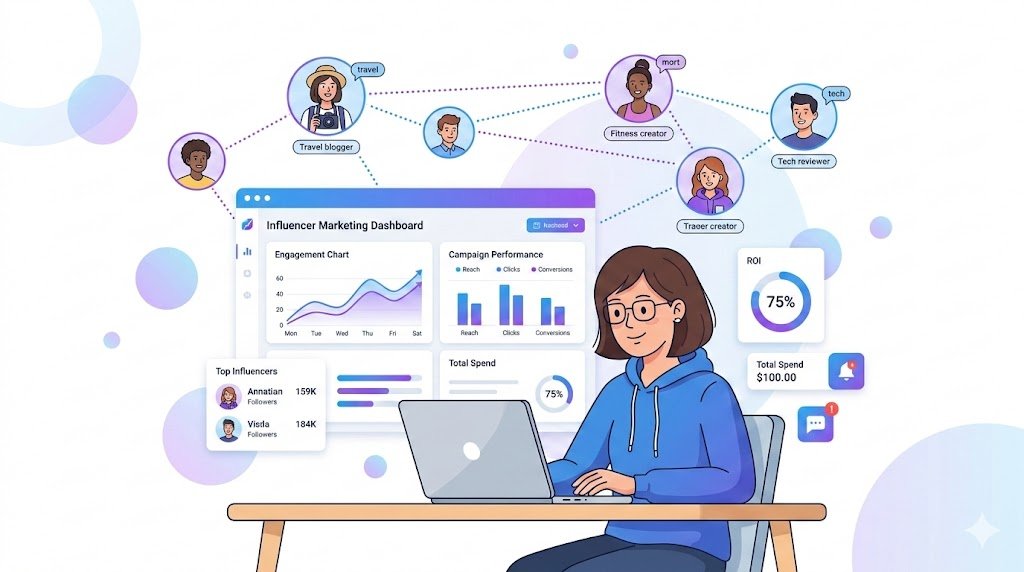
Running influencer marketing as a small brand is a different kind of challenge than most marketing advice accounts for. You’re not managing a team of ten people. You don’t have a dedicated influencer manager on payroll. And you’re definitely not signing off on a $2,000-per-month enterprise software subscription just to track three Instagram creators.
But influencer marketing still works — arguably better for small brands than for big ones, because the audience connection feels real. A micro-influencer recommending your product to their 15,000 followers is often more effective than a celebrity posting a glossy ad to millions of indifferent scrollers.
The problem isn’t whether influencer marketing works. The problem is managing it without losing your mind. Most small brand owners end up doing the whole thing across WhatsApp threads, Gmail drafts, and a spreadsheet that made sense three months ago but now looks like a cry for help.
That’s what this guide is about. We’re going to walk through what actually matters when you’re choosing an influencer marketing tool for a small brand — what features you actually need, which ones you’re paying for but will never use, and which platform makes the most sense for where you are right now.
If you have an existing group of influencers you work with (or plan to), Hyperr Manage is built exactly for this situation. But we’ll get into the why properly instead of just telling you to trust us.
Why Most Influencer Tools Aren’t Built for Small Brands
Here’s the honest truth about most influencer marketing platforms: they were built for enterprise. They were built for the team at a CPG brand with a six-figure quarterly influencer budget and a full-time person whose job is just to manage campaigns.
You’ll see this the moment you open the pricing page. Custom quotes. “Book a demo.” Enterprise tiers that unlock the features you actually need. Platforms that cost more per month than some small brands spend on paid ads in an entire quarter.
The features tell the same story. Massive discovery databases of millions of influencers — useful if you’re constantly scouting cold leads, but not if you already have your people. Deep audience overlap analysis tools — genuinely clever but not something you’ll use in the first year. Automated outreach sequences built for agencies sending hundreds of emails a week.
None of that is bad. It’s just not what a small brand with 10 to 30 active influencer relationships actually needs.
What a small brand actually needs is much more specific
- A clean way to see real Instagram analytics data for the people you’re already working with
- A simple system to create and send campaign agreements without emailing PDFs back and forth
- A way to track which posts performed well and which ones didn’t — without manually checking Instagram every other day
- Something that doesn’t cost a fortune and doesn’t take three weeks to learn
That’s the gap in the market that tools like Hyperr Manage are filling. And that’s why the tool conversation for small brands looks very different from the enterprise comparison charts you usually see.
What to Actually Look for in an Influencer Marketing Tool (As a Small Brand)
Before we get into specific tools, it’s worth spending a few minutes on what you should actually be evaluating. Because a lot of comparison guides will just dump a feature list on you without helping you understand which features matter for your situation.
1. Real Data vs Estimated Data
This is the most underrated difference between influencer tools, and it deserves more attention than it usually gets.
Most platforms — including well-known ones — build their analytics from publicly available Instagram data. They scrape what they can see: follower counts, public likes, public comments. Then they run that through an algorithm to estimate things like engagement quality, audience authenticity, and demographic breakdowns.
The keyword there is estimate. Instagram doesn’t share audience location, story views, real reach numbers, or genuine demographic data with third-party tools. So when a platform tells you that an influencer’s audience is “67% female, aged 25–34, based in the UK” — they’re making an educated guess based on what they can observe from the outside.
Hyperr Manage works differently. When you invite an influencer to your roster, they connect their Instagram account directly. This gives you access to their actual Instagram Insights — the same real-time data the influencer sees on their own phone. Real reach. Real story views. Real audience demographics pulled straight from the source.
For a small brand spending £500 or $600 on an influencer campaign, the difference between estimated and verified data isn’t a minor technical detail — it’s the difference between making an informed decision and crossing your fingers.
2. Campaign Management That Actually Covers the Workflow
A lot of tools handle the “find and evaluate” part of influencer marketing reasonably well. What they don’t handle is everything that comes after — the actual campaign work.
Think about what running a campaign actually involves: briefing the influencer, agreeing on the deliverables, getting a contract signed, following up when the post goes up late, tracking the performance once it’s live, and pulling together a report at the end. That’s six distinct things, and most tools only help with maybe one or two of them.
For small brands, this is where the spreadsheet chaos usually starts. You’re using the tool for analytics, email for contracts, WhatsApp for chasing posts, and manually checking Instagram for performance. It works, sort of — until you’re running three campaigns at once and you can’t remember who’s signed what or which post belongs to which campaign.
When you’re evaluating a tool, ask specifically: does it handle agreements? Does it let me link specific posts to campaigns and track their performance? Does it give me a single place to see everything?
3. Pricing That Makes Sense for Your Scale
Small brands should not be paying enterprise prices for features they won’t use for another two years. This sounds obvious but it’s surprisingly easy to end up in a situation where you’ve signed up for a tool that’s genuinely impressive but costs more than your monthly influencer budget.
Look for tools with honest, transparent pricing. Ideally a free trial so you can actually test it with your real influencer relationships before spending anything. And a starting tier that gives you meaningful functionality — not a crippled version of the platform designed to frustrate you into upgrading.
Hyperr Manage starts at $75 per month and includes a 7-day free trial. For a small brand running an active Instagram influencer program, that’s a genuinely reasonable entry point. You can test the whole workflow — invite your influencers, check the analytics, create a campaign, try the agreement system — before putting any money down.
How the Main Influencer Marketing Tools Compare for Small Brands
Here’s a side-by-side look at the most commonly considered tools for small brand influencer marketing in 2026:
| Feature | HypeAuditor | Modash | Upfluence | Hyperr Manage |
| Data Source | Estimated (public) | Estimated (public) | Estimated (public) | ✅ Verified Instagram Insights |
| Campaign Management | ❌ None | ❌ None | ⚠️ Basic | ✅ Full workflow |
| Digital Agreements | ❌ None | ❌ None | ⚠️ Limited | ✅ Built-in |
| Post Performance Tracking | ❌ Limited | ❌ Limited | ⚠️ Basic | ✅ Post-link tracking |
| Fake Follower Detection | ✅ Strong | ⚠️ Available | ⚠️ Basic | ✅ Via verified access |
| Starting Price | High / Custom | Mid-High | Very High | ✅ $75/month |
| Free Trial | ❌ Limited | ⚠️ 14 days | ❌ Demo only | ✅ 7 days |
| Best For | Audience auditing | Bulk discovery | Large enterprises | ✅ Small brands & agencies |
One thing stands out pretty clearly from this table: HypeAuditor, Modash, and Upfluence are all primarily built around influencer discovery — finding new people from large public databases. Hyperr Manage is built for managing the influencers you already work with or plan to work with regularly. These are genuinely different use cases.
If you’re a small brand that has already built relationships with 10, 15, or 20 creators — or you’re planning to — Hyperr Manage’s approach makes a lot more practical sense than paying for a massive discovery database you’ll barely use.
A Closer Look at Hyperr Manage: What It Actually Does
Let’s get specific about how Hyperr Manage works, because “influencer management platform” can mean a hundred different things depending on who’s saying it.
The Roster System
The core of the platform is your roster — the group of influencers you’re working with. You don’t search for them through a public database. Instead, you invite them using a unique link. They click it, connect their Instagram account, and they’re in your roster.
Once they’ve connected, you start seeing their real Instagram Insights inside your dashboard. Not a third-party estimate of their metrics — the actual data from their account. Their real follower demographics, their actual reach numbers, their genuine story performance.
This matters more than it might sound. A lot of micro-influencers look great on paper but have an audience that doesn’t match your product at all. With estimated data, you’re guessing whether their audience is the right fit. With verified data, you know.
Campaign Creation and Management
Once your influencers are in your roster, you can create campaigns and assign them to specific creators. A campaign in Hyperr Manage is a proper structured thing — it has a name, a timeframe, compensation details, and the specific deliverables you’ve agreed on.
You can run multiple campaigns at the same time without them getting tangled up. Each one sits cleanly in the platform with its own influencers, its own agreements, and its own performance data.
Digital Agreements — The Feature That Saves the Most Time
If you’ve been running influencer campaigns for more than a few months, you’ve probably already run into the agreement problem. You draft something in Word, export it to PDF, email it, wait three days for a response, get back a version with handwritten notes on it, and eventually have a semi-signed document somewhere in a Gmail thread that you can’t find four months later.
Hyperr Manage generates digital campaign agreements inside the platform. You fill in the campaign details — the deliverables, the compensation, the posting timeline — and the system creates an agreement. You send the influencer a signing link. They sign digitally. They’re automatically added to the campaign. The signed agreement is stored on the platform, linked to the campaign and the influencer.
That’s it. No PDFs. No email chains. No mystery about who’s signed what.
For small brands running several campaigns a year across ten or twenty influencers, this feature alone is worth the monthly cost.
Post Performance Tracking
After the content goes live, you add the post link to Hyperr Manage. The platform tracks its performance automatically — reach, engagement, impressions — without you needing to check Instagram manually every day.
You can see how each post is performing, compare it against your other campaign posts, and build a proper picture of what’s working. This is also genuinely useful when reporting back to stakeholders — instead of taking screenshots and pasting numbers into a deck, you have a dashboard with actual campaign data.
Real-World Scenarios: When Hyperr Manage Is the Right Fit
Tools are only useful in context. Here are the kinds of situations where Hyperr Manage fits small brands particularly well.
Scenario 1: The D2C Brand With a Growing Creator Roster
You’re a direct-to-consumer brand — maybe in skincare, homewares, or food — and you’ve built genuine relationships with 15 to 25 Instagram micro-influencers over the past year or two. Some of them post regularly. Some you bring in for seasonal campaigns. You know them personally. The relationships are strong.
The problem is that managing all of this happens across too many places. Briefing conversations on Instagram DM. Contracts on email. Campaign tracking on a spreadsheet that you update when you remember to.
Hyperr Manage organises this without forcing you to change how you work with people. The relationships stay human — Hyperr Manage just gives you a proper system around them. Agreements are stored properly. Performance is tracked automatically. When you want to run a summer campaign, you can see all your influencers’ data in one place and pick the right people based on verified analytics rather than gut feeling.
Scenario 2: A Small Agency Managing Influencer Programs for Clients
If you’re running a small marketing agency and influencer management is one of your services, the problem compounds. You’re managing multiple brands, each with their own roster of creators. That’s already complex. But you also need to produce reports for clients — something that shows the campaign results clearly and professionally.
With Hyperr Manage, each client’s roster is separate. Campaign data and agreements are organized per client. When reporting time comes, you have actual performance data to show — not a screenshot collection from Instagram. The verified analytics also make client conversations easier, because you’re working with real numbers rather than estimates that a client could reasonably question.
Scenario 3: Starting From Scratch
Maybe you’re a brand that’s never done structured influencer marketing before. You’ve had a few creators mention your product informally, but you’ve never run a proper campaign. You’re not sure how to set up agreements, how to brief properly, or how to track results.
Hyperr Manage’s structure helps here because it gives you a framework. The campaign system, the agreement workflow, the roster — they guide you through what a properly managed influencer program actually looks like. You don’t need to build the system yourself from scratch.
The Problem With Estimated Influencer Data (And Why It Matters More Than You Think)
We touched on this earlier but it’s worth going deeper, because it’s genuinely one of the most important distinctions in this space and it doesn’t get enough attention.
When you use a platform like HypeAuditor or Modash to look up an influencer, you’re seeing data that those platforms have constructed from publicly observable information. Instagram doesn’t give these tools direct access to influencer account data. So they work with what’s visible: public follower counts, public post likes and comments, public captions.
From this, they build models that estimate things like audience authenticity, demographic composition, and engagement quality. These models are sophisticated. They’re also still models — which means they’re right most of the time and wrong enough of the time that you should care.
Here’s a concrete example of why this matters for a small brand. Say you’re working with an influencer with 20,000 followers. A third-party tool estimates that their audience is 65% female, aged 18–34, based in the United States. But the influencer’s actual Instagram Insights show that 70% of their audience is in India — because they ran a giveaway eight months ago that brought in a lot of followers from outside their usual region.
You can’t see that with estimated data. With verified data from Hyperr Manage, you see it immediately. That’s the difference between making a confident, informed decision about who to work with and discovering the mismatch three months into a campaign.
The other thing estimated tools can’t access at all is story performance. Instagram Stories is one of the most valuable formats for brand partnerships — authentic, immediate, and genuinely engaging. But story view data is completely private. Third-party platforms cannot access it. With Hyperr Manage’s verified account connection, story views and completion rates are part of the data you see.
Verified vs Estimated Influencer Data: What You Can and Can’t See
| Data Point | Estimated Tools (e.g. HypeAuditor) | Hyperr Manage (Verified) |
| Follower Count | ✅ Public, accurate | ✅ Verified |
| Audience Country Breakdown | ⚠️ Estimated | ✅ Real from Insights |
| Audience Age & Gender | ⚠️ Estimated | ✅ Real from Insights |
| Post Reach (unique accounts) | ⚠️ Estimated | ✅ Real from Insights |
| Story Views | ❌ Cannot access | ✅ Real from Insights |
| Story Completion Rate | ❌ Cannot access | ✅ Real from Insights |
| Follower Growth Spikes | ⚠️ Partially visible | ✅ Full history |
| Fake Follower Detection | ✅ Strong models | ✅ Verified authenticity |
Influencer Marketing Tips for Small Brands in 2026
Beyond choosing the right tool, there are a few principles that consistently make influencer campaigns work better for smaller brands. These aren’t complicated — but they’re easy to skip when you’re busy.
Work With Fewer Creators, More Consistently
One of the most common small brand mistakes is trying to work with too many influencers at once, spreading budget thin, and getting mediocre results across the board. The brands that build the strongest influencer programs usually do it by going deep with a small group of genuinely aligned creators — people who actually use and like their product.
Long-term relationships produce better content, more authentic recommendations, and stronger audience trust. Ten deeply engaged posts from five consistent creators will outperform twenty half-hearted posts from twenty different people almost every time.
Brief Properly — But Don’t Over-Control
A good campaign brief tells the influencer what they need to know: the key message, the posting timeline, any mandatory inclusions (like a discount code or a specific hashtag), and any hard limits (competitor mentions, topics to avoid). What it shouldn’t do is script the content so tightly that the influencer loses their voice.
Audiences follow influencers because they trust their perspective. When content is clearly written by a brand and delivered by an influencer, the audience can feel it. The brief should give the influencer what they need to represent your brand accurately — then trust them to do their job.
Track the Right Metrics
Vanity metrics — follower count, total likes — will tell you almost nothing useful about campaign performance. The numbers that actually matter for a small brand are:
- Reach: how many unique people saw the content
- Saves: a strong signal of genuine interest (people save content they want to act on later)
- Story views and completion rate: especially for swipe-up or link-in-bio campaigns
- Click-through rate: if you’re running trackable links or promo codes
- Conversions: direct sales, sign-ups, or whatever your actual campaign goal is
Hyperr Manage gives you access to the verified Instagram data that makes these metrics meaningful. Instead of looking at public-facing numbers and trying to back-calculate actual performance, you’re working with the real figures.
Always Have a Proper Agreement
This one is non-negotiable, even for brands that work with people they know personally. An influencer agreement doesn’t have to be a 10-page legal document — it just needs to clearly set out what’s been agreed: what content is expected, when it needs to go live, what the compensation is, and what happens if something goes wrong.
Not having an agreement is fine right up until the moment it isn’t. A creator misses a deadline and you have no recourse. A post goes up with incorrect information and you’re not sure who’s responsible. A dispute about payment comes up three months later and there’s nothing in writing.
Hyperr Manage’s built-in agreement system makes this easy enough that there’s no excuse to skip it. Creating and sending an agreement through the platform takes about five minutes. Compare that to drafting a Word document, converting it to PDF, emailing it, chasing a signature, and filing it somewhere you’ll actually find it later.
Pricing Breakdown: What You Actually Pay for Influencer Tools in 2026
Let’s be straightforward about money, because this is where a lot of small brands make decisions they later regret.
| Platform | Starting Price | Free Trial | Value for Small Brands |
| HypeAuditor | Custom / Enterprise pricing | ❌ Limited free features only | Hard to justify — enterprise-focused |
| Upfluence | Custom / Very high | ❌ Demo only, no trial | Not accessible for small brands |
| Modash | Mid-to-high range | ⚠️ 14 days | Better accessibility but still high |
| Hyperr Manage | $75/month | ✅ 7-day free trial | Strong value — built for this scale |
The pricing gap between Hyperr Manage and the enterprise tools isn’t just a number — it represents a fundamentally different approach to who the product is built for. Enterprise platforms justify their pricing with features that large teams with large budgets need. For a small brand running influencer marketing as one part of a broader marketing mix, paying four to ten times more for features you’ll never use doesn’t make sense.
The 7-day free trial on Hyperr Manage removes the biggest risk from the decision. You can connect your existing influencers, look at their verified analytics, create a test campaign, and run through the agreement workflow before you put any money in. If it works for your situation — and for most small brands running Instagram influencer programs, it does — you can commit from there.
Common Questions Small Brands Have About Influencer Marketing Tools
Do I need an influencer marketing tool if I’m only working with 5 or 6 creators?
It depends on how seriously you’re taking the program. If those 5 or 6 creators are posting regularly, you’re running proper campaign agreements, and you want to track performance accurately — then yes, a tool makes the workflow significantly cleaner. If you’re doing something casual and informal, you might be fine for a while without one.
That said, most brands that start with 5 or 6 creators end up with more once the program starts working. Building the right habits and systems early makes scaling up much less painful.
What’s the difference between an influencer discovery tool and an influencer management tool?
Discovery tools — like HypeAuditor and Modash — are built to help you find new influencers. They have searchable databases of public profiles that you can filter by niche, location, follower count, and engagement rate. They’re useful when you’re prospecting.
Management tools — like Hyperr Manage — are built for working with influencers you’ve already identified. They handle the relationship, the campaign logistics, the agreements, and the performance tracking. They’re useful when you’re running.
Some platforms try to do both, usually with uneven results. For most small brands, the bigger day-to-day need is management — keeping campaigns organized, getting agreements signed, tracking what’s working — rather than discovering new creators from a cold database.
Is Instagram the right platform for small brand influencer marketing in 2026?
Instagram remains one of the strongest platforms for product-focused influencer marketing, particularly for lifestyle, fashion, beauty, food, fitness, and home categories. The combination of feed posts, Stories, and Reels gives influencers a lot of creative formats to work with, and the audience is actively engaged with brand content in a way that many other platforms aren’t.
TikTok has grown enormously, and for the right brand and creator combination it’s very powerful. But Instagram’s shopping features, story links, and the depth of its Insights data make it particularly well-suited for small brands that want to actually measure what they’re getting from influencer partnerships.
Can I use Hyperr Manage if I’m just starting out?
Yes — and in some ways, starting with a proper system from the beginning is easier than trying to retrofit one onto an existing mess. The 7-day free trial means you can set up your first roster and run through a campaign workflow before committing.
The platform is designed to grow with you. You might start with 5 influencers and grow to 50 over a year. The roster system, campaign management, and analytics work at both scales without you needing to change how you use it.
What Makes a Good Influencer Relationship in 2026
Tools aside for a moment — the most important thing in influencer marketing is still the actual relationship between your brand and the creator. No software fixes a bad fit.
The small brands that consistently get the best influencer results tend to share a few common habits:
- They choose alignment over reach. A creator with 8,000 followers who genuinely loves and uses your product will deliver better results than a creator with 80,000 followers who’s posting your product between ten other brand deals this month. Authentic enthusiasm shows in the content.
- They treat creators as collaborators, not vendors. The best influencer content comes from a briefing conversation, not a brief document. Talking to the creator about why you love your product, what makes it different, who your customer is — that translates into content that feels genuine because it is.
- They pay fairly and on time. This sounds obvious. It is also not universally practiced. Brands that pay promptly and fairly build the kind of creator reputation that makes good influencers want to keep working with them.
- They track results properly. Understanding what worked, what didn’t, and why — that’s how influencer programs improve over time. Without proper tracking, you’re guessing, and the same mistakes keep repeating.
This is another place where having the right tool matters. When your agreements are stored properly, your campaign data is tracked automatically, and your influencer analytics are verified rather than estimated — making good decisions becomes much easier. The tool doesn’t replace the relationship. It supports it.
Summary: The Best Influencer Marketing Tool for Small Brands in 2026
Let’s bring this together.
If you’re a small brand looking for an influencer marketing tool in 2026, the decision really comes down to what you actually need right now:
| Your Situation | Best Tool Match |
| You need to discover completely new influencers from a cold database | HypeAuditor or Modash for discovery, then transition to Hyperr Manage for management |
| You have existing influencer relationships and need to manage them properly | Hyperr Manage — built exactly for this |
| You need verified Instagram data, not third-party estimates | Hyperr Manage — the only option that does this properly |
| You need campaign management + digital agreements in one place | Hyperr Manage |
| You have an enterprise budget and need Shopify integration + payments | Upfluence |
| You’re a small brand starting your first influencer program | Hyperr Manage — 7-day free trial, $75/month |
For the large majority of small brands with active Instagram influencer programs — or brands building one — Hyperr Manage offers the strongest combination of features, data quality, and pricing on the market in 2026. Verified Instagram Insights instead of estimates. Campaign management that covers the full workflow. Digital agreements built into the platform. Post performance tracking without the manual work. And a starting price that doesn’t require you to rearrange your entire marketing budget to justify it.
The 7-day free trial means there’s genuinely no risk in trying it with your real influencer roster. If it fits — and for most small brands in this situation, it does — you’ll have a much cleaner, more professional influencer program on the other side of the test.
Ready to Get Started?
Head over to manage.hyperrvolt.com to start your 7-day free trial. You can invite your existing influencers, explore their verified analytics, build out a campaign, and test the agreement workflow — all before you pay anything.
If you’ve been managing influencer campaigns across emails, DMs, and spreadsheets, the difference will be noticeable within the first few days. Not because the tool does the relationship-building for you — that part is still yours — but because it gives you a proper system to build those relationships in.