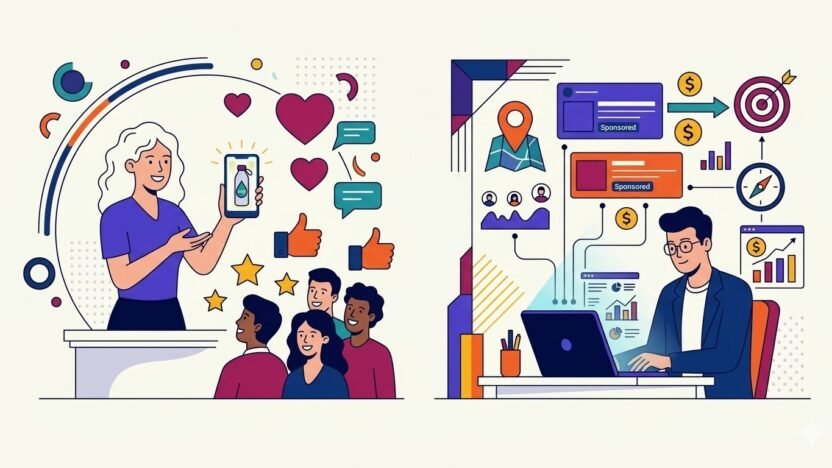
Every marketing team reaches a point where the budget question gets real. You have a set amount to spend, two very different channels sitting in front of you, and a room full of people with strong opinions about which one to use. Social media ads are familiar, measurable, and fast to set up. Influencer marketing keeps showing up in conversations as the thing that is actually moving results right now.
Both channels live on the same platforms. Both target the same people. But they work completely differently, cost differently, and produce different kinds of results. Choosing between them without understanding those differences is how brands end up spending money on the wrong thing for the wrong goal.
This guide puts both channels side by side — not to declare a winner, but to give you a clear picture of what each does well, what each does poorly, and most importantly, which one gives you more return on investment depending on what you are actually trying to achieve.
The data referenced throughout this guide comes from 2025 and 2026 industry research. Influencer marketing has matured significantly. Measurement tools are better, attribution methods are sharper, and performance benchmarks are clearer than they have ever been. This is the right time to make a properly informed decision.
Defining the Two Channels: What Each One Actually Does
Before comparing them on ROI, it helps to be precise about what each channel is and how it works. These two are often lumped together under social media marketing but they function very differently even when they appear on the same screen.
What Are Social Media Ads?
Social media advertising means paying a platform — Instagram, Facebook, TikTok, YouTube, LinkedIn — to show your content to a defined audience. You control the targeting, the budget, the creative, the placement, and the timing. The content comes from your brand account or a connected ad account.
The platform algorithm distributes your ad to users who match your targeting criteria, whether that is based on demographics, interests, behaviours, lookalike audiences, or retargeting lists. Results are tracked inside the platform’s ad manager, and you can see performance data in near real time.
The key characteristics of social media ads are control, speed, and scalability. You can go from zero to reaching hundreds of thousands of people within hours. You can pause, adjust, or scale spending immediately. And the data on what happened — who saw it, who clicked, who converted — is available quickly and in detail.
What Is Influencer Marketing?
Influencer marketing means partnering with a creator who already has an established audience on a social platform. That creator produces content featuring your brand and shares it with their followers. The content appears in the creator’s own feed, so to their audience it looks and feels like a recommendation from someone they already follow and trust.
Unlike ads, the message does not come from your brand account. It comes from a human voice with an existing relationship with their community. The creator’s credibility is what carries the message. You are essentially borrowing the relationship they have built with their audience over time.
The trade-off compared to ads is less control and a longer timeline from decision to published post. But what you gain is something ads struggle to replicate: genuine trust that directly influences purchase decisions.
The ROI Question: Why the Answer Is More Nuanced Than You Think
The most searched version of this question is which channel has better ROI — but that framing creates a false choice. ROI depends entirely on what you are measuring, what your goal is, and how well each channel is being executed. A poorly run influencer campaign will not beat a well-optimised ad campaign. And a brand-new product advertised to a completely cold audience without any trust-building will not beat a well-matched influencer speaking directly to an engaged, relevant community.
What the data does show clearly is that when both channels are executed properly, influencer marketing consistently outperforms standard social media advertising on specific metrics — particularly trust, engagement quality, content longevity, and purchase intent. Social media ads consistently outperform on speed, audience targeting precision, and direct conversion tracking.
Industry research from 2025 and 2026 shows brands investing in influencer marketing report an average return of around 5.78 times their spend. In a multichannel study measuring long-term brand impact, influencer marketing delivered the highest ROI index of any digital channel — nearly double what social media advertising delivered on the same measure.
That is a meaningful number. But it sits alongside a different reality: social media ads offer campaign flexibility and attribution clarity that influencer marketing cannot match in the same way. The question is not which is better. The question is what you are trying to accomplish, and which channel is better suited for that specific goal.
Head-to-Head: The Metrics That Actually Drive Budget Decisions
| Metric | Social Media Ads | Influencer Marketing |
| Average ROI benchmark | 2x to 3x on paid social | 5.78x average; up to 11x vs banner ads |
| Consumer trust factor | Low — users know it is an ad | High — recommendation from a trusted voice |
| Engagement rate | 0.5% to 1.5% typical | 2% to 10%+ depending on creator tier |
| Speed to launch | Hours to days | Days to weeks |
| Content lifespan | Ends when ad spend stops | Continues generating organic views for months |
| Audience targeting | Highly precise via platform data | Depends on creator audience alignment |
| Attribution clarity | Strong — real-time dashboards | Good with proper tracking setup |
| Cost per acquisition | Higher on cold audiences | 30% to 50% lower when creator UGC used in ads |
| Brand credibility building | Weak — ad fatigue reduces impact | Strong — credibility transfers from creator |
| Scalability | Instantly scalable with budget | Scales through roster building |
| Content repurposability | Limited to brand-produced assets | Creator UGC performs strongly in paid ads |
| Ad fatigue risk | High — creative staleness is fast | Low — authentic content stays fresh longer |
This table gives you the landscape at a glance. Now let us go deeper on the dimensions that move real budget decisions.
Trust: The Factor Behind the Entire ROI Gap
The single most important reason influencer marketing outperforms social media advertising on ROI is trust. This is not a soft concept — it is backed by hard purchase behaviour data that directly links consumer trust to conversion rates.
When someone sees an ad from a brand they have never encountered, their default mental state is scepticism. They know it is paid content. They know it is designed to persuade them. That is not an ideal starting point for a purchase decision, and it shows in conversion rates.
When someone sees a creator they follow talking about a product they genuinely use, the mental state is completely different. The audience chose to follow this creator. They find their content valuable. And when that creator says something works, it carries the weight of a real recommendation from someone they feel they know — even without ever having met them.
Research from 2025 backs this up: around 69% of consumers say they trust influencer recommendations more than direct brand messaging, and 61% trust creator endorsements more than traditional advertising including celebrity campaigns. That trust advantage translates directly into higher conversion rates, stronger purchase intent, and better quality customers acquired.
This trust dynamic is a core part of why influencer marketing matters as a channel that builds real relationships with audiences rather than just purchasing their attention for a few seconds at a time.
Engagement Quality: The Number Behind the Number
Engagement rate is one of the most cited metrics in this comparison, and the gap between channels is significant. Average engagement rates on paid social media ads run between 0.5% and 1.5% depending on the platform and audience quality. Influencer content regularly achieves 2% to 6% for micro-influencers and considerably higher for nano-influencers on platforms like TikTok.
But raw engagement rate only tells part of the story. The quality of that engagement matters as much as the volume. Likes on a paid ad are passive signals. Comments on an influencer post are often genuine conversations — people sharing their own experience with a product, asking follow-up questions, tagging friends who might be interested. That quality of interaction cannot be manufactured by well-targeted ads, and it drives downstream purchase behaviour in ways that passive ad exposure does not.
Engagement Benchmarks Across Both Channels
| Channel / Creator Type | Platform | Typical Engagement Rate |
| Social Media Ad (brand) | 0.5% to 1.2% | |
| Social Media Ad (brand) | 0.3% to 0.9% | |
| Social Media Ad (brand) | TikTok | 0.8% to 1.5% |
| Nano Influencer (1K to 10K) | 3% to 8% | |
| Micro Influencer (10K to 100K) | 2% to 5% | |
| Micro Influencer (10K to 100K) | TikTok | 4% to 10%+ |
| Mid-Tier (100K to 500K) | 1% to 3% | |
| Macro Influencer (500K to 1M) | 0.8% to 2% |
The engagement advantage is strongest for nano and micro-influencers. Their focused, niche audiences tend to be far more engaged than those of large accounts because the creator-audience relationship is more personal. This is why brands that move budget from mega-influencers to a wider network of smaller creators typically see better engagement per dollar spent.
Comparing engagement quality across your influencer roster requires proper data access. Using influencer audience analytics that pull verified metrics — not estimated figures from public profiles — lets you make accurate comparisons between creators before committing campaign budget.
Real Cost Comparison: What Your Budget Actually Buys
Budget efficiency is where many brands make incorrect assumptions. Social media ads are perceived as cheaper because you can set precise spending limits and see a cost-per-click or cost-per-conversion figure immediately. Influencer marketing looks more expensive upfront because the creator fee is visible and the attribution is less instant. But when you look at the full picture, the cost comparison shifts considerably.
The True Cost of Running Social Media Ads
Social media ad costs have been rising steadily for years. As more brands compete for the same ad inventory on Instagram, Facebook, and TikTok, cost per thousand impressions and cost per click have climbed across all major platforms. On Instagram and Facebook, typical CPMs for general audiences run from $6 to $15, rising considerably for competitive niches and premium placements.
Beyond media spend, factor in creative production. Brand-produced video and image content for ads — shoots, editing, graphic design, copywriting — adds real cost to every campaign. And that creative gets stale quickly. Most ad creative sees significant performance decline within four to eight weeks, requiring a constant pipeline of new assets to maintain results.
The True Cost of Influencer Marketing
Influencer fees vary by creator tier, platform, and deliverable. A micro-influencer Instagram post might run $150 to $1,500. A dedicated YouTube review from a mid-tier creator might cost $2,500 to $8,000. But evaluate these numbers against what they deliver — not just in reach, but in content value.
The calculation changes significantly when you account for two often-overlooked factors. First, influencer content has ongoing value that extends well beyond the campaign window. A YouTube video or Instagram post continues generating organic views, appearing in search results, and driving traffic for months after it goes live. Second, creator content can be repurposed as paid ads — and when it is, it consistently outperforms brand-produced creative.
Brands using creator-produced content as paid social ads typically see 2x to 3x higher engagement and 30% to 50% lower cost per acquisition compared to brand-produced ad creative on the same platforms. When you account for these savings, the cost of an influencer partnership often pays for itself in production efficiency alone.
Attribution: The Measurement Gap Is Closing Fast
One of the strongest arguments for social media ads over influencer marketing has historically been measurement. Ad platforms give you a dashboard: impressions, clicks, conversions, cost per result. It feels clean and straightforward. Influencer marketing, by contrast, has had a reputation for being harder to measure — which has made it easier to deprioritise when budgets get tight.
That gap has closed significantly. Brands now have reliable ways to track influencer campaign performance with a level of rigour that competes with ad platform reporting.
How to Track Influencer ROI Accurately
- Unique discount codes: Assign a specific promotional code to each influencer. Every purchase using that code is directly attributed to that creator, giving you exact revenue figures per influencer.
- UTM-tagged tracking links: Each influencer gets a unique link. When someone clicks and converts, your analytics platform records which creator drove the traffic and what they did on your site.
- Dedicated landing pages: Sending influencer audiences to a creator-specific landing page lets you track not just clicks but conversion rate and average order value by creator.
- Brand lift measurement: For awareness campaigns, pre- and post-campaign surveys measure changes in brand recall, consideration, and purchase intent. This quantifies ROI for goals that do not produce direct conversions.
- Verified first-party analytics: Tools that access Instagram Insights directly from creator accounts give you actual reach numbers, genuine story view data, and verified audience demographics that no public-facing analytics tool can match.
The brands that find influencer marketing unmeasurable are almost always the ones that did not set up tracking before the campaign started. Building measurement infrastructure — codes, links, landing pages, analytics — before a single influencer posts is what separates campaigns that produce clean data from campaigns that produce anecdotes.
For teams managing several influencer partnerships simultaneously, an Instagram influencer analytics tool with free trial removes the manual work of pulling performance data from multiple places and makes campaign-level reporting much faster and more reliable.
Content Lifespan: The Compounding ROI Advantage Nobody Talks About Enough
This is one of the most underappreciated differences between the two channels, and it has a genuine impact on long-term ROI calculations that most budget discussions miss entirely.
When you pause a social media ad, it stops. The impressions stop accumulating. The clicks stop arriving. Everything the ad was doing ceases the moment the budget runs out. All that reach and engagement only existed because you were paying the platform to deliver it.
Influencer content does not disappear when the campaign ends. A post on Instagram stays on the creator’s profile and continues to surface in search results, get recommended to new followers, get shared in conversations, and generate organic impressions for months. A well-produced YouTube review can drive meaningful traffic two or three years after it was published. A TikTok that resonates with an algorithm can get pushed to new audiences long after the collaboration period ended.
This compounding effect is difficult to include in an upfront ROI calculation, which is why it tends to get left out of budget conversations. But brands that track a creator’s post over a six-month window instead of just the first two weeks typically see total impressions, clicks, and conversions that are dramatically higher than the initial campaign window suggests — and the effective cost per result drops accordingly.
Content longevity and compounding brand association are two of the core reasons that influencer marketing helps brands grow in ways that paid advertising cannot sustain on its own. The trust signals and organic discoverability generated through creator partnerships continue working long after the campaign budget has been spent.
Where Social Media Ads Genuinely Win the ROI Argument
A fair comparison has to acknowledge where social media ads outperform influencer marketing. There are specific goals and scenarios where paid advertising is clearly the better choice — and recognising these helps you allocate budget more intelligently rather than swinging entirely from one channel to the other.
Speed and Time-Sensitive Campaigns
You can launch a social media ad today and reach your target audience within hours. For time-sensitive situations — a flash sale, a product launch with a tight window, a reactive campaign tied to a trending news moment — ads can move at a speed that influencer marketing cannot match. Influencer campaigns require outreach, negotiation, briefing, content creation, and review, all of which take days or weeks.
Precision Audience Targeting
Social media ad platforms offer targeting capabilities that influencer marketing cannot replicate. You can target by age, location, interests, behaviours, device type, job title, purchase history, and dozens of other variables. You can retarget people who visited specific product pages on your website. You can build lookalike audiences from your best existing customers. This kind of surgical precision is genuinely powerful for campaigns where the audience definition is narrow and exact.
Retargeting and Bottom-of-Funnel Conversion
For audiences who have already shown interest in your brand — people who visited your product page, added to cart but did not purchase, or engaged with a previous ad — retargeting is one of the most efficient uses of ad spend. The audience is warm, the intent signal is there, and a well-crafted retargeting ad at the right moment converts at rates that influencer marketing simply cannot match for the same purpose.
Systematic A/B Testing
With paid ads you can run multiple creative variants to the same audience simultaneously, identify which performs best automatically, and reallocate budget toward the winner. This systematic optimisation at scale is a genuine advantage that influencer marketing does not have an equivalent for. You can compare creator performance over time, but you cannot run controlled creative tests with the same speed and statistical reliability.
The ROI-by-Goal Framework: Which Channel to Use When
The most practical approach to this comparison is anchoring it to specific campaign goals. Here is a clear decision framework based on what the data shows for each objective.
| Campaign Goal | Best Channel | Core Reason |
| Introducing brand to new audiences | Influencer Marketing | Trust and authentic reach outperform cold ad impressions |
| Retargeting site visitors and warm leads | Social Media Ads | Platform retargeting data and automation are best here |
| Building pre-launch product buzz | Influencer Marketing | Creator communities generate organic conversation ads cannot |
| Running a limited-time flash sale | Social Media Ads | Speed to launch and targeting precision win for time-sensitive offers |
| Building long-term brand affinity | Influencer Marketing | Ambassador relationships create compounding trust over time |
| Direct response and immediate sales | Social Media Ads | Optimisation tools and conversion tracking give ads the edge |
| Generating content assets for paid ads | Influencer Marketing | Creator UGC outperforms brand content at lower production cost |
| Reaching a highly specific niche | Influencer Marketing | Creator audience fit often beats platform targeting for niche categories |
| Testing multiple creative concepts quickly | Social Media Ads | A/B testing infrastructure is faster and more controlled |
| Sustained brand equity growth | Influencer Marketing | Content lifespan and trust compounding favour creator partnerships |
The pattern is clear. Social media ads are better for fast, precise, bottom-of-funnel actions where control and real-time measurability are the priority. Influencer marketing is better for building trust, reaching new audiences authentically, and generating content assets that compound in value. The smartest brands are asking not which one to use, but how to use both at the right moment in the customer journey.
The Combination Strategy: Making Both Channels Work Together
The highest-performing brands in 2026 are not treating influencer marketing and paid social as competing budget lines. They are running them as a connected system where each channel amplifies the other.
The core of this approach is using influencer-produced content as creative for paid ads. Instead of investing in expensive brand-produced video and photography, brands run creator campaigns, secure content usage rights, and then put paid spend behind the best-performing pieces.
The results are consistently strong. Creator-produced content used in paid social ads regularly achieves two to three times higher engagement and meaningfully lower cost per acquisition compared to brand-produced ad creative running to the same audience. TikTok’s Spark Ads, which let brands run an influencer’s organic post as a paid ad from the creator’s own account, see significantly higher click-through rates and stronger engagement than standard branded ad content on the same platform.
How the Combined Approach Works in Practice
- Phase 1 — Trust building: Run influencer campaigns with well-matched creators whose content reaches your target audience authentically. Negotiate usage rights as part of every agreement.
- Phase 2 — Identify top performers: Track organic performance across all creator posts in the first two weeks. Find the content pieces generating the strongest engagement and click-through rates.
- Phase 3 — Paid amplification: Put paid spend behind the top-performing creator content as whitelisted or dark post ads. This extends reach beyond the creator’s own audience and to your targeted segments.
- Phase 4 — Retargeting: Use platform retargeting tools to follow up with people who engaged with the influencer content but did not convert, serving them a direct response ad with a clearer call to action.
- Phase 5 — Measure the full picture: Calculate combined cost per acquisition across both channels and compare to what a purely ad-based campaign with brand-produced creative would have cost.
Managing this kind of integrated campaign across multiple creators requires the right infrastructure. A dedicated influencer campaign management tool for marketing agencies and brands gives you the oversight to track content performance, manage usage rights, and coordinate paid amplification workflows without losing visibility into what is actually driving results.
ROI by Industry: Where Each Channel Works Best
The ROI comparison also shifts significantly by industry. Some sectors see dramatically higher returns from influencer marketing while others are consistently better served by paid social. Here is how it breaks down across common categories.
| Industry Sector | Stronger Channel | Core Reason |
| Fashion and Apparel | Influencer Marketing | Visual inspiration and style trust drive discovery and purchase intent |
| Beauty and Skincare | Influencer Marketing | Demonstration content and transformation results build credibility ads cannot replicate |
| Food and Beverage | Influencer Marketing | Recipe integration and appetite appeal work best through authentic creator content |
| Technology / SaaS | Social Media Ads | Precise professional targeting and retargeting of high-intent buyers |
| B2B Services | Social Media Ads | Job title and company size targeting is more reliable than creator audience matching |
| E-commerce (DTC Brands) | Combined approach | Creators build trust and awareness; ads handle conversion and retargeting |
| Fitness and Wellness | Influencer Marketing | Transformation content and community trust outperforms branded ads significantly |
| Travel and Hospitality | Influencer Marketing | Destination inspiration content drives high purchase intent organically |
| Finance and Insurance | Social Media Ads | Compliance needs and precise audience targeting make ads the safer, cleaner choice |
| Gaming and Entertainment | Influencer Marketing | Community-first culture makes creator partnerships far more credible than ads |
Understanding both the strengths and the genuine limitations of influencer marketing for your specific sector is essential before committing budget. The detailed breakdown of the benefits and real drawbacks of influencer marketing covers both sides honestly so you can plan around the real picture, not just the optimistic one.
Small Brand Reality Check: Which Channel Stretches Budget Further
Budget constraints make this decision feel even more pressing for smaller brands. When you have a few thousand dollars to spend on marketing each month, you need every dollar to perform. Let us look at what that money actually gets you in each channel.
What Five Thousand Dollars Gets You in Paid Social
A $5,000 monthly paid social budget on Instagram and Facebook typically delivers somewhere between 300,000 and 800,000 impressions depending on your target audience competitiveness. You will get measurable click data and potentially some conversions if your creative and funnel are optimised. But you are competing with hundreds of other brands for the same audience, producing all your own content, and the campaign stops completely the moment the budget runs out.
What Five Thousand Dollars Gets You in Influencer Marketing
The same $5,000 in influencer marketing could fund three to five micro-influencer collaborations in your exact niche. Each creator reaches between 20,000 and 80,000 followers with content they produced — at no additional production cost to you. You also own usage rights to that content, which you can use in paid ads afterward. The organic engagement from five targeted micro-influencer posts often delivers higher quality reach than $5,000 in paid ads — plus you end up with a library of creator-produced content assets as a byproduct.
For a complete breakdown of what tools and strategies work best with smaller marketing budgets, the guide on influencer marketing tools designed for small brands covers everything from free discovery methods to affordable platforms that give small teams real capability without enterprise pricing.
The Infrastructure Problem: Why Influencer Marketing Feels Harder Than It Should
One of the real reasons many brands over-invest in paid social relative to where the ROI data points is operational simplicity. Logging into an ad manager, adjusting a budget, and checking a dashboard is easy. Managing multiple influencer relationships across outreach, contracts, content review, and performance tracking feels genuinely complex when you are doing it manually.
This operational friction is not a property of influencer marketing as a channel — it is a property of how you are managing it. Brands that manage influencer programs through email threads, WhatsApp messages, and manually updated spreadsheets will find it difficult and hard to measure. Brands that build proper systems find it efficient, scalable, and very measurable.
- Centralised roster management: All influencers in one place with their verified analytics, contact details, campaign history, and performance data at a glance.
- Digital agreement system: Contracts created, sent, signed, and stored inside a single platform. No more PDFs over email, no version confusion, no wondering who has signed what.
- Content workflow: A clear process for submitting, reviewing, and approving content with a written record of every round of feedback.
- Trackable campaign performance: Unique links and discount codes set up before launch, with a performance dashboard that shows results by creator and by campaign.
- Verified creator analytics: First-party Instagram Insights accessed directly from creator accounts — so the data you see is real, not an estimate from a third-party algorithm.
Hyperr Manage is built for exactly this workflow. Creators connect their Instagram accounts through a unique invitation link, giving you access to verified first-party Insights data. Campaign management, digital agreements, and post performance tracking all sit in one platform, starting from $75 per month with a 7-day free trial. The guide to managing influencer campaigns without spreadsheets shows how brands make this transition.
You can also review how teams are doing this today at scale by exploring the guide on managing influencer campaigns without spreadsheets — covering the operational shift from manual processes to systems that actually support growth.
Ad Fatigue and Rising Costs: The Structural Challenge Facing Paid Social
There is a structural challenge in social media advertising that deserves a direct mention because it shapes the long-term ROI comparison in an important way.
Ad fatigue is real and accelerating. Average users see thousands of brand messages daily across all channels. Social media users have become skilled at filtering out content that looks commercial. Scroll speed increases when an ad appears. Eyes skip the copy. The thumb moves before the message registers. Platform algorithms that once made it relatively affordable to reach new audiences have become increasingly expensive as advertiser competition grows.
iOS privacy changes reduced the accuracy of third-party audience tracking and attribution significantly. Retargeting campaigns that used to be highly efficient are more expensive and less precise than they were three years ago. And the rising floor on CPMs means the same budget buys progressively less reach every year.
None of this makes social media ads ineffective. But it does mean the efficiency of paid social is declining relative to where it was in 2021 and 2022, while the infrastructure and measurement tools for influencer marketing are improving at the same time. The trend lines are moving in different directions, and brands that are still allocating budget based on outdated assumptions are likely under-investing in a channel where the returns are now consistently higher.
Understanding where each channel fits in your broader marketing mix — and how an influencer management platform makes the influencer side of that mix genuinely manageable — is the foundation of a strategy that follows where the results actually are rather than where they used to be.
Common Mistakes That Reduce ROI on Both Channels
Paid Social Mistakes
- Running the same creative too long: Ad creative gets stale faster than most teams refresh it. Significant performance decline typically starts within four to six weeks. Build a creative refresh schedule before you launch.
- Targeting too broadly: Wide targeting maximises reach on paper but lowers conversion rates and increases wasted spend. Narrower, better-qualified audiences usually deliver better ROI.
- Ignoring the warm-up stage: Running conversion ads immediately to cold audiences without prior brand exposure is inefficient. A sequence of awareness, consideration, and conversion campaigns to progressively warmer audiences consistently outperforms direct conversion campaigns to cold traffic.
- Over-relying on platform attribution: Post-iOS changes mean platform-reported ROAS misses a meaningful portion of the actual customer journey. Brands that treat ad dashboard numbers as the complete truth often under-measure real contribution.
Influencer Marketing Mistakes
- Choosing influencers by follower count: This remains the most expensive mistake in influencer marketing. Audience quality and engagement rate predict campaign performance far more reliably than total follower numbers.
- No tracking setup before launch: Running influencer campaigns without unique codes, trackable links, or dedicated landing pages makes ROI measurement impossible. Build your measurement infrastructure before any content goes live.
- Only running one-off campaigns: Single-post collaborations create awareness spikes that fade quickly. Long-term partnerships with a consistent creator roster build genuine brand association and compounding ROI that one-off campaigns cannot achieve.
- Over-scripting creator content: Audiences can tell when a creator is reading brand copy rather than speaking in their natural voice. Authentic content consistently outperforms heavily scripted content — trust the creator enough to work within parameters rather than a script.
The Verdict: Which Channel Delivers More ROI in 2026?
After going through trust, engagement quality, cost efficiency, content lifespan, attribution, platform dynamics, and industry-specific performance — here is the honest summary.
If you measure ROI purely as immediate, direct-response sales tracked cleanly in a single-channel dashboard over a short time window, social media ads will often show a cleaner result because the attribution infrastructure is built into the platform and the conversion timeline is shorter.
If you measure ROI across a broader window — factoring in content lifespan, the trust advantage in purchase decisions, content production savings from creator UGC, and the compounding brand value built through creator relationships — influencer marketing consistently delivers a higher return per dollar invested. The benchmarks back this up: around 5.78 times average return on influencer spend versus 2 to 3 times on standard paid social, with long-term brand impact studies showing influencer marketing delivering nearly double the ROI index of social media advertising.
The answer that the data actually supports is not a binary choice. The brands getting the most from their marketing spend are using influencer marketing to build trust, generate content assets, and reach new audiences — and using social media ads to amplify that content, retarget warm audiences, and capture conversion intent at the bottom of the funnel. Each channel makes the other more effective when they are coordinated as a system rather than run as separate budget lines competing for the same resources.
The question is not which channel wins. The question is whether your current budget allocation reflects where the ROI data points today — or where it pointed three years ago before the gap between these two channels widened this much.
Final Thoughts: Making the Right Decision for Your Brand
The debate between influencer marketing and social media ads is not resolved by a single data point or a single campaign result. What matters is making the decision based on real benchmarks, your specific goals, and an honest evaluation of what each channel delivers for your particular situation.
If you have been heavily reliant on paid social and have not seriously invested in influencer marketing, the ROI data suggests you are likely leaving meaningful returns on the table — especially in awareness, trust building, and content production efficiency. If you have been running influencer campaigns without proper tracking setup or without integrating creator content into your paid media strategy, you are underutilising what you are already paying for.
The best version of your marketing strategy includes both channels — each doing the work it is most suited for, feeding results to the other, and measured in a way that shows you the full picture rather than just what each platform’s dashboard chooses to report. Getting there requires clear goals, the right tools for managing creator relationships, and a willingness to follow the data even when it challenges your current budget allocation.
That is how you resolve this comparison for your brand. And that is how you find where your marketing budget genuinely works hardest.
Want verified influencer analytics and complete campaign management in one place?
Hyperr Manage gives you first-party Instagram Insights, digital agreements, and post tracking — starting at $75/month with a 7-day free trial. Visit Hyperr Manage to get started.