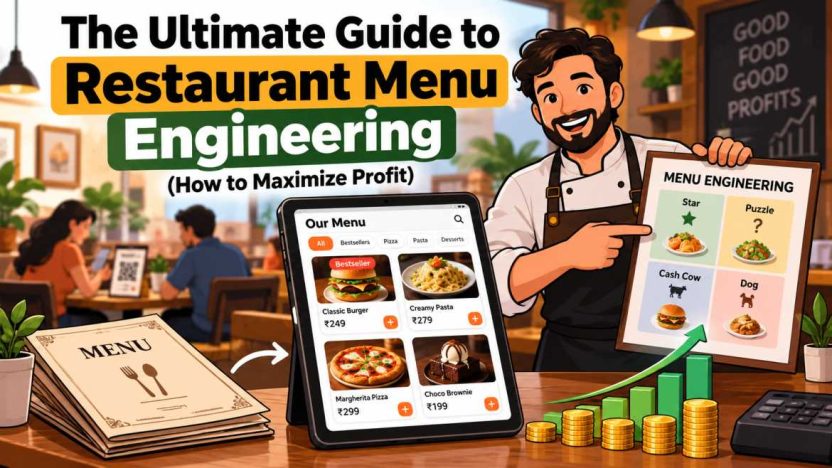
Restaurant Menu Engineering is a data-driven strategy that analyzes and designs restaurant menu items based on their popularity and profitability (Contribution Margin). Its primary objective is to utilize customer psychology to increase sales of high-profit items and maximize a restaurant's overall profit by 10% to 15%.
Running a restaurant is no easy task. With ever-rising food costs, staff salaries, and fierce competition, simply serving good food isn’t enough. You need a solid strategy to maximize the profits of each dish you serve.
This is where Restaurant Menu Engineering comes in. If you’re wondering how to increase cafe sales without spending more on marketing, optimizing your menu is the best way to do it.
When implemented correctly, this strategy can increase your restaurant’s profits by 10% to 15% without bringing in a single new customer. Let’s explore what Menu Engineering is and how you can implement it in your cafe or restaurant.
What is Restaurant Menu Engineering?
Simply put, Menu Engineering is a data-driven analysis of the popularity and profitability of your menu items. It’s the ultimate math behind your restaurant’s sales.
You don’t just guess what customers will like, but instead use your POS (Point of Sale) data to measure each dish on two parameters:
- Contribution Margin (how much profit this dish actually generates)
- Popularity (how often this dish is ordered)
By understanding these two factors, you can tailor your menu design to ensure customers order the dishes that generate the most profit.
Step 1: Do the Math (Costing Your Menu)
Before you begin menu engineering, you need accurate numbers. You should know the ingredient cost of each plate.
Calculate Food Cost Percentage:
Calculate the percentage of how much a dish costs to make and how much you’re selling it for.
Formula: (Item Cost / Selling Price) x 100 = Food Cost Percentage
Calculate Contribution Margin:
Even more important than the food cost percentage in menu engineering is the Contribution Margin. It tells you how much money goes directly into your pocket when a dish is sold.
Formula: Selling Price – Item Cost = Contribution Margin
Example: Suppose the cost of making a pasta dish is ₹100 and you sell it for ₹300. Your contribution margin is ₹200. Whereas a pizza costs ₹200 to make and you sell it for ₹450, the margin is ₹250. In menu engineering, we promote the item with the highest contribution margin.
Step 2: The Menu Engineering Matrix (The 4 Categories)
After gathering your POS data and margins, you need to divide all your menu items into 4 categories according to the BCG Matrix (Boston Consulting Group):
- Stars (High Profit, High Popularity)
These are your best items. They sell well and make you the most money.
The Strategy: Don’t change their price or recipe. Highlight them most prominently on the menu (e.g., in a box or in bold text).
- Plowhorses (Low Profit, High Popularity)
These are items that everyone orders (like regular tea or a basic sandwich), but their profit margin is very low.
The Strategy: Don’t remove them from the menu because customers come for them. Simply increase their profitability by either raising the price slightly or reducing the portion size slightly.
- Puzzles (High Profit, Low Popularity)
Puzzles are a hidden treasure that has a high profit margin, but customers aren’t ordering them often.
The Strategy: Find out why they’re not selling. Is their name boring? Or is the price too high? Write great descriptive copy for these items and place them in a good position on the menu.
- Dogs (Low Profit, Low Popularity)
These items don’t sell and don’t generate any profit. They just waste your kitchen time and inventory.
The Strategy: Remove them from your menu altogether.
Step 3: Menu Psychology and Design Tactics
Now that you know which items to sell, use menu psychology to draw customers’ attention there.
- The Golden Triangle: When a customer looks at a menu, their eyes first go to the middle, then the top-right, and finally the top-left. Place your ‘Stars’ in these areas.
- Ditch the Currency Signs: A ₹ or $ sign on the menu reminds customers that they’re spending money. Instead of writing ₹250, just write 250.
- Decoy Pricing: Place a very expensive item (decoy) at the top of the menu. This will make your high-profit item directly below it appear much cheaper and a better deal to customers.
Step 4: Digital Menu Engineering (QR Code Menus)
These days, digital menus have more power than physical menus. When you use a QR code menu for restaurant, implementing menu engineering becomes much easier because you can arrange your items at any time by dragging and dropping.
If you’re still using paper menus, you should understand the difference between QR Code Menu vs Traditional Menu. Digital menus not only allow you to showcase high-profit items at the top, but they also speed up your operations.
Major benefits of digital menus:
- Faster service: Saves staff time. To learn how to implement one, read How to Reduce Restaurant Order Taking Time
- Reduced errors: Customers place their orders by viewing them on their phones. This eliminates order errors. For more information, visit Reduce Order Errors in Restaurants.
- Create one easily: If you don’t already have a digital menu, you can easily learn how to Create a QR Code Menu for a Restaurant.
- You can add HD photos of your ‘Stars’ items to your digital menu, which increases sales by up to 30%. That’s why every smart cafe owner knows why QR Code Menu is Best for Restaurants.
Step 5: Train Your Staff
Your menu will do its job, but your waiters also play a big role in increasing sales. Inform your frontline staff about your ‘Stars’ and ‘Puzzles’ items. When customers ask, ‘What’s the special here?’, staff should suggest those high-profit items.
Conclusion
Restaurant menu engineering isn’t a fluke; it’s a perfect combination of data and customer psychology. By analyzing your numbers and dividing your dishes into a Menu Matrix, you can directly increase your revenue. Forget the limitations of paper menus, adopt smart digital QR menus, and turn your menu into a profit machine today.
Also Check –